
To use a BOSU ball correctly as a beginner without losing your balance, you must establish a stable foundation, master key body alignment principles, and progress through low-risk movements. Balance training on an unstable surface forces your deep stabilizing muscles to work in unison, improving your coordination, posture, and joint stability. However, stepping onto an air-filled dome for the first time can feel highly unpredictable. By preparing your physical environment, focusing your gaze, keeping your joints active, and starting with basic exercises, you can build your confidence and physical capacity safely.
Setting Up Your Space and Equipment for Safety
Before you even place a foot on the BOSU ball, you must prepare your physical surroundings to minimize the risk of injury from an accidental slip or fall. Balance training inherently challenges your equilibrium, meaning that a safe fall zone is your first line of defense.
Clearing the Surrounding Area In many home environments, such as a typical Singapore apartment where space can be compact, it is easy to overlook nearby hazards. Clear a radius of at least two meters around your training zone. Move coffee tables, dining chairs, toys, and any sharp-edged furniture out of the way. Ensure there are no loose rugs, cables, or clutter on the floor that could trip you if you need to step off the ball quickly.
Products mentioned in this guide
![🏅[58CM] Bosu Ball For Home Balance Training / Fitness Exercise Ball With Resistance Bands](https://img.lazcdn.com/g/p/b4d5fd7da1f48ad171f237bc297ff4f4.jpg_400x400q80.jpg_.webp)
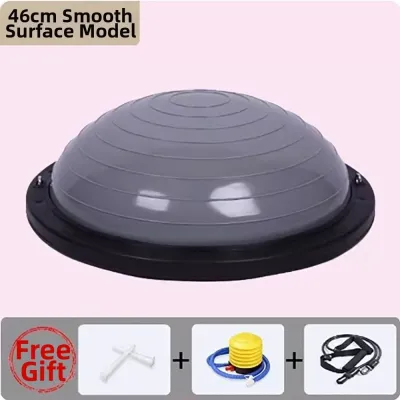
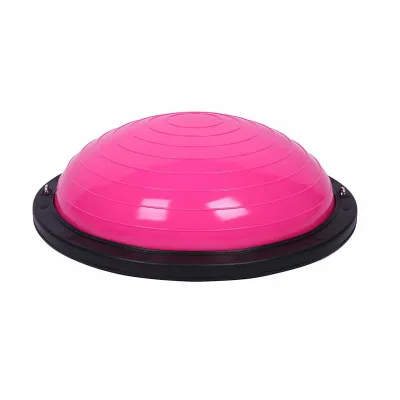
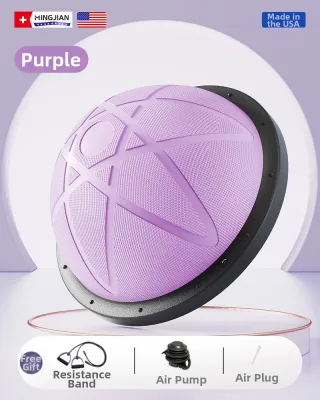
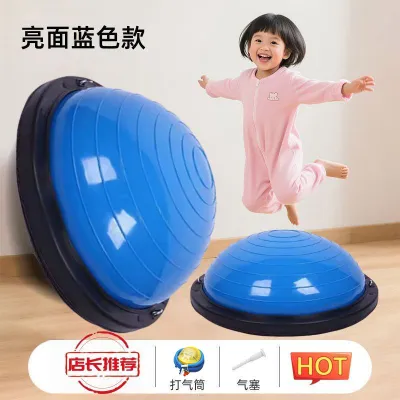
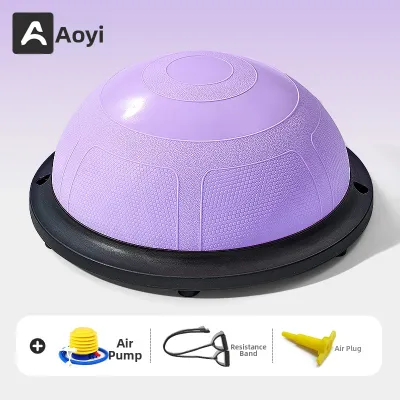
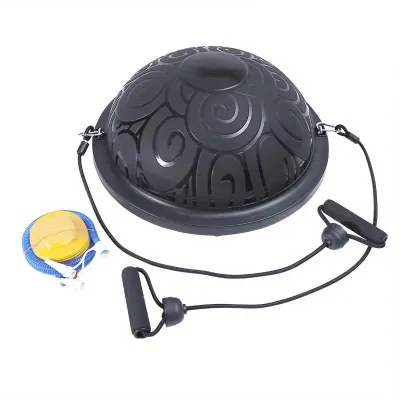
Prices are valid at publication and may change. Please refer to the product page for the latest price.
Verifying Equipment Stability and Inflation Inspect your BOSU ball before every session. The flat plastic base must sit completely flush against the floor without rocking or sliding. Check the inflation level according to the manufacturer’s instructions. An under-inflated ball will feel excessively mushy and may cause your ankles to roll inward, while an over-inflated ball creates a highly rounded, tense surface that is incredibly difficult to stabilize. Use the manufacturer’s measuring tool or a standard tape measure to verify that the dome height matches the specified limit, ensuring a firm yet slightly yielding surface.
Choosing the Right Footwear and Surface The interaction between your feet and the dome is critical for maintaining grip. For beginners, wearing flat-soled athletic shoes with excellent rubber traction is highly recommended. Avoid running shoes with thick, heavily cushioned midsoles, as they reduce your sensory feedback and make balancing harder. Alternatively, you can train barefoot to maximize the sensory input from your feet, provided you are standing on a verified non-slip floor surface, such as a high-grip rubber gym mat. Avoid training in socks on smooth surfaces like polished marble, parquet, or laminate flooring, as this creates an immediate slip hazard.
Core Techniques to Maintain Balance on the BOSU Ball
Succeeding on an unstable surface requires a shift in how you position your body and focus your mind. Instead of fighting the movement of the ball, you must learn to absorb it using specific biomechanical adjustments.

Fixing Your Gaze on a Stationary Point Your visual system plays a massive role in how your brain calculates balance. When you look down at your feet or watch the moving dome, your brain struggles to find a stable reference frame, which often leads to immediate wobbling. To counteract this, fix your eyes on a stationary object directly in front of you at eye level. Keeping your gaze locked on a wall outlet, a picture frame, or a mark on the wall helps your vestibular system maintain spatial orientation, allowing your body to make micro-adjustments automatically.
Engaging Your Core and Softening Your Knees A common mistake among beginners is freezing up and locking their joints out of fear. Locking your knees prevents your lower body from absorbing the shifting air inside the dome, causing every minor movement to travel up to your torso and throw you off balance. Keep a slight, active bend in your knees at all times. Simultaneously, engage your deep core muscles by drawing your belly button slightly toward your spine. This lowers your center of gravity and stabilizes your pelvis, turning your torso into a solid anchor while your legs adapt to the movement.
Utilizing Strategic Arm Positioning Your arms are highly effective counterweights. When starting out, extend your arms straight out to your sides at shoulder height, keeping them relaxed but active. If you feel yourself tilting to the left, gently press your right arm down to restore your center of mass. As you build confidence, you can transition to keeping your hands hovering just a few centimeters away from a stable external support, such as a sturdy wall or the back of a heavy wooden chair, ready to grab hold if you lose your footing.
Step-by-Step Beginner Exercises to Build Confidence
To prevent falls and build lasting confidence, you must follow a progressive training sequence. Do not attempt advanced dynamic movements until you can comfortably stand still on the dome.
Starting Dome Side Up: Stepping On and Off Begin with the inflatable dome facing upward and the flat platform resting securely on the floor. This is the most stable configuration for learning.
- The Setup: Place the BOSU ball near a wall or sturdy support.
- The Movement: Place your dominant foot directly in the center of the dome. Press down firmly, engage your core, and step up with your second foot, placing it hip-width apart from the first.
- The Hold: Stand still for three seconds, focusing on your stationary gaze point.
- The Dismount: Step backward off the dome, one foot at a time, landing softly on the flat floor. Repeat this sequence ten times to build muscle memory and familiarize your nervous system with the transition.
Static Standing and Gentle Weight Shifting Once you can step onto the dome confidently, practice holding a static stand and exploring your limits.
- Static Hold: Stand on the dome with your feet hip-width apart. Try to keep the dome as still as possible for 30 seconds.
- Heel-to-Toe Shifts: Slowly shift your weight forward onto your toes, then backward onto your heels. Keep the movements tiny—only a few millimeters at first. Feel how your calves and shins contract to stabilize you.
- Side-to-Side Shifts: Gently transfer your weight from your left foot to your right foot, keeping your torso upright and avoiding any sudden leaning.
Progressing to Controlled Movements When static standing feels secure, introduce basic dynamic exercises to challenge your stability further.
- Shallow Squats: With your feet placed wide on the dome, slowly lower your hips a few inches as if sitting back into a high chair. Keep your chest lifted and your knees tracking over your toes. Return to the starting position. Do not attempt a deep squat until your ankles are completely stable.
- Slow Marching: Stand in the center of the dome. Slowly lift your right heel off the surface, keeping your toes in contact with the dome. If you feel stable, lift the entire foot a few centimeters, hold for a second, and place it back down. Repeat on the left side.
Transitioning to the Flat Platform Side Only transition to the flat platform side (dome side down) after you have fully mastered dome-side stability over several weeks. The flat side is significantly more unstable because the rigid plastic board tilts rapidly on the rounded dome beneath it.
- Supported Step-Ups: Place the BOSU ball flat side up next to a wall. Place one hand on the wall for support. Step onto the platform with one foot, then the other, placing them near the outer edges of the board for maximum leverage.
- Board Leveling: Use your ankle strength to keep the plastic platform perfectly level and parallel to the floor. Do not attempt squats or dynamic movements on this side until you can easily keep the board level without relying heavily on the wall for support.
Safety Precautions and When to Stop
Balance training is highly demanding on both your muscles and your central nervous system. Knowing your limits is essential to prevent fatigue-induced falls.
Recognizing Physical Warning Signs Unlike traditional weightlifting, where fatigue is felt as a deep muscle burn, balance fatigue often manifests as rapid, uncontrollable muscle tremors (shaking legs) or a sudden inability to focus. If your ankles begin to shake violently or you find yourself stepping off the ball repeatedly, your stabilizing muscles and nervous system are fatigued. Stop the exercise immediately. Continuing past this point greatly increases the risk of rolling an ankle or falling.
Establishing a Safe Dismount Strategy If you feel yourself losing your balance, do not panic or try to jump off the ball. Jumping can cause the ball to shoot out from under you, leading to a hard fall. Instead, bend your knees deeply to lower your center of gravity, and step down backward, one foot at a time, onto the solid floor. Always prioritize stepping backward or to the side rather than forward, as stepping forward can cause you to trip over the front edge of the dome.
Knowing When to Seek Professional Guidance If you experience persistent joint discomfort in your ankles, knees, or lower back during or after using the BOSU ball, pause your training. Balance exercises should not cause pain. If you have a history of ankle sprains, knee surgeries, or vestibular (inner ear) issues, seek guidance from a qualified fitness professional or a physical therapist. They can provide personalized modifications and ensure your alignment is correct before you progress to more challenging routines.
Frequently Asked Questions (FAQ)
Should I use the dome side or the flat side first as a beginner?
As a beginner, you should always start with the dome side facing up. When the dome is up, the rigid plastic platform sits flat and secure on the floor, providing a stable, non-slip foundation. The air-filled dome conforms to the shape of your feet, allowing for a more predictable and manageable introduction to instability. Conversely, placing the flat side up positions the rounded dome against the floor. This causes the rigid platform to tilt sharply and rapidly in response to the slightest weight shift, requiring advanced ankle strength, rapid reflexes, and superior core stability that beginners have not yet developed.
How long should a beginner balance on the BOSU ball per session?
Beginners should focus on the quality of their balance rather than trying to sustain a position for a long duration. Start by incorporating brief intervals of 30 to 60 seconds of active balancing, followed by a full minute of rest on solid ground. Limit your total balance training to 5 to 10 minutes per workout session, performing it at the beginning of your routine when your mind and muscles are fresh. Always stop the exercise immediately if you experience muscle fatigue, joint discomfort, or a loss of concentration, as tired stabilizers cannot protect your joints or prevent sudden falls.
Community discussion
Share your experience or ask a question. Comments are reviewed before publication.