
Quick Answer: Which Slant Board Type Fits Your Routine?
Choosing between an adjustable and a fixed-angle slant board depends on your current mobility levels, training goals, and whether the equipment will be shared. An adjustable slant board is the ideal choice if you are navigating progressive rehabilitation, looking to gradually increase your ankle mobility, or sharing the board with household members who have varying levels of flexibility. The ability to modify the incline allows you to scale the intensity of your stretch as your tissues adapt over time.
Conversely, a fixed-angle slant board is best suited for individuals who prioritize maximum structural stability under heavy loads. If your routine heavily features weighted lower-body exercises, such as slant board squats or loaded calf raises, a solid, single-piece platform eliminates any risk of mechanical shifting. This type is also excellent for those who have already established a specific, unchanging mobility target and prefer a robust, zero-maintenance tool.
Why Use a Slant Board for Lower Leg Recovery?
To understand which board fits your routine, it helps to look at the biomechanics of inclined training. Elevating your heel or forefoot on an incline alters the angle of your ankle joint, directly increasing ankle dorsiflexion. This position places a targeted stretch on the posterior chain of the lower leg, specifically isolating the gastrocnemius and soleus muscles that make up the calf complex, as well as the Achilles tendon. Tightness in these areas often restricts your movement patterns, leading to compensatory strain further up the kinetic chain in the knees, hips, and lower back.
Products mentioned in this guide
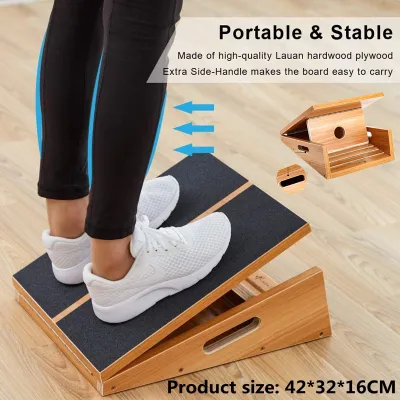
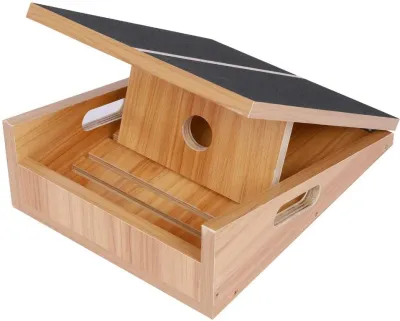
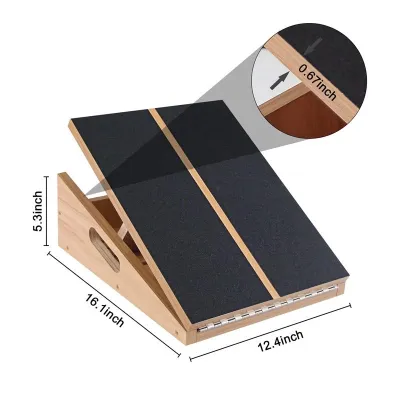
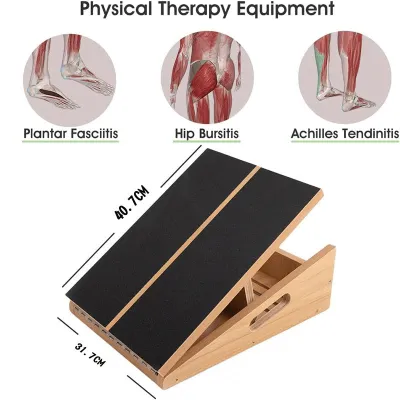
Prices are valid at publication and may change. Please refer to the product page for the latest price.

For runners, hikers, and active individuals in Singapore, lower leg tightness is a common hurdle. Training on hard concrete pavements, park connector networks (PCNs), or the undulating trails of MacRitchie Reservoir subjects the lower limbs to repetitive high-impact forces. When humidity levels are high, muscles can fatigue more rapidly, which sometimes leads to localized tightness and a higher susceptibility to calf strains or plantar fasciitis. Integrating a slant board into your post-workout routine helps restore tissue length, improves localized blood flow, and assists in maintaining the ankle mobility required for efficient stride mechanics.
Adjustable vs Fixed Slant Boards: Core Differences
When evaluating these recovery tools, three primary dimensions dictate their utility: adjustability, structural stability, and portability. Understanding how these factors interact will help you determine which design matches your space and physical demands.
Adjustable Slant Boards: Pros and Cons
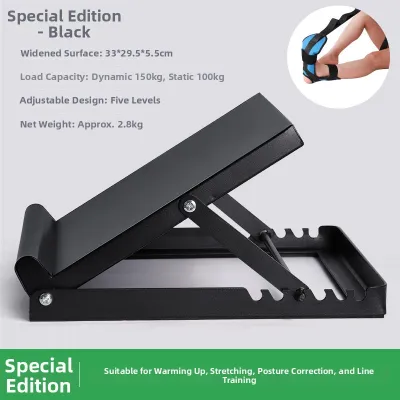
Adjustable slant boards are defined by their versatility. Most models offer a range of angles, typically starting around 10 to 15 degrees and scaling up to 40 degrees or more. This incremental design is highly beneficial for progressive stretching, as it allows you to start at a mild incline and gradually increase the angle as your flexibility improves. It also allows you to target different muscle fibers within the calf complex; lower angles are often used for longer, passive holds, while steeper angles can be reserved for active, short-duration mobility work.
However, the mechanical versatility of adjustable boards introduces certain trade-offs. Because these boards rely on hinges, support bars, or slot-in pegs to change angles, they have inherent moving parts. Over time, these components can experience wear, particularly if exposed to moisture or heavy use. At higher inclines, some adjustable models may exhibit a slight wobble or mechanical play, which can decrease user confidence during active movements. Additionally, the inclusion of steel adjustment brackets or multi-layered wooden support structures often makes these boards heavier and more complex to set up than their single-angle counterparts.
Fixed-Angle Slant Boards: Pros and Cons
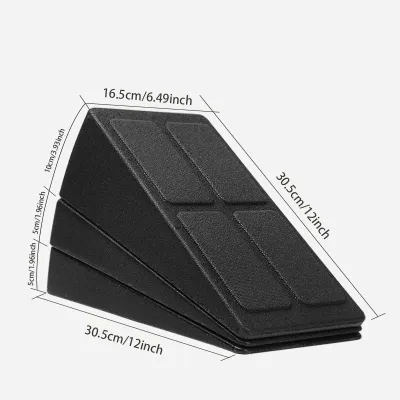
Fixed-angle slant boards prioritize structural integrity over flexibility. These boards are typically crafted from a single, solid piece of wood, high-density foam, or welded metal, set at a permanent angle—most commonly between 15 and 25 degrees. Because there are no hinges, locking pins, or adjustable supports, there is virtually no risk of mechanical failure or shifting under load. This solid construction makes them the preferred choice for high-load strength training, where any movement in the platform could compromise your balance or joint alignment.
The primary limitation of a fixed-angle board is its lack of adaptability. If you purchase a 20-degree board, you are locked into that specific angle for all exercises. For individuals undergoing acute rehabilitation, a fixed 20-degree angle might initially be too aggressive, causing discomfort or improper alignment. Furthermore, if multiple people in your household plan to use the board, a single angle may be too steep for one person and too shallow for another, limiting its overall utility as a shared family recovery tool.
Decision Guide: How to Choose the Right Slant Board
Selecting the right tool requires matching the board’s design to your specific training environment, physical condition, and long-term goals.
- Choose an adjustable slant board if: You are currently recovering from a lower leg injury and need to carefully control the progression of your rehabilitation under low-load conditions. This style is also the most practical choice for shared households where family members have different flexibility baselines, or for individuals who want a single piece of equipment that can transition from gentle morning stretches to deep, targeted mobility sessions.
- Choose a fixed-angle slant board if: Your primary objective is dedicated strength training, such as performing heavy loaded squats, Patrick steps, or Poliquin steps to build knee resilience and activate the vastus medialis oblique (VMO) muscle. A solid, non-adjustable wedge is also ideal if you have a dedicated home gym space, prefer a simple "step-and-go" setup with zero adjustment time, and already know your optimal stretching angle.
- Verify your physical condition first: If you are dealing with an acute medical condition, severe pain, or suspected tendon pathology, do not attempt to self-diagnose or aggressively stretch the area. Always consult a physiotherapist or a qualified healthcare professional before introducing inclined loading or deep stretching to your recovery routine.
Safe Usage and Stretching Guidelines
To maximize the benefits of your slant board while minimizing the risk of strain, proper execution and environmental awareness are essential. Always begin your session by placing the board on a flat, non-slip surface. If you are using the board on smooth tiled floors, place a rubber exercise mat underneath to prevent the unit from sliding during use.
Before stepping onto the incline, ensure you have a stable support structure nearby, such as a wall, a sturdy chair, or a fitness rack, to help you maintain your balance. Begin at the lowest comfortable angle to assess your current tissue tension. Avoid any bouncing or ballistic movements while on the board; rapid, uncontrolled pulsing can trigger a stretch reflex, causing the muscles to contract rather than relax, which increases the risk of micro-tears in the muscle fibers.
To target the different structures of your lower leg, utilize both straight-leg and bent-knee positions:
- Straight-Leg Stretch (Gastrocnemius Focus): Keep your knee fully extended and stand tall on the board. Keep your hips aligned over your ankles and gently lean your torso forward from the hips to deepen the stretch along the upper portion of your calf.
- Bent-Knee Stretch (Soleus Focus): From the starting position on the board, slightly bend your knees while keeping your heels firmly planted on the surface. This shifts the primary tension downward, targeting the deeper soleus muscle and the lower portion of the Achilles tendon.
Always listen to your body and stop the exercise immediately if you experience sharp, pinching, or localized pain in the joints or tendons. Additionally, be mindful of your training environment. In Singapore’s warm and humid climate, sweat can quickly accumulate on the surface of your equipment. Before stepping onto the board, verify that the anti-slip grip tape or textured surface is dry and intact to prevent slipping. Always check the manufacturer’s specified weight limits before performing any exercises, particularly when holding external weights.
Frequently Asked Questions (FAQ)
Can I use a slant board every day?
Gentle, bodyweight-only stretching on a low incline can generally be integrated into a daily routine to help combat the tightness caused by prolonged sitting or walking. However, if you are performing deep, high-intensity stretches or loaded strength exercises on the board, your tissues require adequate rest to adapt and repair. Limit high-intensity or loaded sessions to two or three times per week, and always monitor your body for signs of persistent muscle soreness or joint fatigue.
What angle is best for Achilles tendonitis?
There is no single, universally perfect angle for managing Achilles tendon issues, as the appropriate incline depends on your individual ankle mobility, pain levels, and the specific stage of your recovery. Attempting to stretch an inflamed tendon on a steep incline can aggravate the condition. It is safest to start at a very mild incline, such as 10 to 12 degrees, where you feel a gentle stretch without pain. For a safe, structured rehabilitation plan, consult a physiotherapist who can assess your tendon health and prescribe specific, controlled loading parameters.
Are wooden slant boards better than plastic or metal ones?
Each material offers distinct physical characteristics that suit different training preferences. Wooden slant boards are highly durable and offer a solid, aesthetic feel, though high-quality wood models can be heavy and susceptible to moisture damage if left in damp environments. High-density plastic models are lightweight, highly portable, and easy to clean, making them convenient for travel, though they may exhibit slight flexing under very heavy loads. Metal boards provide exceptional structural rigidity and wear resistance, but they can feel cold to the touch and rely heavily on high-quality grip tape to prevent slipping. When choosing, prioritize the manufacturer’s rated weight capacity and the quality of the non-slip surface over the material type alone.
Community discussion
Share your experience or ask a question. Comments are reviewed before publication.