
In football, matches are often decided by split-second movements in tight spaces. Whether you are dropping your shoulder to evade a defender or shifting your weight to block a passing lane, your success relies heavily on foot speed, coordination, and dynamic balance. The agility ladder is one of the most effective tools for programming your neuromuscular system to execute these rapid, precise movements instinctively.
By practicing structured patterns over a flat set of rungs, you train your brain to fire motor signals to your lower limbs more rapidly. This article explains how to set up your training environment safely, master the foundational footwork patterns, integrate the ball for realistic match preparation, and measure your progress on the pitch.
Setting Up for Safe and Effective Training
Before laying down your agility ladder, you must select an appropriate training surface to maximize safety and performance. In Singapore, football players frequently train on artificial turf pitches or concrete hard courts. Each surface requires specific footwear to maintain traction and prevent lower-limb injuries.
Products mentioned in this guide
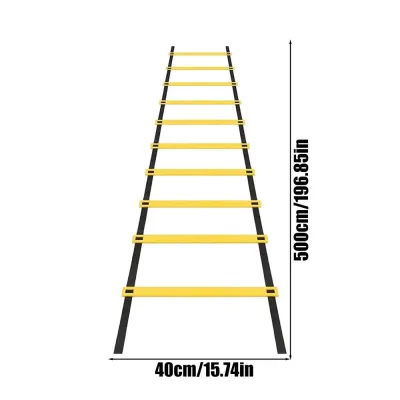
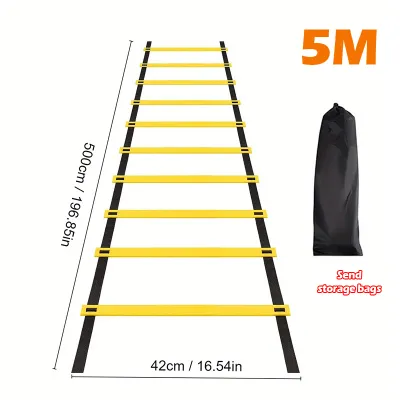
![[SG] Nylon Strap Agility Ladder Speed Training Football Fitness Flexibility Plyometric Workout Equipment](https://img.lazcdn.com/g/p/f631eecb7b6fe53488efffcb083d2930.jpg_400x400q80.jpg_.webp)
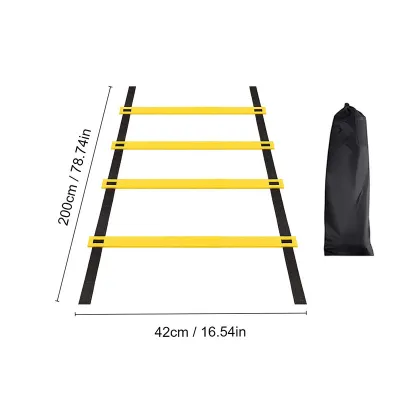
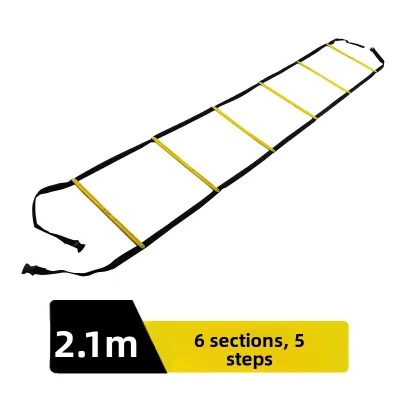
Prices are valid at publication and may change. Please refer to the product page for the latest price.
When training on artificial turf, opt for turf shoes featuring short, multi-directional rubber studs that offer balanced grip without clinging to the surface. For hard courts, lightweight athletic trainers with flat, non-slip rubber outsoles are ideal. Avoid wearing boots with long metal studs or aggressive firm ground blades during ladder drills; these long studs can easily catch on the plastic rungs or fabric webbing, leading to sudden tripping, severe ankle rolls, or knee sprains. Always inspect your footwear and ensure it is compatible with the surface before starting.
Once your surface is selected, lay the agility ladder completely flat. Walk the length of the ladder to pull out any twists in the side straps and ensure every plastic rung lies flush against the ground. Overlapping or raised rungs pose immediate tripping hazards when moving at high speeds.
Never skip a dynamic warm-up before starting high-intensity coordination drills. Spend five to ten minutes preparing your body with light jogging, leg swings, ankle rotations, high knees, and hip openers. This physical preparation increases joint mobility and muscle temperature, reducing the risk of strains. Remember that training equipment cannot replace proper physical preparation and sound athletic judgment.
Core Footwork Drills to Build Speed and Coordination
To get the most out of your agility ladder training, you must adhere to several universal mechanical principles. Always perform these drills on the balls of your feet, keeping your heels slightly elevated to utilize the natural spring-like elasticity of your Achilles tendons. Keep your knees slightly bent, your hips pushed back, and your chest forward in an athletic, low-center-of-gravity stance.

As you build confidence, practice keeping your head up rather than staring directly down at your feet. In a real match, looking down prevents you from scanning the field, spotting open teammates, or anticipating a defender’s challenge. Finally, prioritize technical accuracy over raw speed; executing a drill slowly with perfect form builds better muscle memory than rushing through with sloppy steps.
The Icky Shuffle (Multi-Directional Control)
The Icky Shuffle is a classic three-step pattern that teaches lateral coordination and rapid weight distribution.
Step-by-step execution:
- Start on the left side of the ladder, facing forward.
- Step your right (inside) foot into the first square.
- Bring your left (outside) foot into the same square.
- Step your right foot out to the right side of the ladder, immediately followed by moving your left foot forward into the second square.
- Continue this "two feet in, one foot out" pattern down the length of the ladder, alternating sides.
Common mistakes: Avoid looking down continuously at the rungs, which disrupts your balance. Do not cross your legs over each other, as this compromises your athletic stance and increases the risk of tripping. Keep your upper body stable and avoid excessive swaying.
Football application: This drill directly mimics the rapid weight shifts and body feints used to unbalance a defender. By mastering this lateral progression, you can drop your shoulder to simulate a movement in one direction before quickly exploding in the opposite direction.
In-In, Out-Out (Forward Acceleration)
This high-tempo drill focuses on rapid forward foot placement and accelerating out of tight spaces.
Step-by-step execution:
- Stand at the base of the ladder, facing forward.
- Step your right foot into the first square, then immediately step your left foot into the same square.
- Step your right foot out to the right side of the ladder, then step your left foot out to the left side.
- Move forward to the second square, stepping right foot in, left foot in, right foot out, and left foot out.
- Maintain a rapid, continuous rhythm as you progress forward.
Common mistakes: Avoid striking the ground with your heels, which acts as a brake and slows down your momentum. Do not bounce too high vertically; your feet should skim just above the rungs to keep your transitions as fast as possible.
Football application: This rapid stepping pattern trains the short, quick strides needed to accelerate rapidly into open space, adjust your stride length right before striking a ball, or close down an opponent who is about to shoot.
Lateral Quick Steps (Defensive Shuffling)
This lateral drill develops side-to-side speed, hip mobility, and balance, which are crucial for defensive positioning.
Step-by-step execution:
- Stand sideways at the start of the ladder, with your left shoulder facing the direction of travel.
- Step your left (lead) foot into the first square.
- Bring your right (trail) foot into the same square.
- Move sideways down the ladder, placing both feet in each square successively.
- Drive off your trailing foot to generate lateral power, keeping your hips square and facing forward.
Common mistakes: Avoid letting your feet touch or click together, which ruins your balance. Do not allow your hips to drop too low or rise too high; maintain a consistent, athletic defensive crouch throughout the entire movement.
Football application: This drill translates directly to defensive jockeying. It helps you track a winger running down the flank, allowing you to match their lateral movements while remaining balanced enough to make a clean tackle or transition into a sprint.
Adding the Ball: Transitioning to Football-Specific Skills
While isolated footwork drills are excellent for neuromuscular training, you must bridge the gap to actual match scenarios by integrating the ball. Adding a football forces your brain to process spatial awareness and ball control simultaneously under physical exertion.
Receiving at the exit: Place a teammate or a rebounder board five meters from the end of the ladder. Execute a high-speed footwork drill, such as the Icky Shuffle. The moment your feet clear the final square, transition into an active receiving stance. Have your partner deliver a firm pass, and focus on executing a clean, directional first touch that sets you up for a quick pass back or a simulated shot.
Dribbling through: Instead of stepping over the rungs, use the spaces to guide tight ball manipulation. Guide the ball through or alongside the ladder using the inside, outside, and sole of both feet. This exercise requires a slower, highly controlled pace. Prioritize technical precision and close control over maximum speed, keeping the ball within a few inches of your feet.
Exit and shoot/cross: Set up a game-like scenario at the end of the ladder. Complete a lateral quick-step drill, exit the ladder, receive a pass from a teammate, take one touch to escape a simulated defender, and immediately execute a precise shot into a mini-goal or a cross to a teammate. This teaches you to make high-quality technical decisions when your leg muscles are fatigued.
Structuring Your Routine and Measuring Progress
To maximize the benefits of agility ladder training, you must program these drills correctly into your weekly routine. Because coordination training relies on a fresh nervous system, perform these drills early in your training session, immediately after your dynamic warm-up and before any heavy tactical or conditioning work. Training when highly fatigued can reinforce slow, sloppy movement patterns.
Aim for two to three sessions per week. For each session, select three to four different drills. Perform three to four sets of each drill, focusing on maximum intensity and technical precision. Allow 30 to 60 seconds of complete rest between sets to ensure your central nervous system recovers fully before the next repetition.
To progress over time, gradually increase the complexity of your routine rather than just moving your feet faster. You can transition from simple forward patterns to complex lateral movements, add cognitive cues (such as a partner flashing colored cards to signal a change of direction), or link multiple drills together into a continuous footwork circuit.
Validate your progress by looking for improvements on the pitch rather than focusing solely on how fast you complete the ladder. Real-world progress is demonstrated by a higher success rate in one-on-one defensive jockeying, faster reaction times in tight spaces during small-sided games, and better balance when turning under pressure from an opponent.
Frequently Asked Questions (FAQ)
Does agility ladder training actually make you faster on the pitch?
Agility ladder drills do not directly increase your maximum linear sprint speed, which relies on ground force production and stride length. Instead, they improve your neuromuscular coordination, foot speed, and rapid deceleration and acceleration mechanics. This makes you significantly more agile, balanced, and efficient when changing directions in tight spaces.
How often should football players use an agility ladder?
Football players should integrate agility ladder work two to three times per week. These short, focused sessions are best performed as part of your pre-training warm-up when your muscles and nervous system are completely fresh. High-quality, focused repetitions are far more valuable than high-volume, fatigued sessions.
What type of footwear is best for ladder drills?
Choose lightweight athletic trainers with flat rubber outsoles for hard courts, or turf shoes with short rubber studs for artificial grass. Avoid wearing boots with long metal studs or aggressive firm ground blades, as they can easily catch on the ladder rungs and cause severe ankle or knee injuries.
Community discussion
Share your experience or ask a question. Comments are reviewed before publication.