
Quick Verdict: Are Dunlop AO Balls Right for Your Skill Level?
Dunlop AO (Australian Open) tennis balls are premium, pressurized tournament-grade balls engineered for high-level consistency and durability. If you are considering buying Dunlop AO balls as a beginner learning the game, they offer an excellent balance of quality and performance. When taking formal coaching lessons on standard hard courts, these balls provide a highly predictable bounce and realistic flight path, helping you build correct timing and muscle memory from your very first session.
However, if you are an absolute beginner who has never picked up a racket, or if you are practicing casually without instruction, you might find fresh Dunlop AO balls too fast and bouncy. For young children or those still struggling with basic hand-eye coordination, low-compression transition balls are generally a more suitable starting point. Choosing the right ball is about matching your equipment to your current learning environment, ensuring you progress steadily without unnecessary frustration.
Understanding the Specs: What Makes Dunlop AO Balls Unique?
Dunlop AO tennis balls are engineered as high-performance, tour-level equipment, famously serving as the official ball of the Australian Open. This tournament pedigree guarantees that every ball is manufactured to strict international standards, ensuring uniform weight, size, and bounce consistency. For a beginner, this level of consistency is invaluable because it removes unpredictable equipment variables, allowing you to focus entirely on your swing path and footwork.
Products mentioned in this guide

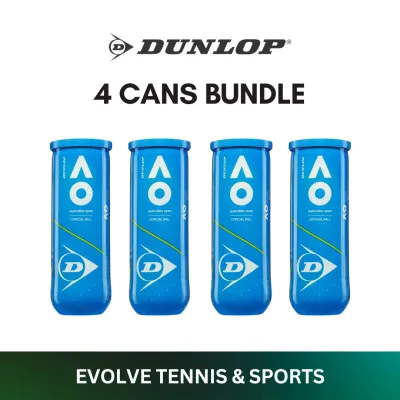
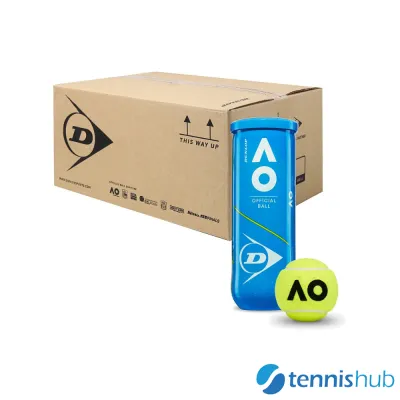

Prices are valid at publication and may change. Please refer to the product page for the latest price.

When buying these balls, pay close attention to the felt type specified on the packaging. Dunlop AO balls are primarily available in “Extra Duty” and “Regular Duty” formats. Extra Duty felt is woven with a durable blend of synthetic fibers and premium wool, specifically engineered to withstand the highly abrasive nature of outdoor hard courts. Regular Duty felt is thinner and designed for clay or indoor courts. Because almost all public ActiveSG, private club, and condominium tennis courts in Singapore are hard courts, always verify that you are purchasing the Extra Duty variant to avoid rapid wear.
Unlike pressureless training balls that rely on a thick, heavy rubber wall to bounce, Dunlop AO balls feature a pressurized core. The interior of the ball is filled with pressurized gas that provides a responsive, lively rebound when striking the court or your racket strings. This pressurized design ensures a crisp feel and predictable flight path, though it does mean the balls have a finite lifespan once the vacuum-sealed can is opened.
On-Court Diagnosis: How Dunlop AO Balls Feel for Beginners
Bounce and Speed
Fresh out of a pressurized can, Dunlop AO balls deliver a high, energetic bounce and a relatively fast pace. For a beginner, this lively action can initially feel challenging. You might find yourself mistiming your swings, striking late, or watching the ball sail past your baseline. However, practicing with standard-speed balls trains your eyes and feet to react to real-game velocities from the very beginning, preventing you from developing bad habits.
Rather than adapting to the artificially slow pace of non-pressurized or worn-out balls, practicing with Dunlop AO balls forces you to establish proper court positioning and early racket preparation. If you find the speed too difficult to manage at first, ask your coach to feed balls from a shorter distance or at a lower velocity. This allows you to gradually adapt to standard bounce heights and paces without feeling overwhelmed.
Feel and Arm Comfort
Pressurized tournament balls are inherently firmer than transition or pressureless balls. When a beginner makes clean contact in the center of the sweet spot, a Dunlop AO ball feels remarkably plush, crisp, and rewarding. However, because beginners naturally experience frequent off-center hits near the racket frame, the firm impact of a premium pressurized ball can transmit significant vibration up the racket shaft, potentially leading to wrist or elbow discomfort over long sessions.
To mitigate this risk, beginners should ensure their racket is strung at a moderate, arm-friendly tension—typically between 48 to 53 pounds—using a soft multifilament string rather than a stiff polyester. Focusing on a relaxed grip and smooth, continuous swing mechanics, rather than trying to muscle the ball with brute force, will also dramatically improve comfort when playing with these high-performance balls.
Control and Spin Potential
One of the standout features of the Dunlop AO ball is its premium HD Pro Felt, which offers exceptional grip on the racket strings. For a beginner transitioning from basic flat hits to learning spin mechanics, this grip is highly beneficial. When your racket face brushes upward against the ball, the high-quality felt grabs the strings, providing immediate tactile feedback and helping you understand how topspin pulls the ball down into the court.
This control aspect is crucial for developing players. Cheap, low-quality balls often have slippery, synthetic felt that slides off the strings, making it incredibly difficult to control the ball’s depth. The predictable grip of the Dunlop AO allows you to confidently increase your racket head speed, knowing that the ball will respond consistently to your technique.
Durability Check: Hard Courts and Singapore's Humid Climate
Singapore’s tropical climate presents a unique set of challenges for tennis equipment. The combination of intense heat, high humidity, and abrasive hard court surfaces accelerates the wear and tear on any tennis ball. Dunlop’s Extra Duty felt is highly resilient, but the rough acrylic paint on local courts will gradually cause the felt fibers to fluff up. While a fluffed-up ball actually slows down slightly in the air—which can be helpful for a beginner—eventually, the felt will wear down to bald patches, drastically altering the ball’s aerodynamics.
Humidity is another critical factor. In high-humidity environments, open tennis balls quickly absorb moisture from the air and the damp court surface, especially during evening sessions. This moisture absorption makes the balls feel transitionally heavier on the racket, increasing the physical strain on a beginner’s arm and shoulder. Furthermore, high ambient temperatures accelerate the natural diffusion of gas through the rubber core, causing the balls to lose their internal pressure faster than they would in cooler, drier climates.
To protect your joints and maintain a high-quality training session, you should learn to perform a simple self-check on your balls before every game. First, conduct a basic drop test: hold a ball at eye level (about 1.8 meters) and drop it onto a hard surface; it should rebound to approximately chest height (around 1.3 meters). If it struggles to reach your waist, the ball is “dead” and should be retired. Additionally, check for a hollow, flat sound upon impact, visible bald spots, or a soft, squishy feel when squeezed between your thumb and fingers. Playing with dead balls forces you to overswing to generate depth, which can quickly ruin your stroke mechanics.
Progression Path: When to Switch to or from Dunlop AO Balls
Navigating your tennis journey requires using the right equipment at the right time. While Dunlop AO balls are an excellent gold standard, forcing yourself to use them too early can stunt your technical development. Conversely, staying on slow transition balls for too long will prevent you from adapting to the speed of real match play.
Stage 1: The Absolute Beginner and Young Learners For those who are stepping onto a tennis court for the very first time, or for young children under the age of ten, starting directly with Dunlop AO balls is generally not recommended. Instead, look for low-compression transition balls, which are color-coded by stage (Red, Orange, and Green dot). These balls are larger, lighter, and pressurized at a fraction of a standard ball’s level, giving you ample time to track the ball, set up your feet, and make clean contact.
Stage 2: The Transition and Casual Rally Phase Once you can consistently rally over the net with a green dot ball, you are ready to transition to standard tennis balls. At this stage, using slightly used Dunlop AO balls—such as those played with for only one or two sessions by intermediate players—is an incredibly effective training strategy. These “semi-pressurized” balls have lost their initial aggressive bite and speed, making them slightly slower and more forgiving, yet they still retain enough structure to teach you proper court depth and bounce heights.
Stage 3: Formal Coaching and Match Play When you enter formal coaching lessons where you are actively working on directional control, pace generation, and basic point play, it is time to open a fresh can of Dunlop AO balls. Training with fresh, premium balls ensures that your timing, footwork, and swing speeds are calibrated to standard playing conditions. This transition is vital if you plan to play social matches or join local amateur leagues, as it ensures your practice environment matches the competitive environment.
Value and Purchasing Strategy For beginners, managing the cost of tennis balls is an important consideration. A single can of Dunlop AO balls typically costs between S$7 and S$10 in Singapore, depending on the retailer. If you only play once a week, buying individual three-ball or four-ball cans is highly practical, ensuring you always have fresh bounce. However, if you are practicing multiple times a week, using a ball machine, or practicing serves, purchasing these balls in bulk cases of 24 cans offers a much better unit price and ensures you always have a consistent supply of training balls.
Frequently Asked Questions (FAQ)
Can I use Extra Duty Dunlop AO balls on clay or grass courts?
While you can physically use Extra Duty Dunlop AO balls on clay or grass, it is not recommended for optimal play. The thick, fuzzy Extra Duty felt is designed to resist abrasion on hard courts, but on clay, it will quickly pick up loose dirt and moisture, making the ball heavy, dark, and sluggish. On grass, the heavy felt can cause the ball to skid excessively low. If you are playing on clay or grass, look for the Regular Duty version of the Dunlop AO, which features a thinner, more tightly woven felt that sheds debris and maintains a consistent bounce on softer surfaces.
How long does a can of Dunlop AO balls stay fresh once opened?
Once you crack the metal seal on a pressurized can of Dunlop AO balls, the internal gas begins to slowly escape through the porous rubber core. Even if the balls are left unused in your bag, they will lose a noticeable amount of pressure within two to three weeks. For active play, a single can will generally provide peak performance for about two to four hours of continuous hitting, depending on the intensity of your rallies. To maximize their playable life, store opened balls in a cool, dry place away from direct sunlight, and avoid leaving them in a hot car trunk, as extreme heat accelerates pressure loss.
Are Dunlop AO balls good for use with a tennis ball machine?
Dunlop AO balls are highly durable, but using premium, pressurized tournament balls in a ball machine can be an expensive endeavor. Ball machines subject balls to intense friction from spinning throwing wheels, which quickly wears down the felt and rapidly depletes their internal pressure. If you are a beginner using a ball machine to practice repetitive strokes, you will get much better value by using specialized pressureless training balls, which maintain their bounce indefinitely and can withstand hundreds of machine cycles without losing their rebound height.
Community discussion
Share your experience or ask a question. Comments are reviewed before publication.