
Are retractable carabiners safe for climbing? The short answer is no—at least not in the way many climbers initially assume. In the world of vertical sports, there is a crucial distinction between standard climbing carabiners and retractable safety devices. True “retractable carabiners” do not exist as standard climbing gear; rather, this term usually refers to industrial fall-arrest lanyards or is a misnomer for auto-locking climbing carabiners. Using the wrong equipment in a high-angle environment can lead to catastrophic gear failure. To stay safe on the rock or wall, you must understand the exact differences between these devices, the stringent safety standards that govern them, and the specific risks associated with mechanical components.
Clarifying "Retractable" Gear: Auto-Locks vs. Fall Arresters
When beginners or recreational climbers search for a “retractable carabiner,” they are typically conflating two entirely different categories of equipment. The first category consists of auto-locking climbing carabiners. These are highly specialized aluminum or steel connectors featuring gates that automatically snap shut and lock when released. They utilize spring-loaded, twist-lock, or magnetic mechanisms to prevent accidental opening. While they feature spring-loaded gates, their structural frame is rigid and does not retract or extend.
The second category comprises retractable fall-arrest lanyards, which are common in industrial work-at-height applications. These systems consist of a heavy-duty plastic or metal housing containing a spring-wound drum. A high-strength webbing strap or steel cable extends from this drum and terminates in a locking connector or carabiner. As a worker moves, the line extends and retracts automatically, locking instantly under sudden acceleration to arrest a fall.
Products mentioned in this guide
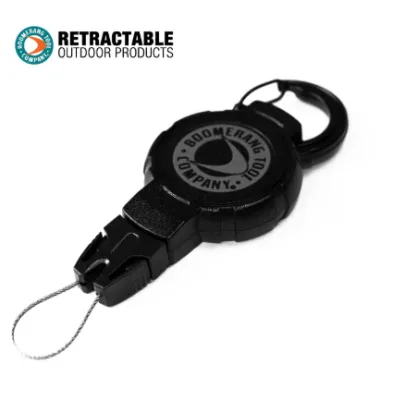
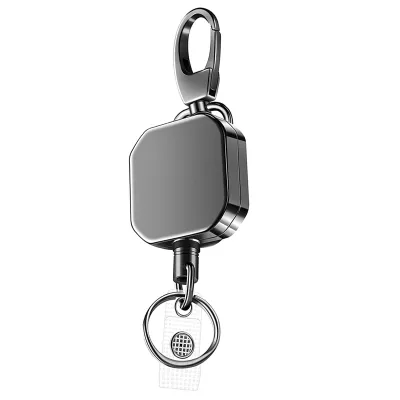
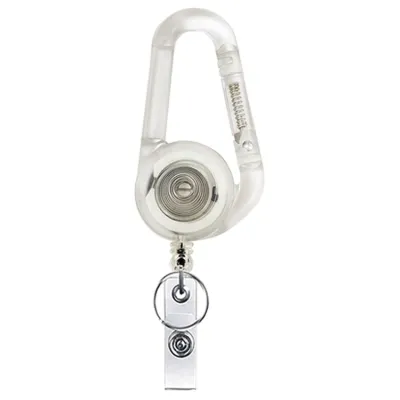
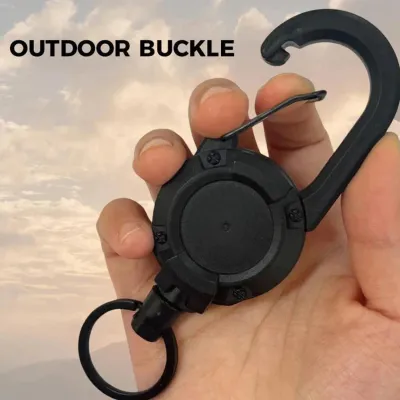
Prices are valid at publication and may change. Please refer to the product page for the latest price.
Traditional rock climbing, sport climbing, and bouldering rely heavily on standard manual-locking or non-locking carabiners. Climbers use these simple, solid-metal connectors to build quickdraws, clip into protection, and manage ropes. The simplicity of a standard carabiner is its greatest asset; it offers predictable behavior and rapid, one-handed operation.
In contrast, true retractable mechanisms are restricted to specific vertical disciplines. You will find them integrated into certified Via Ferrata sets, high ropes adventure courses, and industrial fall-protection systems. They are designed to manage slack automatically in controlled, linear pathways. Attempting to use these complex, retractable mechanical systems in standard recreational free climbing introduces severe hazards that standard climbing gear is specifically designed to avoid.
Essential Safety Standards and Certifications to Verify
In any vertical sport, your gear is your lifeline. You must never guess whether a connector is strong enough to support your weight or withstand the forces of a fall. Legitimate climbing gear is subjected to rigorous testing and must carry specific certifications stamped directly onto its body.

The primary authority for mountaineering equipment is the UIAA (International Climbing and Mountaineering Federation). The UIAA safety label indicates that a piece of gear has met strict performance requirements developed by international experts. When purchasing connectors for climbing, always check for the UIAA logo alongside European standard (EN) certifications.
Three distinct European standards govern these types of equipment, and confusing them can have fatal consequences:
- EN 12275 (Mountaineering Connectors): This is the mandatory standard for any carabiner used in recreational climbing, mountaineering, or caving. It classifies carabiners into specific types (such as Type B for basic use, Type K for Via Ferrata, and Type H for belaying) and mandates strict minimum breaking strengths.
- EN 362 (Industrial Connectors): This standard applies to connectors designed for industrial fall protection and work positioning. While some heavy-duty steel carabiners carry dual certification for both EN 12275 and EN 362, industrial-only connectors are often too heavy, bulky, or shaped incorrectly for dynamic climbing ropes.
- EN 360 (Retractable Fall Arresters): This standard regulates industrial self-retracting lifelines. Devices certified under EN 360 are strictly industrial safety tools and are never certified or safe for recreational lead or top-rope climbing.
When inspecting a climbing carabiner, look closely at the markings stamped or laser-etched onto the spine. A certified climbing connector will display its minimum breaking strength in kilonewtons (kN) across three distinct axes:
- Major Axis Strength: This represents the carabiner's strength when loaded end-to-end with the gate closed. For climbing, this rating must be at least 20 kN (approximately 2,000 kg of static force).
- Minor Axis Strength: This indicates the strength when the carabiner is cross-loaded sideways. This rating is significantly lower, typically ranging between 7 kN and 10 kN.
- Open Gate Strength: This measures the strength if the gate is forced open during a fall. This is the weakest state, often rated at only 7 kN to 9 kN.
You must completely avoid using unbranded, uncertified, or novelty “carabiners” for any load-bearing climbing activity. Many inexpensive accessory clips sold online or in hardware stores look identical to climbing carabiners but are rated only for keys or light gear. Using these non-rated items for climbing can result in immediate failure under even minor body weight.
Specific Safety Risks and Mechanical Limitations
Climbing in natural environments exposes your equipment to harsh elements. Mechanical complexity is the enemy of reliability when dirt, moisture, and friction are involved. This is why retractable lanyards and complex auto-locking mechanisms carry inherent risks that require constant vigilance.
The primary hazard of any retractable or auto-locking mechanism is mechanical failure. The internal springs, sliding sleeves, and rotating barrels of auto-locking carabiners rely on tight manufacturing tolerances. When you climb outdoors, these moving parts are exposed to fine dust, sand, climbing chalk, and moisture. If grit penetrates the locking sleeve, the spring can jam, leaving the gate partially open or unlocked. In humid tropical climates, like Singapore, this risk is compounded by atmospheric moisture, which can cause internal steel springs to corrode, leading to sluggish or failed gate closure.
Another critical risk is cross-loading and gate flutter. Cross-loading occurs when a carabiner shifts during movement, causing the rope or anchor webbing to pull against the minor axis. If the locking mechanism fails to engage fully due to dirt or mechanical sluggishness, the carabiner is highly susceptible to opening. Furthermore, during a dynamic fall, the rapid vibration of the rope running through the runner can cause “gate flutter”—a phenomenon where the gate briefly vibrates open. If the carabiner is subjected to peak fall forces while the gate is fluttered open, it can easily snap, as its open-gate strength is less than half of its closed-gate rating.
Environmental factors also play a major role in gear degradation. In Singapore’s hot, humid, and often coastal climbing environments, salt spray and high humidity accelerate the oxidation of aluminum and steel. If you do not dry your gear thoroughly after a humid outdoor session, or if you store it while damp, the internal spring mechanisms can seize. This makes the auto-locking or retractable function highly unpredictable, increasing the likelihood of an accidental gate opening during a climb.
Safe Applications vs. Dangerous Misuses in Climbing
To maintain a safe climbing environment, you must apply the right tool to the right scenario. Understanding the limits of your gear prevents dangerous misapplications.
There are several safe and highly recommended applications for certified auto-locking carabiners. They are the gold standard for securing your belay device to your harness belay loop, as they prevent accidental gate opening from rope rub. They are also ideal for building top-rope anchors and attaching personal anchor systems (PAS) to belay stations, where a secure, locked connection is paramount. Certified retractable lanyards are also safe when used within engineered Via Ferrata systems or commercial zipline courses, where they manage slack automatically as you traverse horizontal cables.
However, misusing these devices can lead to catastrophic accidents. You must never use auto-locking carabiners on quickdraws for lead climbing. Lead climbing requires you to clip the rope quickly and cleanly with one hand while holding onto the rock. Fumbling with a twist-lock or magnetic gate while pumped or in a precarious position increases your fall risk. Furthermore, the gate of an auto-locker can easily press against the rock face during a fall, forcing the locking sleeve to rotate and open.
Using industrial retractable fall arresters (EN 360) for lead rock climbing is an extremely dangerous misuse. These industrial units are designed to lock immediately when a fall occurs, assuming a vertical, static fall path with minimal clearance. In lead climbing, this immediate, rigid locking prevents the belayer from providing a dynamic catch, resulting in massive impact forces on the climber’s body and the anchor bolts. The constant tension of a retractable cable also creates severe rope drag, pulling the climber off balance and increasing the risk of dangerous pendulum swings against the rock face.
Ultimately, no high-tech gear can compensate for a lack of proper training. Safe climbing requires comprehensive instruction in rope management, knot-tying, anchor building, and fall physics. Your judgment and skills are your primary safety devices; equipment is merely a backup.
Inspection, Maintenance, and When to Retire Your Gear
To ensure your climbing connectors and auto-locking mechanisms remain reliable, you must establish a strict inspection and maintenance routine. Regular care extends the life of your gear and ensures it functions correctly when you need it most.
Begin with a thorough visual and functional check before every climbing session. Hold the carabiner and open the gate fully, then let it go. The gate must snap shut and lock completely and instantly. If there is any hesitation, stickiness, or if the locking sleeve fails to return to the fully locked position, the gear must be set aside. If you are using a certified Via Ferrata retractable lanyard, inspect the protective casing for cracks and pull the webbing out fully to check for cuts, abrasion, chemical stains, or frayed stitching. Examine the metal bodies of all connectors for deep wear grooves caused by rope friction, sharp burrs, or visible cracks.
Proper cleaning is essential to remove abrasive grit and salt residue. Wash your carabiners in clean, warm water (not exceeding 30 degrees Celsius) using a mild, pH-neutral soap if necessary. Use a soft toothbrush to clean around the gate hinge, spring recess, and locking barrel. Rinse the gear thoroughly to remove all soap residue, then shake out any trapped water.
Allow the equipment to air-dry completely in a shaded, well-ventilated area away from direct sunlight or artificial heat sources. Once fully dry, apply a single drop of a manufacturer-approved dry lubricant (such as a PTFE- or paraffin-based lubricant) to the gate hinge and locking sleeve. Avoid heavy oils, WD-40, or wet lubricants, as these will attract dirt, chalk, and sand, quickly clogging the mechanism again. Wipe away any excess lubricant with a clean cloth.
You must know when to permanently retire your gear. Immediately discard any carabiner if:
- The gate action remains sluggish or fails to lock automatically even after thorough cleaning and lubrication.
- You detect any visible cracks, deep grooves (exceeding 1 mm or the manufacturer's specified limit), or severe rust pitting.
- The metal body has undergone visible deformation or bending.
- The gear has been subjected to a severe fall or high-impact force, even if there is no visible damage, as internal micro-fractures may have compromised its structural integrity.
- The manufacturer's recommended lifespan (typically 10 years for synthetic textile components like lanyards, and variable for metal gear) has been exceeded.
Frequently Asked Questions (FAQ)
Can I use an industrial retractable fall arrester for lead rock climbing?
No, industrial retractable fall arresters are highly dangerous for lead rock climbing. These devices are engineered for static vertical environments to catch a worker quickly over a short distance. In lead climbing, they create massive rope drag, make dynamic belaying impossible, and can lead to severe pendulum swings. Furthermore, they are not designed to absorb the dynamic forces of a lead fall in the same way a dynamic climbing rope and belay system do, which can result in catastrophic anchor or gear failure.
How do I clean an auto-locking carabiner after climbing in dusty or humid conditions?
To clean your auto-locking carabiner, first rinse it thoroughly under warm, clean tap water to flush out dust, sand, or salt. For stubborn grime or chalk buildup, use a mild, pH-neutral soap and a soft-bristled brush to gently clean around the hinge and locking barrel. Rinse the connector completely, then shake out any trapped water. Allow it to air-dry fully in a well-ventilated space away from direct sunlight. Once dry, apply a single drop of a manufacturer-approved dry lubricant to the pivot and sleeve, cycling the gate several times to distribute it, and wipe off any excess.
Community discussion
Share your experience or ask a question. Comments are reviewed before publication.