
Choosing between an axis board and a wobble board depends on whether your fitness goals require targeted, single-plane stability or comprehensive, multi-directional balance. Axis boards restrict movement to a specific plane—typically side-to-side or front-to-back—making them highly effective for sport-specific training like surfing, skateboarding, or skiing. Wobble boards, featuring a spherical base, offer 360-degree omnidirectional movement that challenges your core and ankle stability from every angle, making them the preferred choice for general fitness, core activation, and lower-limb rehabilitation.
To select the right tool for your home gym or workout routine, it is essential to understand how their mechanical differences translate to muscle engagement, joint impact, and athletic performance. By evaluating your personal training objectives against the unique physical demands of each board, you can invest in the equipment that best supports your long-term physical development.
Understanding the Mechanics: Axis Board vs Wobble Board
The fundamental difference between these two balance trainers lies in their fulcrum design, which dictates how they move and how your body must respond to maintain equilibrium.
Products mentioned in this guide
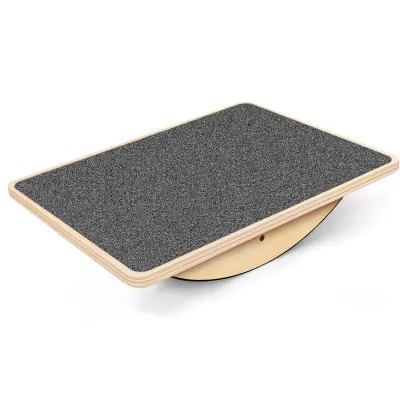
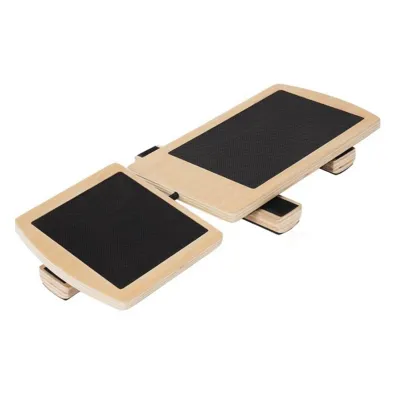
Prices are valid at publication and may change. Please refer to the product page for the latest price.
An axis board, often referred to as a rocker board or roller board, operates on a fixed or semi-fixed axis. The deck rests on a cylindrical roller or a curved wooden rocker base that limits motion to a single directional plane. When you stand on an axis board, you tilt primarily left-to-right or forward-to-back. This predictable path of motion allows you to focus on high-amplitude balance adjustments, shifting your weight dynamically from one edge to the other without worrying about the board slipping out in an unexpected direction.
In contrast, a wobble board features a centrally located spherical or dome-shaped base. This design allows the board to tilt, pivot, and rotate a full 360 degrees. Because the base offers no fixed path, the board is inherently less stable and responds to the slightest shift in your center of gravity. Standing on a wobble board requires continuous, rapid micro-adjustments from all the stabilizing muscles in your feet, ankles, and hips to keep the deck from touching the floor.
These mechanical differences directly influence joint impact and stability requirements. The wobble board places a high demand on ankle inversion and eversion, forcing the joint to stabilize against multi-directional forces. The axis board, by restricting lateral twisting, focuses the physical challenge on knee tracking, hip alignment, and lateral weight distribution, making it a highly structured training tool.
Matching the Board to Your Fitness Goals
Your training objectives—whether you want to sculpt a stronger midsection, recover from an injury, or prepare for outdoor adventures—will determine which balance trainer deserves a spot in your workout space.

Core Training and General Stability
For those looking to enhance overall core strength and daily functional balance, the wobble board is exceptionally efficient. Because it moves in 360 degrees, your body cannot rely on a single set of muscles to stay upright. Instead, it recruits a complex network of deep stabilizing muscles, including the transversus abdominis, multifidus, and obliques, to manage the constant, unpredictable movement.
An axis board offers a different style of core engagement. Rather than managing rapid micro-adjustments, you must brace your core to control larger, deliberate shifts in weight. This is particularly useful for building lateral trunk strength and improving your ability to resist rotational forces.
To progress your stability training on either board, start with static holds, aiming to keep the deck completely level. Once you can maintain balance for 30 to 60 seconds, you can introduce dynamic movements. Performing bodyweight squats, lunges, or even holding a plank with your hands on the board will significantly increase the difficulty and accelerate your strength gains.
Rehabilitation and Injury Prevention
When recovering from lower-limb injuries, selecting the appropriate movement pattern is critical for safe healing. Wobble boards are widely utilized in physical therapy settings to rebuild proprioception—your body’s awareness of its position in space—following lateral ankle sprains. The multi-directional tilt helps re-educate the nervous system and strengthen the supporting ligaments of the ankle joint, though any post-injury training must be cleared by a qualified physiotherapist.
However, there are stages in rehabilitation where multi-directional movement can be counterproductive or dangerous. If you are recovering from a specific ligament tear or joint instability where lateral twisting must be avoided, an axis board is often the safer choice. Its restricted, single-plane motion allows you to perform controlled flexion and extension exercises without risking accidental inversion or eversion of the ankle.
Regardless of the board you use, safety must remain your primary focus. Always establish clear stopping conditions: immediately step off the board if you experience sharp pain, sudden swelling, joint clicking, or a feeling of instability that you cannot control. Training through joint pain can exacerbate injuries and delay your recovery.
Athletic Performance and Sport-Specific Drills
If your primary goal is to improve your performance in board sports or dynamic outdoor activities, the axis board is the clear winner. For Singaporeans preparing for surfing trips to Bali, snowboarding holidays in Japan, or wakeboarding sessions at local cable parks, the axis board serves as an excellent dry-land simulator. It perfectly mimics the edge-to-edge transitions and lateral weight transfers required to carve, turn, and maintain control on a moving deck.
On the other hand, the wobble board is highly beneficial for athletes participating in court sports like tennis, badminton, or basketball, as well as trail runners. These activities require rapid, multi-directional agility and the ability to react to unpredictable ground surfaces. Training on a wobble board prepares your ankles and nervous system to handle sudden changes in direction, reducing the risk of rolled ankles on the court or trail.
When selecting a board for athletic training, always check the manufacturer’s specified maximum tilt angle. A steeper tilt angle provides a more intense challenge that closely replicates high-performance athletic maneuvers, while a shallower angle is better suited for foundational agility drills.
Key Comparison Factors to Verify Before Buying
Before purchasing a balance trainer for your home workouts, you should verify several physical specifications on the product label or manufacturer’s website to ensure it matches your body type and training environment.
First, examine the base height and maximum tilt angle. A higher base elevates the deck further from the ground, resulting in a steeper tilt angle and a much higher level of difficulty. If you are new to balance training, look for a wobble board with an adjustable base height or an axis board with a wider, lower-profile rocker to ensure a manageable learning curve.
Second, evaluate the deck surface grip and size. In warm, humid climates, workouts can quickly become sweaty, making a non-slip surface essential for safety. Verify that the board features high-traction grip tape, a textured rubber overlay, or molded non-slip ridges. Additionally, ensure the deck width is compatible with your natural athletic stance; a board that is too narrow will force your feet into an awkward position, compromising your form and stability.
Finally, check the manufacturer-stated weight capacity and material construction. High-quality balance boards are typically constructed from multi-ply hardwood or heavy-duty, reinforced molded plastics. Ensuring the board can comfortably support your weight—plus any additional resistance like dumbbells or medicine balls you plan to use—is vital for long-term durability and safety.
Decision Framework: Which One Should You Choose?
To make your final decision, evaluate your fitness profile against these straightforward, condition-based guidelines:
Choose an axis board if:
- Your primary goal is to train for board sports like surfing, skateboarding, snowboarding, or wakeboarding.
- You want to focus on lateral stability, knee tracking, and controlled weight shifts.
- You require a restricted-plane movement pattern to accommodate specific physical therapy guidelines.
Choose a wobble board if:
- You want to maximize deep core activation and improve overall daily balance.
- You are looking to strengthen your ankles and rebuild proprioception after a general sprain, under professional guidance.
- You participate in multi-directional sports like tennis, running, or court-based activities.
Before starting any new balance training regimen, always verify if you have pre-existing joint hypermobility, acute lower-limb injuries, or vestibular conditions that affect your equilibrium. If any of these apply, obtain professional medical clearance from a doctor or physiotherapist before stepping onto a balance board.
Frequently Asked Questions (FAQ)
Can beginners use an axis board safely?
Yes, beginners can use an axis board safely by implementing proper progression and safety measures. When starting out, place the board near a sturdy wall, a heavy piece of furniture, or a stable chair that you can lightly hold for support. Begin with a wide stance, placing your feet near the outer edges of the deck to maximize leverage and control. Focus on making small, slow tilts rather than rocking aggressively from side to side. As your confidence and muscle memory improve, you can gradually reduce your reliance on hand support and transition to a narrower stance.
Are balance boards effective for weight loss?
Balance boards are primarily designed to improve neuromuscular control, joint stability, and core strength rather than to burn a high number of calories. While standing on a balance board does increase muscle activation compared to standing on flat ground, the overall caloric expenditure is relatively low. To support a weight loss goal, balance boards are best used as a complementary tool. You can integrate them into high-intensity circuit training—such as performing balance-board-assisted push-ups or squats—or use them during active recovery sessions to keep your body moving while allowing your primary muscle groups to rest.
Community discussion
Share your experience or ask a question. Comments are reviewed before publication.