
Selecting the right recovery equipment is a common challenge when building a home gym or optimizing a post-workout routine. The choice between a foam roller and a balance ball trainer depends entirely on your specific physical needs, as these two tools target completely different systems within the body. While both are categorized under recovery and conditioning, they are not interchangeable, and using the wrong one for your specific issue can delay your progress.
To put it simply, a foam roller is a passive-to-active soft tissue tool designed for self-myofascial release, muscle relaxation, and temporary flexibility gains. It works by applying direct, concentrated pressure to muscles and fascia to alleviate tightness and reduce soreness. In contrast, a balance ball trainer is an active neuromuscular conditioning tool designed to improve joint stability, core strength, and proprioception. It uses an unstable surface to force your nervous system and stabilizing muscles to coordinate, making it ideal for joint rehabilitation and balance training.
To determine which tool you actually need, you must assess whether your primary recovery bottleneck is muscular tightness or joint instability. If your legs feel heavy and sore after a long run, the foam roller is your ideal companion. If you are recovering from an ankle sprain or want to prevent slips on uneven hiking trails, the balance ball trainer is the correct choice. Understanding the distinct physiological mechanisms of each tool will help you invest your time and money wisely.
Products mentioned in this guide
![3H Fitness [46CM/58CM] Upgrade Bosu Yoga Balance Ball Fitness Gym Workout Half Yoga Ball Exercises Balance Trainer Ball](https://img.lazcdn.com/g/p/aeaa9601b120e1f9f9cd61096fe6c306.jpg_400x400q80.jpg_.webp)
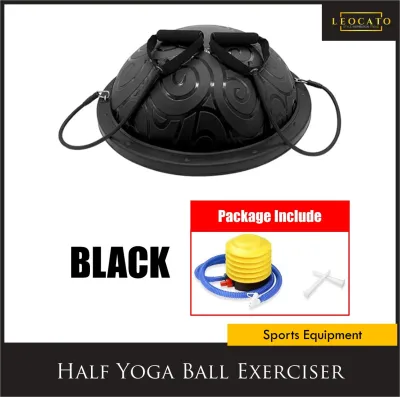


Prices are valid at publication and may change. Please refer to the product page for the latest price.
Muscle Relief vs Joint Stability: How Each Tool Works
To make an informed decision, it is essential to understand how these tools interact with your body on a physiological level. They target different anatomical structures and elicit distinct neurological responses, meaning they serve entirely different phases of the recovery and conditioning spectrum.
Foam Rollers for Myofascial Release
Foam rolling is based on the principles of self-myofascial release (SMR). Fascia is a specialized connective tissue sheath that wraps around every muscle, fiber, nerve, and blood vessel in your body. Due to intense exercise, repetitive strain, or prolonged sitting, this fascial tissue can become bound, dry, or develop microscopic adhesions, commonly referred to as muscle knots. These adhesions restrict movement and contribute to the localized discomfort known as Delayed Onset Muscle Soreness (DOMS).
When you rest your body weight on a foam roller and slowly move across its surface, you apply a combination of direct compression and shear force to the underlying tissue. This mechanical pressure stimulates sensory receptors within the muscle and fascia, specifically the Golgi tendon organs and Pacinian corpuscles. These receptors signal the central nervous system to reduce the tone of the overactive muscle, allowing it to relax and lengthen.
Additionally, this compression acts like a sponge mechanism. As the roller passes over the tissue, it temporarily displaces blood and interstitial fluids. Once the pressure is released, a fresh wave of highly oxygenated, nutrient-rich blood rushes back into the area. This localized increase in circulation accelerates the removal of metabolic waste products, reduces inflammation, and temporarily restores tissue elasticity. It is important to note that this process is primarily mechanical and circulatory, targeting the muscular and fascial systems rather than joint ligaments or neurological balance pathways.
Balance Ball Trainers for Proprioception and Stability
Unlike the localized, tissue-deforming pressure of a foam roller, a balance ball trainer works by challenging your entire neuromuscular system. A typical balance ball trainer consists of a rigid, flat platform on one side and a flexible, air-filled dome on the other. This unique construction creates a highly unpredictable, multi-directional unstable surface when inflated.
When you stand, kneel, or perform exercises on this unstable surface, your body cannot rely on static bone-on-bone alignment for support. Instead, your brain must constantly process real-time feedback from proprioceptors—sensory receptors located in your joints, muscles, and tendons that detect movement, tension, and spatial positioning. This neurological feedback loop travels rapidly to the cerebellum, which instantly sends motor commands back to the muscles to make micro-adjustments in posture and alignment.
This continuous loop of sensory input and motor output retrains your proprioceptive system, which is often compromised after joint injuries like ankle sprains or knee tweaks. By forcing the deep, stabilizing muscles around your joints (such as the peroneals in the ankle or the vastus medialis in the knee) to fire rapidly, the balance ball trainer builds functional joint stability. It is an active, demanding form of neuromuscular rehabilitation that teaches your body how to protect its joints during dynamic, unpredictable movements. It does not massage or physically manipulate soft tissue; rather, it trains the nervous system to coordinate muscular contractions more efficiently.
Key Differences in Function, Target Areas, and Daily Use
To help you quickly compare these two popular fitness tools, the table below highlights their primary differences across several key decision-making dimensions.

| Feature | Foam Roller | Balance Ball Trainer |
|---|---|---|
| Primary Recovery Goal | Relieving muscle tightness, reducing DOMS, and temporary flexibility gains. | Retraining joint stability, improving balance, and core/neuromuscular activation. |
| Target Physiological System | Muscular and fascial systems (soft tissue). | Nervous system, joint ligaments, and deep stabilizing muscles. |
| Best Time to Use | Post-workout cool-downs, evening relaxation, or brief pre-workout mobility. | Dedicated active recovery sessions, rehabilitation routines, or pre-workout activation. |
| Space & Storage Requirements | Compact, lightweight, easily tucked under a bed or in a closet corner. | Bulky, heavier, requires dedicated floor space and proper storage away from sharp objects. |
| Learning Curve | Low to moderate; requires learning correct body positioning and pressure control. | Moderate to high; requires baseline balance and strict form to prevent falls. |
Evaluating these dimensions against your personal living space and daily routine is crucial before making a purchase. In urban living environments, such as typical apartments in Singapore where space is at a premium, storage is a practical consideration. A foam roller is highly compact and can be tucked away effortlessly, making it an easy addition to any household. A balance ball trainer, however, has a much larger physical footprint, is significantly heavier, and must be kept away from sharp objects or direct heat sources to prevent puncture risks.
Your daily schedule and energy levels also play a role in this decision. Foam rolling is a low-energy, highly passive activity that you can easily perform while unwinding at the end of the day or watching television. It requires minimal physical exertion. Conversely, utilizing a balance ball trainer is an active, focused training session. It demands mental concentration, physical engagement, and a baseline level of energy, meaning it cannot be done passively. You must decide whether you have the mental and physical bandwidth to dedicate to active stability training, or if you simply require a straightforward tool to help your muscles relax after a demanding day.
When to Reach for a Foam Roller
There are specific, clear-cut scenarios where the foam roller is the undisputed tool of choice. If you are an avid runner, cyclist, or high-intensity cardio enthusiast, your primary physical complaints likely center around muscle fatigue, stiffness, and localized soreness. Training in warm, humid climates—such as outdoor running along Singapore’s East Coast Park—can accelerate dehydration and muscle cramping, leaving your lower body feeling exceptionally tight and heavy.
In these situations, a foam roller is highly effective for targeting large muscle groups. Rolling out the gastrocnemius (calves), quadriceps, hamstrings, and the gluteal complex helps to physically break up tension and encourage healthy blood flow. If you experience lateral knee discomfort related to tight tissues around the iliotibial (IT) band, using a foam roller to target the surrounding muscles, such as the tensor fasciae latae (TFL) and gluteus medius, can relieve the tension pulling on the joint.
Furthermore, the foam roller is an excellent tool for quick pre-workout preparation. By performing light, rapid rolling over your major muscle groups for just 10 to 15 seconds per area, you can stimulate local circulation and temporarily increase your joint range of motion. This helps you move more freely during your workout without sedating the muscle or reducing its explosive power, which can happen with prolonged static stretching.
However, you must recognize the mechanical boundaries of this tool. While a foam roller can make tight muscles feel looser and significantly reduce the discomfort of DOMS, it is not a cure-all. It cannot correct structural joint instability, strengthen weak stabilizer muscles, or fix poor movement mechanics. If your knee is collapsing inward during squats due to weak gluteal stabilizers, repeatedly rolling your quadriceps will not solve the root cause of the movement error.
When a Balance Ball Trainer Is the Right Choice
A balance ball trainer becomes necessary when your physical limitations are structural, neural, or joint-related rather than purely muscular. If you are recovering from a lateral ankle sprain, a minor knee strain, or if you frequently feel unsteady when walking on uneven terrain like the natural trails around Bukit Timah, joint stability is your primary bottleneck.
When a joint is injured, the tiny nerve endings that communicate with your brain are often damaged or dulled. This impairment can lead to a clumsy gait, poor balance, and a high risk of re-injury. Standing on the unstable dome of a balance ball trainer forces these nerve endings to reactivate, rebuilding the protective reflexes that keep your joints aligned during sudden, unexpected movements. It is also an exceptional tool for core and pelvic stabilization, as exercises like planks, bird-dogs, or single-leg balances on the dome require deep muscular engagement that flat ground simply cannot replicate.
To ensure your safety when using a balance ball trainer, you must follow strict preparation and usage guidelines. Always place the trainer on a flat, non-slip floor surface with ample clear space around you, ensuring there are no sharp objects, furniture corners, or walls close enough to cause injury if you lose your balance. Before stepping onto the dome, check the manufacturer’s inflation guidelines and use the provided measuring tape to verify that the dome is inflated to its correct height; over-inflation can make the surface excessively rigid and round, while under-inflation can cause the platform to bottom out.
Always check your equipment’s user manual for weight capacity limits and specific safety warnings. If you are new to balance training or are recovering from an injury, do not attempt advanced exercises immediately. Start with a basic baseline check: stand on the dome with both feet while holding onto a stable support, such as a sturdy wall or a heavy chair. Only progress to hands-free standing, single-leg balancing, or dynamic movements once you can maintain a quiet, stable posture for 30 seconds without pain or excessive shaking. If you experience sharp joint pain, swelling, or dizziness during use, stop immediately and consult a medical professional.
Your Decision Framework: Which Tool to Buy or Use Today
To help you make a definitive choice, use this structured conditional framework to evaluate your current physical state, fitness goals, and living constraints.
- Choose a foam roller if:
- Your primary physical complaints are muscular tightness, stiff joints, and delayed onset muscle soreness (DOMS) after cardiovascular or resistance training.
- You want a passive, low-energy recovery tool that you can use while relaxing at home.
- You have limited storage space and require a highly portable, lightweight tool that is easy to pack or store.
- Your budget is modest, and you want a highly cost-effective recovery solution.
- Choose a balance ball trainer if:
- You are recovering from a joint sprain (such as an ankle or knee injury) and need to rebuild joint stability and proprioception.
- You want to improve your balance, coordination, and agility for dynamic sports or trail running.
- You want to challenge your core, glutes, and joint stabilizers with active, functional strength exercises.
- You have dedicated floor space to safely use and store a larger, heavier piece of fitness equipment.
- Consider both if:
- You have the budget and storage space, and you want a comprehensive athletic recovery and conditioning routine. These tools are entirely complementary: you can use the balance ball trainer to actively build joint stability and core strength, and use the foam roller to passively soothe the muscular fatigue resulting from those workouts.
- Neither may fit if:
- You are experiencing acute, sharp joint pain, visible localized swelling, or suspect a muscle tear or ligament rupture. Self-treatment with either tool can exacerbate acute structural damage. Stop all exercises immediately and seek a professional medical evaluation from a physiotherapist or sports physician.
- Verify first if:
- You have chronic spinal conditions (such as herniated discs), severe joint degeneration, inner ear disorders, or vertigo. Balance training on an unstable surface can place unpredictable stress on the spine and increase your risk of falling, making professional clearance mandatory before starting.
Frequently Asked Questions (FAQ)
Can I use a balance ball trainer to massage sore muscles?
No, using a balance ball trainer to massage sore muscles is highly discouraged. The air-filled dome of a balance ball trainer is engineered to deform under dynamic weight to create instability, not to provide the firm, concentrated pressure required for deep tissue compression. Attempting to roll or press your muscles over the curved, flexible dome is highly ineffective because the surface yields too much to release deep muscular knots. Furthermore, trying to balance your body weight in awkward positions on the dome to target specific muscles introduces a significant risk of slipping, falling, or straining a joint. For safe and effective muscle massage, stick to dedicated tools like foam rollers, massage balls, or handheld massage rollers.
Should I use a foam roller before or after running?
You can use a foam roller both before and after running, but you must adjust your technique to match your physiological goals for each phase. Before a run, use light, rapid rolling for 10 to 15 seconds per muscle group to stimulate local blood flow, warm up the tissues, and temporarily increase joint mobility without decreasing muscle tension or power. After your run, switch to slow, deliberate rolling with deep, sustained pressure on tight areas for 30 to 60 seconds per muscle group. This slower post-run technique helps to down-regulate your central nervous system, encourage muscular relaxation, and initiate the recovery process by flushing out metabolic waste products.
Community discussion
Share your experience or ask a question. Comments are reviewed before publication.