
To build rapid reflexes and clean hand-eye coordination at home, the best badminton racket for solo wall practice is a lightweight (4U or 5U), head-light or even-balanced racket with a medium-to-flexible shaft. This specific configuration maximizes your reaction speed, reduces wrist fatigue, and provides the necessary repulsion power for short, compact swings.
Setting up a regular badminton home training routine using a wall is one of the most effective ways to improve your defensive blocks and flat drives. However, because the wall returns the shuttlecock almost instantly, you cannot rely on the same heavy, power-focused rackets used for deep-court smashing.
Why Solo Wall Practice Requires a Different Racket Profile
Solo wall practice introduces physical and mechanical dynamics that are completely different from a standard court game. On a standard court, the shuttlecock travels over a distance of several meters, giving you ample time to track its trajectory, prepare your stance, and execute a full-body swing. Against a flat wall, the distance is cut down to just two or three meters, reducing your reaction window to fractions of a second.
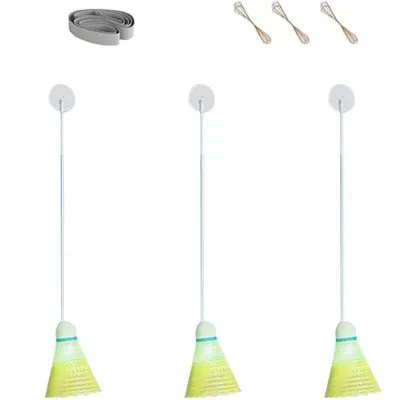
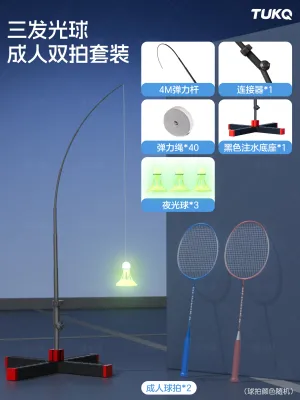
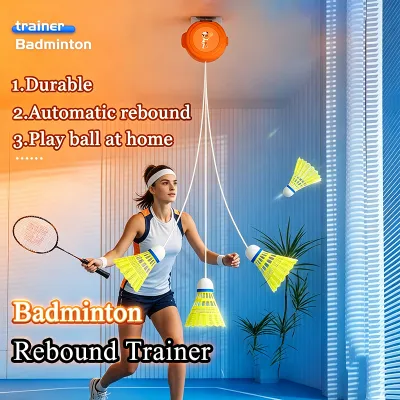
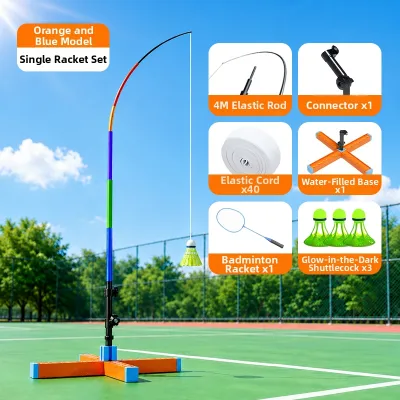
Products mentioned in this guide
![🇸🇬 [In Stock]NEW Badminton Trainer Indoor Professional Training Tool Badminton Rebound Trainer Children Adult Trainer Badminton Trainer](https://img.lazcdn.com/g/p/03efa0fcc4e32ef5d2c0e728c9e4b781.jpg_400x400q80.jpg_.webp)
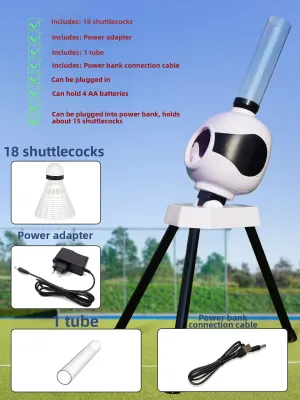
Prices are valid at publication and may change. Please refer to the product page for the latest price.
This extreme proximity means you must rely entirely on rapid, continuous, and highly compact strokes. Standard court rackets, especially those designed with a head-heavy balance for powerful overhead clears and smashes, are highly unsuitable for this training environment. The high rotational inertia of a head-heavy frame makes it incredibly difficult to reset your racket face quickly enough to meet the rapid rebound.
Furthermore, indoor settings like typical Singapore apartments or HDB flats present severe spatial limitations. Without the high ceilings and wide clearances of an indoor sports hall, full-arm swings risk striking nearby furniture, low-hanging light fixtures, or the wall itself. Attempting to force a heavy match racket through these restricted, choppy movements quickly leads to wrist fatigue, shoulder strain, and potential repetitive motion injuries.
Because the wall returns the shuttle with zero deceleration time, your muscles remain under constant tension. In a standard game, the flight time of the shuttle allows for brief moments of physical relaxation between hits. Wall drills strip away these recovery windows, meaning any excess racket weight or resistance will compound muscle fatigue rapidly, leading to a deterioration in your form and technique.
Ideal Racket Specifications for Fast-Paced Wall Drills
To optimize your home training sessions, you must prioritize maneuverability, rapid recovery, and effortless short-distance power generation. The ideal wall practice racket should act as a natural, lightning-fast extension of your hand rather than a heavy tool designed for raw smashing power.

Optimal Weight for Quick Recovery (4U and 5U)
When selecting a racket specifically for high-repetition wall drills, the overall weight of the frame is your first major consideration. Badminton rackets are categorized by weight classes using the “U” system, where a higher number indicates a lighter racket. For home wall practice, a 4U (approximately 80 to 84 grams) or 5U (75 to 79 grams) racket is highly recommended.
A lighter racket frame drastically reduces the physical effort required to stop and reverse your swing direction. Because wall drills involve hitting dozens of consecutive shots without the natural pauses of a court rally, a heavy frame will quickly exhaust your forearm muscles.
Opting for a 4U or 5U model allows you to maintain a high-frequency rhythm for longer periods. This lightweight profile helps you build quick-twitch muscle fibers in your wrist and forearm without putting excessive, dangerous strain on your joints.
Furthermore, these lighter weight classes make it much easier to execute rapid wrist pronation and supination. When the shuttle rebounds at unexpected angles, a 5U racket allows you to make micro-adjustments mid-swing, ensuring you keep the rally alive without overextending your elbow.
Balance Point for Flat Drives and Blocks
The distribution of weight along the racket frame, known as the balance point, directly dictates how fast you can maneuver the racket face. For fast-paced wall drills, you should look for head-light or even-balance rackets.
Head-light rackets have their center of gravity positioned closer to the handle, which makes the frame feel incredibly light and easy to swing. This design is perfect for executing the rapid defensive blocks and flat drives that form the core of any wall-based training routine.
Even-balanced rackets offer a neutral compromise, providing a bit more stability while remaining highly maneuverable. Avoid head-heavy rackets entirely for this drill; the extra weight at the top of the frame creates a dragging sensation that slows down your defensive transitions and strains your wrist.
Using a head-light racket also facilitates smoother transitions between your forehand and backhand grips. In wall practice, the shuttle often returns directly toward your body, requiring an instant shift to a backhand thumb grip. A head-light frame responds instantly to these subtle grip adjustments, preventing the racket head from lagging behind.
Shaft Flexibility for Short-Distance Power
Racket shafts range from highly flexible to extremely stiff, and this characteristic determines how easily you can generate power. For wall practice, a medium or flexible shaft is far superior to a stiff one.
Stiff shafts are designed for advanced players who can execute full, explosive body swings to bend the racket and generate power. In a confined home space where you can only use short, compact wrist snaps, a stiff shaft will feel like a wooden plank, forcing you to muscle every shot and increasing the risk of injury.
A medium or flexible shaft bends easily even with minimal swing space. This flexibility creates a whip-like effect, providing natural repulsion power that pops the shuttlecock back to the wall with very little physical effort.
This built-in repulsion is highly beneficial for sustaining long, rhythmic wall rallies. It allows you to focus entirely on your hand-eye coordination and foot alignment rather than straining to push the shuttle hard enough to make it rebound back to your position.
Frame Durability and Mishit Tolerance for Indoor Spaces
Practicing indoors means your racket will inevitably face physical impacts. Whether you scrape the floor trying to retrieve a low rebound or accidentally clip a concrete wall on a wide reach, frame durability is a critical factor.
Look for rackets constructed with durable carbon composite materials or reinforced aluminum frames rather than ultra-thin, high-modulus graphite designed purely for competition. Frames with an isometric head shape are also highly beneficial, as they feature a larger sweet spot that remains forgiving when you inevitably hit the shuttle off-center during high-speed rallies.
Avoid using delicate, highly aerodynamic frames with thin cross-sections for home drills. These specialized frames are engineered to slice through the air on a court but are highly brittle and prone to cracking or snapping upon the slightest contact with a solid wall or tiled floor.
Additionally, pay attention to the racket’s bumper strip and grommets. A thicker, more prominent bumper strip at the top of the frame provides an extra layer of defense against scrapes, absorbing the impact energy when you accidentally brush the wall during tight defensive recoveries.
Match Racket vs. Dedicated Trainer: Which Should You Use?
A common dilemma for players setting up a home training routine is whether to practice with their expensive match racket or buy a dedicated training frame. Both approaches have distinct trade-offs depending on your budget and training goals.
Using your primary match racket ensures that the weight, grip size, and overall feel match your actual game conditions perfectly. However, the financial risk is substantial, as high-end match rackets in Singapore typically cost between S$150 and S$300+. A single accidental collision with a concrete wall can instantly ruin an expensive piece of equipment.
Purchasing a dedicated, budget-friendly racket for S$40 to S$80 is often the most practical solution for home drills. This allows you to practice aggressive, fast-paced drives without the constant fear of damaging your primary gear. It also saves your high-end strings from the rapid wear and tear associated with continuous, high-frequency wall impacts.
If you choose a dedicated trainer, try to select a model that closely matches the weight class (such as 4U) and grip size of your match racket. This ensures that the muscle memory and reflex patterns you develop at home will transition smoothly to your court games.
Ultimately, if you have a spacious, carpeted room with protective wall padding, using your match racket is relatively low-risk. For typical high-rise apartments with hard concrete or plaster walls, however, dedicating a cheaper, highly durable backup racket is the smartest choice to preserve your main equipment.
Space Setup and Safety Tips for Home Wall Drills
Creating a safe environment is just as important as choosing the right racket when setting up your badminton home training area. A poorly planned space can lead to broken household items, damaged walls, or physical injuries.
Begin by clearing a dedicated zone that is completely free of breakable objects, electronics, and furniture. Stand in the center of your practice space and swing your racket gently in all directions, including overhead, to verify that you will not hit low-ceiling fixtures, fans, or hanging decorations. If your home has tiled or polished wooden floors, wear proper indoor court shoes with good grip to prevent slipping during quick lateral adjustments.
The surface of your wall also requires consideration; solid concrete walls provide the most consistent rebound but will quickly scuff paint and damage racket frames. To protect your home, you can tape a large sheet of thick cardboard, a corrugated plastic board, or a specialized foam panel to the target area of the wall.
If you live in a high-rise HDB flat where noise might disturb your neighbors, consider using a plastic shuttlecock or a foam-tipped training shuttle. These options produce a much quieter impact against the wall and rebound at a slightly slower pace, giving you more time to focus on your footwork and hand positioning.
Frequently Asked Questions (FAQ)
Can I use a squash racket for badminton wall practice?
No, you should never use a squash racket for badminton wall practice. Squash rackets are significantly heavier, typically weighing between 110 and 150 grams, and are designed to hit a heavy rubber ball rather than a feather shuttlecock. Attempting to use a squash racket for rapid badminton-style wrist movements will place extreme, unnatural stress on your wrist and elbow joints, which can quickly lead to severe injuries like tennis elbow.
What string tension is best for wall practice?
For home wall practice, a lower to medium string tension of 20 to 24 lbs is highly recommended. Lower tensions create a springy trampoline effect on the string bed, which enlarges the sweet spot and makes it much easier to sustain continuous rallies with compact swings. Additionally, lower tension reduces the physical shock transmitted to your arm upon impact and makes the strings far more resilient to accidental off-center hits near the frame.
Community discussion
Share your experience or ask a question. Comments are reviewed before publication.