
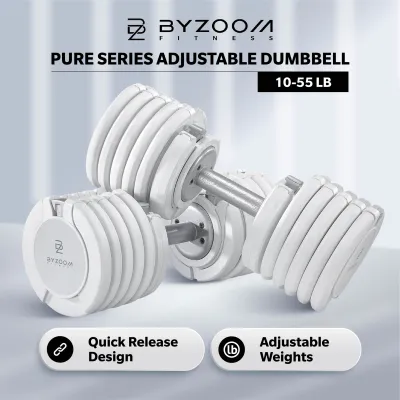
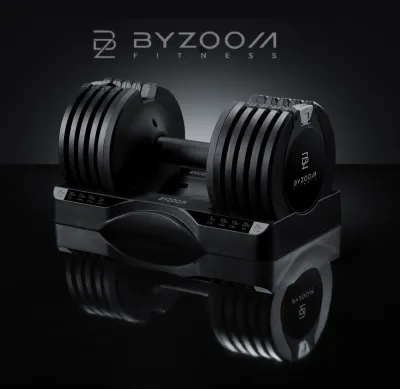
Selecting the best Byzoom adjustable dumbbells for a small HDB flat requires balancing your personal strength goals with the physical footprint of the storage cradle. For most compact HDB bedrooms or study corners, the Byzoom 12.5-pound (approximately 5.7 kg) or 25-pound (approximately 11.3 kg) models offer the most space-efficient footprints. If you require heavier loads for advanced strength training, the 50-pound (approximately 22.7 kg) or 55-pound (approximately 25 kg) models are highly capable but require a wider, sturdier storage base. To make the right choice, you must evaluate the base dimensions, the lateral clearance needed to adjust the weights, and how the physical length of the handles fits within your designated workout zone.
Why Adjustable Dumbbells Solve HDB Space Constraints
Living in a modern Singapore Housing & Development Board (HDB) flat requires a thoughtful approach to space management. With the average size of new Build-To-Order (BTO) bedrooms hovering around 9 to 11 square meters, every piece of furniture must justify its footprint. Traditional strength training setups, which rely on fixed-weight dumbbells, are space-intensive. A standard set of fixed dumbbells ranging from 2 kg to 20 kg requires a multi-tier rack that can easily occupy over a meter of wall space and require significant clearance in front of it.
Adjustable dumbbells solve this spatial puzzle by consolidating an entire rack of weights into a single, compact system. By using a clever nesting design, a pair of Byzoom dumbbells allows you to select different weight increments using only the footprint of the largest plate setting. This means you can transition from light lateral raises to heavy goblet squats without cluttering your floor with multiple pairs of iron or rubber weights. The entire system sits neatly in its custom cradle, occupying a fraction of a square meter in the corner of your bedroom, study, or living room.
Products mentioned in this guide
Prices are valid at publication and may change. Please refer to the product page for the latest price.
This compact footprint is crucial for maintaining a progressive overload training routine at home. Progressive overload requires you to gradually increase the resistance as your muscles adapt. In a traditional setup, this means buying new pairs of dumbbells as you get stronger, leading to an ever-growing pile of equipment. With an adjustable system, you simply dial up the weight on your existing set, allowing your home gym to grow with your fitness level without taking up extra floor space.
Key Byzoom Features for Compact Living
When selecting a Byzoom adjustable dumbbell set for a compact HDB flat, you must look beyond the maximum weight capacity. The physical design, mechanical operation, and storage requirements of the equipment will directly impact how easily it integrates into your daily living space.

Weight Range vs. Base Footprint
The maximum weight capacity of an adjustable dumbbell is directly proportional to the physical size of its storage base. Heavier models require larger, thicker, and wider weight plates to achieve those higher loads. Consequently, the storage cradles for these models have a significantly larger footprint than lighter alternatives.
Before purchasing, honestly assess your current strength levels and long-term training goals. If your routine primarily consists of high-repetition endurance training, mobility work, or light resistance training, a lighter Byzoom model with a smaller base footprint will serve you well while preserving precious floor space. Conversely, if you are focused on heavy strength building, the larger footprint of a heavier model is a necessary trade-off. In this scenario, you must plan your storage space more meticulously to ensure the larger base does not obstruct daily foot traffic.
To avoid surprises, never rely on visual estimates when planning your layout. Always check the manufacturer’s official specification sheet or product label for the exact dimensions of the storage base, including its length, width, and height. Measure your intended storage spot with a tape measure to confirm that the base will fit comfortably within the designated area.
Adjustment Mechanisms and Clearance
Byzoom adjustable dumbbells utilize mechanical systems to secure and release the weight plates, and these mechanisms have distinct spatial requirements. Some models feature a dial-based system where you rotate the handle or an end dial to select the weight, while others may use a slider or selector-pin mechanism. Understanding how these mechanisms operate is essential for planning the physical clearance around your storage base.
Dial-based systems that require you to turn the handle are highly space-efficient because they do not require extra lateral clearance to adjust the weights. You simply grip the handle, rotate it to your desired setting, and lift. However, systems that utilize end-of-handle dials or lateral selector pins may require additional physical space on either side of the cradle to allow your hands to access and operate the adjustment mechanism. If you plan to store your dumbbells in a tight gap between a wardrobe and a wall, a handle-rotation mechanism is generally the more practical choice.
You must also consider the physical length of the dumbbell handle and its end caps. On some adjustable models, the physical length of the dumbbell remains the same regardless of whether you are lifting the minimum or maximum weight. This fixed length can affect your grip width and the clearance needed when performing exercises close to your body, such as bicep curls or chest presses. Ensure you have enough lateral clearance in your workout zone to accommodate the full length of the dumbbell handles during movement.
How to Measure and Plan Your HDB Workout Corner
Creating a functional and safe workout corner in an HDB flat requires a systematic approach to measurement and environmental planning. By taking the time to prepare your space, you can prevent accidents, protect your home, and ensure a comfortable training environment.
First, measure the base footprint of your chosen spot. Whether you are using a corner of your bedroom, a study room, or an alcove in your living room, clear the area of all clutter and measure the exact length and width of the floor space. When comparing these measurements to the dimensions of the Byzoom storage cradle, add a buffer of at least 10 centimeters on all sides. This extra space ensures that you do not scrape your knuckles against walls or furniture when lifting or docking the dumbbells, and it allows for easy cleaning around the base.
Second, calculate your operational clearance. This refers to the space you need to physically maneuver during your exercises. Stand in your proposed workout spot and extend your arms fully to the sides and overhead. Ensure you have a clear path that is free from furniture, shelves, and low-hanging light fixtures. If you plan to perform overhead exercises like shoulder presses or standing tricep extensions, pay close attention to your ceiling height. Standard HDB ceilings are generally safe for overhead movements, but the presence of ceiling fans or decorative false ceilings can significantly reduce your safe working height.
Third, prioritize floor protection and noise control. HDB flats are built with concrete floor slabs that are highly efficient at transmitting impact noise and structural vibrations to the units below. Dropping heavy dumbbells, or even placing them back into their cradles too forcefully, can create loud thuds that disturb your neighbors. Furthermore, dropping adjustable dumbbells can crack your floor tiles and damage the delicate internal locking teeth of the equipment. To mitigate this, place a high-density rubber gym mat underneath your dumbbell storage base. The mat will absorb shock, dampen sound, and protect both your flooring and your equipment from impact damage.
Fourth, consider environmental factors. Singapore’s tropical climate is characterized by high humidity and warm temperatures, which can pose challenges for fitness equipment maintenance. Position your workout corner away from direct sunlight, as prolonged UV exposure can degrade plastic components and fade the weight markings on your dumbbells. Additionally, ensure the storage area is clear of air-conditioning units that are prone to dripping condensation. Avoid storing your dumbbells directly adjacent to high-humidity zones, such as bathroom entrances, to minimize the risk of moisture accumulation and subsequent rust.
Common Space-Planning Mistakes to Avoid
When setting up a home gym in a compact flat, it is easy to overlook minor details that can ultimately make your workout space impractical or unsafe. Recognizing these common space-planning mistakes beforehand will help you design a highly functional training area.
One frequent error is ignoring the “lift path” of the dumbbells. Many users measure the static footprint of the storage cradle and find a tight niche where it fits perfectly, such as under a low bed or inside a narrow closet. However, they forget to account for the physical space required to reach down, grip the handles, and lift the heavy dumbbells straight up out of the cradle. If you have to bend at an awkward angle or squeeze your hands into a tight space to retrieve the weights, you risk injuring your back or pinching your fingers. Always ensure the path directly above and around the cradle is completely clear.
Another common oversight is failing to account for ceiling fixtures. While you might have measured your standing height and arm reach, a spinning ceiling fan poses a severe hazard during dynamic overhead movements. Striking a ceiling fan with a metal dumbbell can cause catastrophic damage to the fan, destroy your equipment, and lead to serious personal injury. Always perform a dry run of your exercises with empty hands in your designated spot, looking upward to verify that your hands remain a safe distance from all ceiling fixtures at the peak of your movement.
Neglecting the stability of the storage surface is another critical mistake. Because adjustable dumbbells consolidate a large amount of weight into a small area, the storage base is extremely heavy. Placing this base on an uneven floor, a thick plush rug, or a flimsy piece of furniture can cause the cradle to tilt or wobble. If the cradle is not perfectly level, the individual weight plates may fail to align correctly within their slots. This misalignment can cause the adjustment mechanism to jam, or worse, prevent the plates from locking securely onto the handle, creating a hazard where plates could fall off during a lift. Always place the storage base on a solid, flat, and level floor surface.
Finally, avoid buying for your ego rather than your actual space and fitness requirements. It is common to feel tempted to purchase the heaviest available Byzoom model to “future-proof” your strength journey. However, if a massive 55-pound set results in a bulky cradle that blocks a major walkway in your bedroom, the constant inconvenience will quickly become a source of frustration. A smaller, lighter set that fits seamlessly into your daily life is far more likely to encourage consistent, long-term training than a heavy, cumbersome set that makes your living space feel cramped.
Care and Storage in Singapore's Climate
Proper maintenance is essential for preserving the functionality and safety of adjustable dumbbells, particularly in Singapore’s hot and humid climate. Because these systems rely on precise internal locking mechanisms, keeping them clean and dry is critical to preventing mechanical failure.
The primary threat to your equipment in a tropical environment is humidity combined with sweat. Sweat contains salt and minerals that are highly corrosive to metal surfaces. After every workout session, make it a habit to wipe down the dumbbell handles, weight plates, and the storage cradle with a dry microfiber cloth. This simple step removes moisture and prevents the formation of surface rust, which can cause the weight plates to stick together or interfere with the smooth operation of the adjustment dials. Avoid using harsh chemical cleaners or abrasive pads, as these can strip away protective coatings or damage plastic components.
In addition to moisture control, careful mechanical handling is vital for the longevity of adjustable dumbbells. Unlike traditional solid iron dumbbells, adjustable models contain intricate internal gears, springs, and locking pins that secure the selected plates to the handle. Dropping these dumbbells on the floor—even from a low height—can bend these internal components or chip the locking teeth. This damage can make the adjustment mechanism difficult to turn or, more critically, compromise the safety of the locking system. Always lower the weights to the floor under control, and never drop them.
Finally, practice proper docking habits. When you finish a set, return the dumbbells to their storage base gently. Ensure that the plates align perfectly with their corresponding slots in the cradle before releasing your grip. Forcing a misaligned dumbbell into the base can bend the alignment guides or damage the locking pins. If you feel resistance when trying to dock the dumbbell or turn the adjustment dial, do not apply force. Instead, lift the dumbbell out, check that all plates are sitting flat in the cradle, and try again.
Frequently Asked Questions (FAQ)
Can I keep Byzoom adjustable dumbbells on a standard HDB shelving unit?
No, you should avoid placing heavy adjustable dumbbell bases on standard particleboard shelves, wall-mounted shelving units, or lightweight storage racks. These storage solutions are typically not rated to support highly concentrated, heavy static loads, nor can they withstand the dynamic forces applied when you lift or return the weights. Placing heavy dumbbells on elevated, unstable shelving increases the risk of structural collapse, falling equipment, and severe physical injury. Always store your adjustable dumbbell base on a solid, level floor surface, preferably on top of a protective rubber gym mat.
Do adjustable dumbbells make noise that disturbs HDB neighbors?
Adjustable dumbbells can produce minor clicking or clinking sounds during use, as the individual weight plates have slight tolerances to allow for smooth mechanical adjustment. While this internal noise is normal, the sound of placing the dumbbells back into their cradles or setting them on the floor can transmit through the concrete floor slabs of an HDB flat, potentially disturbing your downstairs neighbors. To minimize noise transmission, always place a thick, high-density rubber gym mat beneath your workout area. Additionally, handle your equipment mindfully by avoiding sudden impacts and returning the dumbbells to their cradles gently.
Community discussion
Share your experience or ask a question. Comments are reviewed before publication.