
Finding the right dhs table tennis racket as a beginner in Singapore requires balancing control, spin, and affordability. Double Happiness (DHS) is one of the most respected names in the sport, offering a structured range of pre-made rackets that cater specifically to developing players. For most beginners, the ideal choice is a racket from the DHS 3-Star or 4000 series, or a pre-assembled Hurricane series racket if you are committed to regular coaching. These models provide the necessary ball feedback and moderate speed required to master fundamental strokes before transitioning to high-speed custom setups.
Why DHS Rackets Are Ideal for Beginners
Double Happiness (DHS) has been a cornerstone of global table tennis for decades, frequently supplying official equipment for World Championships and Olympic Games. This professional heritage trickles down directly into their consumer-grade equipment. For someone starting their table tennis journey in Singapore, DHS rackets offer an accessible entry point into authentic table tennis physics. Unlike generic department store paddles that use cheap, non-reactive rubber, DHS equips its beginner models with genuine, high-friction rubbers.
The brand’s design philosophy for entry-level rackets prioritizes control and spin generation over raw speed. When learning the game, using a racket that is too fast can severely hinder your progress. High-speed paddles bounce the ball off the blade too quickly, preventing you from developing correct stroke mechanics and muscle memory. DHS beginner rackets feature slower, more forgiving all-wood blades and tacky rubbers that grip the ball, allowing you to learn how to actively brush the ball to create topspin and backspin.
Products mentioned in this guide
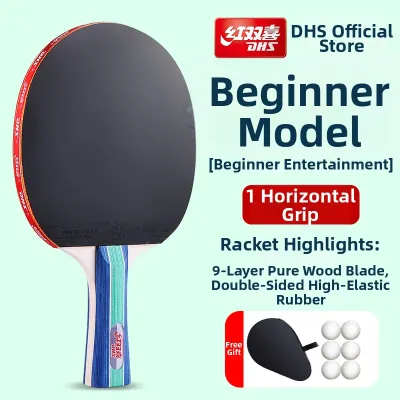
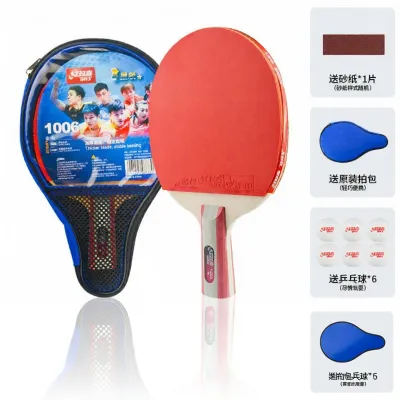
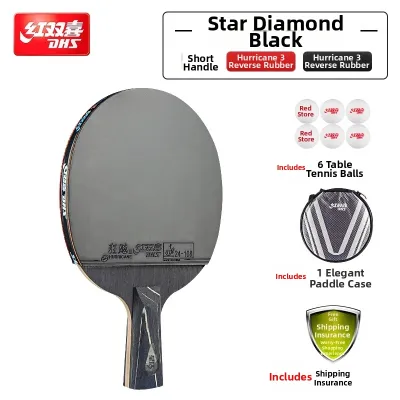
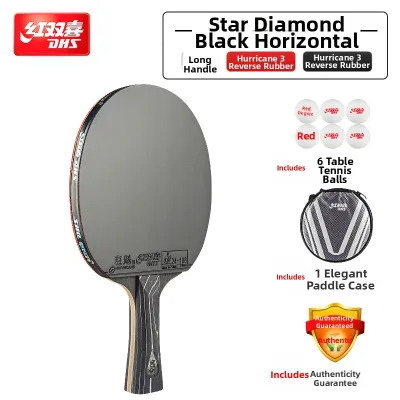
Prices are valid at publication and may change. Please refer to the product page for the latest price.
Additionally, DHS offers exceptional value for money in the local market. With prices for entry-level rackets typically ranging from S$15 to S$80, new players can acquire a high-quality piece of sporting equipment without making a massive financial commitment. This makes DHS a highly practical choice for school students, casual community club players, and adults picking up the sport at local ActiveSG sports halls.
Selecting the Right DHS Table Tennis Racket for Your Skill Level
To select the most appropriate racket, you must look beyond the brand name and evaluate several key technical specifications. Understanding how grip, blade materials, rubber characteristics, and weight interact will help you avoid buying a racket that is either too advanced or too basic for your current physical abilities.

Grip Style: Shakehand vs. Penhold Your first decision is choosing between the two primary grip styles. The Shakehand grip, characterized by a longer handle, is the most common grip globally and is highly recommended for modern beginners. It provides a balanced distribution of forehand and backhand control. Within Shakehand handles, you will mostly find Flare (FL) designs in pre-made rackets, which widen at the base to prevent the racket from slipping out of your hand. The Penhold grip features a shorter, thicker handle designed to be held like a pen. While Penhold has a rich historical tradition in Asian table tennis, it requires highly specialized footwork and wrist flexibility. Unless you have a specific coach training you in Penhold mechanics, starting with a Shakehand racket is generally the safer and more versatile path.
Blade Composition: The Case for All-Wood The blade is the wooden core of the racket. For beginners, an all-wood blade (typically consisting of 5 plies of wood) is highly superior to carbon-fiber composite blades. Wood blades absorb energy and vibrate slightly upon impact, transmitting tactile feedback—often called “feel”—directly to your hand. This feedback is essential for learning how hard to strike the ball and adjusting your paddle angle. Carbon blades, while popular among advanced players for their speed and large sweet spot, are rigid and unforgiving. A beginner using a carbon blade will struggle to keep the ball on the table, as the high rebound speed leaves zero margin for error.
Rubber Characteristics: Understanding Tackiness and Sponge DHS is famous for its tacky (sticky) top sheets, particularly the legendary Hurricane series. Tacky rubber behaves differently from the grippy, elastic rubbers typical of European brands. It grips the ball physically, allowing players to generate heavy spin even with slower arm speeds. For beginners, a tacky rubber is excellent for learning backspin serves and topspin loops. However, you must also pay attention to the sponge beneath the rubber. Beginner rackets should feature medium-soft sponges with a thickness of 1.5mm to 2.0mm. A thinner, softer sponge slows down the ball and increases dwell time (the duration the ball stays on the racket), giving you maximum control over your placement.
Weight and Balance A suitable beginner racket must be light enough to allow for repetitive practice without causing wrist or elbow fatigue. Many DHS pre-made rackets, especially those with thicker wood plies and double-sided tacky rubbers, can feel head-heavy. When browsing local stores, look for rackets that feel balanced in your hand. A racket that is too heavy can lead to poor stroke mechanics, as you may begin to drop your elbow or rely on your wrist to compensate for the weight, increasing the risk of repetitive strain injuries.
Top DHS Racket Series for Beginners in Singapore
DHS organizes its pre-made rackets into distinct series, making it relatively straightforward to find a model that matches your budget and commitment level. Here is a breakdown of the primary product lines available in Singapore’s retail stores and online marketplaces.
DHS Star Series (1-Star to 3-Star)
The DHS Star Series is the brand’s entry-level tier, designed primarily for recreational play, school physical education classes, and casual games at home or in condominium function rooms. These rackets are highly budget-friendly, typically costing between S$15 and S$35.
The performance profile of the 1-Star to 3-Star rackets is heavily weighted toward maximum control. They feature basic all-wood blades and thinner, less reactive sponges. This combination results in a low-speed racket that is incredibly forgiving. If your primary goal is to keep long rallies going with friends without the ball flying off the table, a 2-Star or 3-Star racket is an excellent starting point.
When purchasing a Star Series racket, check the product packaging to verify the rubber type. While 1-Star rackets often use basic, non-branded rubbers, 3-Star models frequently feature entry-level DHS rubbers like PF4. Ensure that the rubbers are clean and free from bubbles or peeling edges before you purchase, as these can occur if the racket has been stored in a hot warehouse.
DHS 4000 Series (e.g., 4002, 4006)
The DHS 4000 Series represents a significant step up in material quality and is designed for “improving beginners”—players who are taking basic coaching, joining community club sessions, or playing multiple times a week. These rackets bridge the gap between recreational play and competitive sport, usually priced around S$40 to S$60.
The major upgrade in the 4000 Series lies in the blade construction and rubber quality. These rackets typically feature a higher-grade 7-ply all-wood blade that offers a more solid, crisp feel upon impact. More importantly, they are equipped with high-quality rubbers, often featuring DHS Hurricane II or III on the forehand and PF4 or G888 on the backhand. This setup allows you to practice advanced techniques, such as looping against backspin and executing aggressive blocking.
When selecting a model in this series, pay close attention to the model numbers. DHS utilizes specific numbering conventions where the last digit often indicates the grip style. For example, the DHS 4002 is typically a Shakehand (FL) racket, while the DHS 4006 is a Penhold (CS) version. Always double-check the physical handle shape on the packaging to ensure you are purchasing the correct grip for your playing style.
DHS Hurricane Pre-Made Series
For highly dedicated beginners who want to experience professional-grade equipment without the hassle of buying separate blades and rubbers, the DHS Hurricane Pre-Made Series is the premium choice. These rackets are designed for players committed to regular training and club-level play, generally retailing between S$60 and S$90.
These rackets feature authentic DHS Hurricane III rubbers pre-assembled onto selected all-wood blades. Hurricane III is one of the most famous rubbers in table tennis history, known for its intense tackiness and low throw angle. This combination allows for devastating spin generation on both serves and loops.
However, beginners should be aware that the Hurricane series has a steeper learning curve and is physically demanding. Because the rubber is highly tacky and the sponge is relatively hard, the racket does not provide much “catapult effect.” To get speed out of a Hurricane rubber, you must use proper physical technique, involving body rotation and an active upward brushing motion. If you rely solely on your arm or wrist, your shots will land short. This makes the Hurricane pre-made series ideal for players who are actively receiving coaching to build correct stroke habits.
Pre-Made vs. Custom DHS Rackets: Which Should You Buy?
As you progress in your table tennis journey, you will inevitably face the decision of whether to continue using a factory-assembled pre-made racket or transition to a custom-built setup. Understanding the trade-offs in cost and performance will help you time this transition perfectly.
Pre-made DHS rackets offer unmatched convenience and cost-efficiency. For a single upfront price (usually under S$80), you receive a fully assembled racket complete with edge tape and, in many cases, a protective carrying case. They are ready to use immediately out of the box. However, the performance ceiling of pre-made rackets is limited. The wood used in pre-made blades is typically of a lower grade than individual blades, and the rubbers are glued using industrial adhesives that make them difficult to peel off and replace once they wear out.
A custom setup involves purchasing a separate DHS blade (such as the DHS Wind series or PG series for beginners) and choosing individual rubber sheets to be glued on manually. While a basic custom DHS setup will cost more—typically starting around S$120 to S$180—it offers several major advantages:
- Customization: You can select a softer, high-control rubber for your backhand and a harder, spin-heavy rubber for your forehand.
- Longevity: When the rubber loses its grip after 6 to 12 months of play, you can simply peel it off and glue on a new sheet, keeping the same wooden blade.
- Superior Materials: Custom blades use higher-quality wood cuts that provide more consistent ball feedback across the entire surface of the paddle.
You will know you have outgrown your pre-made DHS racket when you start to feel a distinct lack of speed and spin during offensive loops, or when the rubber sheets begin to lose their tackiness despite regular cleaning. If your strokes are technically correct but your shots are consistently landing short or failing to penetrate your opponent’s defense, it is time to upgrade to a custom DHS setup.
Where to Buy Authentic DHS Rackets in Singapore
Because DHS is one of the most popular table tennis brands globally, counterfeit rackets and rubbers are highly prevalent in the market. Purchasing a fake DHS racket can severely impact your playing experience, as counterfeit models often use cheap, non-tacky rubber and poor-quality wood that splits easily.
To ensure you are buying an authentic product, it is highly recommended to purchase from reputable local sources. In Singapore, dedicated table tennis specialty shops—often located in central areas like Bras Basah Complex or specialized sports centers—are the safest physical retail options. These shops source directly from official distributors and can offer expert advice on model selection. Official brand storefronts on major local ecommerce platforms also provide a secure avenue for online purchasing.
Avoid buying from unverified third-party sellers on online marketplaces who list DHS rackets at suspiciously low prices (such as a 4-Star racket for under S$15). If a deal seems too good to be true, it is highly likely a counterfeit.
To verify the authenticity of your purchase, look for the official DHS holographic anti-counterfeit label on the product packaging. Authentic DHS rackets feature a scratch-off area on this label that reveals a unique 12-digit or 16-digit verification code. You can enter this code directly on the official DHS website to confirm that your racket is a genuine product manufactured in their facilities.
Frequently Asked Questions (FAQ)
How do I maintain the tackiness of my DHS rubber?
To keep your DHS tacky rubber performing at its best, you must clean it after every playing session. Sweat, dust, and oils from your hands quickly accumulate on the sticky surface, neutralizing its spin-generating capabilities. Wipe the rubber gently using a specialized table tennis rubber cleaning spray or a small amount of distilled water, using a soft, non-abrasive sponge. Avoid using harsh household detergents or tap water with high mineral content. Once the rubber is completely dry, immediately apply a non-adhesive plastic protective sheet over the surface. Press out any air bubbles to seal the rubber away from oxygen and dust, which prevents the rubber from oxidizing and drying out in Singapore’s humid climate.
Should I choose a penhold or shakehandle DHS racket?
For the vast majority of beginners in Singapore, the shakehand grip is the recommended choice. Shakehand rackets feature a longer handle that is comfortable for most players and allows for an easier, more natural transition between forehand and backhand strokes. The penhold grip, while historically popular across Asia, requires highly specialized wrist strength, rapid footwork, and a specific style of play that can be incredibly difficult to master without professional, one-on-one coaching. If you are playing casually or attending general group classes at a community club, a shakehand DHS racket will provide a much smoother learning curve and a more balanced foundation.
Community discussion
Share your experience or ask a question. Comments are reviewed before publication.