
Finding space for cardio equipment in a Singapore Housing & Development Board (HDB) flat requires careful planning. Traditional fitness equipment like treadmills and stationary spin bikes often demand too much permanent floor space, making them impractical for compact living. A compact pedal exerciser offers an efficient, low-impact cardio solution that can be easily tucked away under a desk, sofa, or inside a built-in wardrobe when not in use.
To find the best model for your home, you must prioritize compact dimensions, low-profile pedal paths, and silent operation. This guide covers how to measure your living space, evaluate key space-saving features, and compare brand characteristics to find a reliable device that fits seamlessly into your daily routine.
Why Space Planning Matters for Cardio Equipment in HDB Flats
Modern HDB flats, particularly 2-room Flexi, 3-room, and 4-room layouts, are highly optimized environments where every square meter counts. Living rooms must often serve multiple functions, acting as dining areas, home offices, and relaxation zones simultaneously. Introducing bulky exercise equipment into these shared spaces can quickly make a home feel cluttered and restrictive.
Products mentioned in this guide
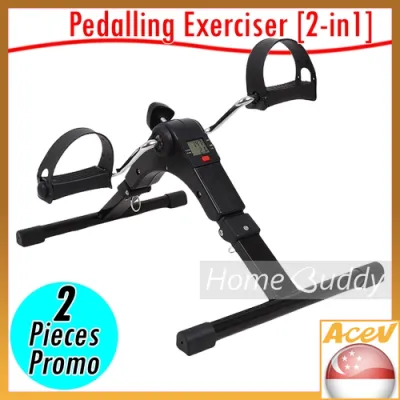
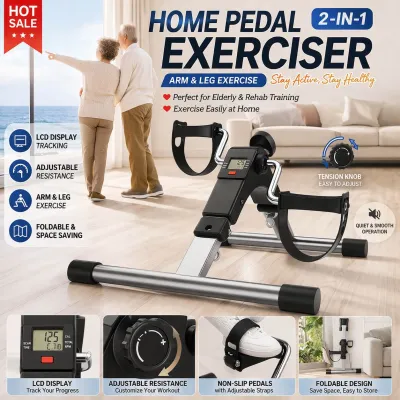
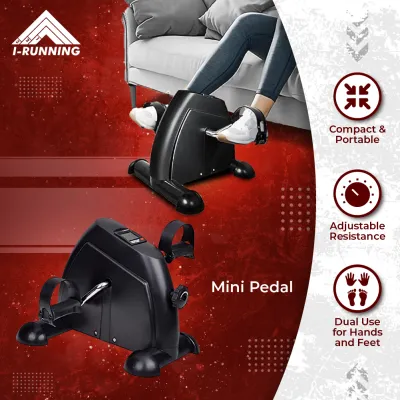
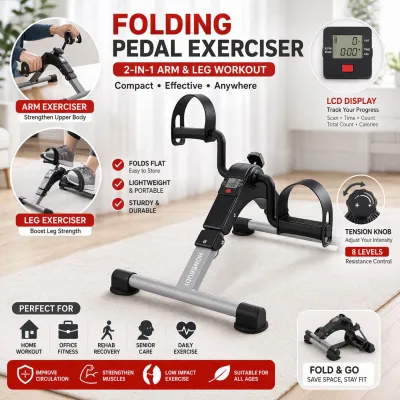
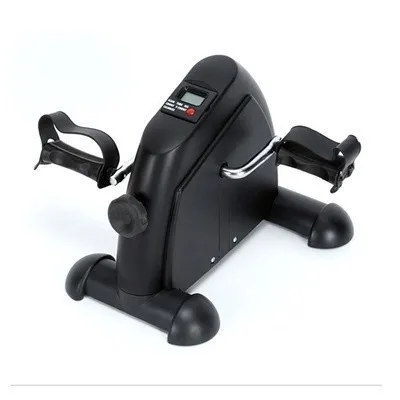
![[SG SELLER LOCAL STOCK]Adjustable Pedal Exerciser Bike Fitness Bike Upper And Lower Limb Rehabilitation Bicycle](https://img.lazcdn.com/g/p/032f3bcbf8694ac4b934140c490ebdc5.jpg_400x400q80.jpg_.webp)
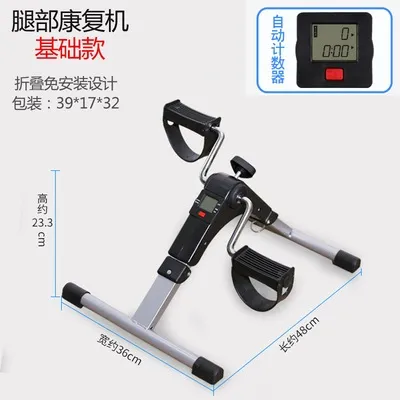
Prices are valid at publication and may change. Please refer to the product page for the latest price.
Traditional cardio machines have a massive physical presence. A standard treadmill or stationary bike not only occupies a large permanent footprint but also disrupts the visual flow of a room and blocks natural light. For many residents, dedicating a permanent corner of the living room to a heavy machine is simply not a practical option.
Pedal exercisers solve this spatial dilemma by offering a highly portable, seated workout alternative. These devices allow you to convert any existing chair, sofa, or office seat into a temporary workout station. Because they lack tall frames and handlebars, they maintain a low visual profile and do not dominate the room’s decor.
Integrating fitness into a compact home is about balancing health goals with daily functionality. A piece of equipment that is easy to set up and quick to put away ensures that your living space remains comfortable, clean, and adaptable to social gatherings or daily household chores.
Essential Space Measurements to Take Before Buying
Before purchasing a pedal exerciser, you must measure the physical boundaries of your intended workout area. Start by measuring the floor footprint where the device will sit during use. If you plan to pedal while sitting on your living room sofa, ensure there is enough clear floor space in front of the couch so you do not trip when standing up or walking past.

Calculating pedal clearance is the most critical step if you plan to use the device under a desk or table. Standard HDB study desks and dining tables typically have a clearance height of 70 to 75 centimeters. To avoid painful knee strikes, you must calculate the maximum height of your knees at the top of the pedal rotation. Take the maximum pedal height specified by the manufacturer, add the length of your lower leg, and compare this total to the clearance height of your desk.
Storage dimensions are equally vital for maintaining an organized home. Measure the height, width, and depth of your intended storage spots, such as the gap under your bed frame, the bottom shelf of a wardrobe, or a utility closet. Many bed frames have a clearance of 15 to 25 centimeters, which may require a particularly low-profile or folding exerciser to slide underneath smoothly.
Weight and portability must also be factored into your measurements. While a heavier unit provides better stability, it is harder to move around. If you plan to transfer the device between your bedroom study and the living room TV area daily, verify that you can comfortably lift and carry the unit’s weight using its built-in handle.
Key Space-Saving Features for Compact Pedal Exercisers
When comparing different models, look for specific design elements that maximize space efficiency. Folding and collapsible frames are highly advantageous for small flats. These models feature legs that fold inward, significantly reducing the storage height and width. Before buying, check the durability of the locking hinges and pull-pins to ensure they lock securely during operation.
Low-profile bases are essential for under-desk use. Some specialized models are engineered with an elliptical or low-arc pedal path rather than a traditional circular motion. This design keeps your feet closer to the floor throughout the entire rotation, allowing you to pedal comfortably under lower tables without hitting your knees against the underside of the desk drawer.
Detachable components can make storage much easier in tight spaces. Some brands design their units with quick-release pedals, removable foot straps, or detachable digital consoles. Being able to easily slide off these protruding parts allows you to pack the main body of the exerciser flat against a closet wall or stack it neatly on a narrow shelf.
Noise and vibration control are critical considerations for high-density HDB living, where sound travels easily through concrete floors. Magnetic resistance systems are virtually silent, making them ideal for early morning or late-night workouts. Additionally, look for units with wide, non-slip rubber feet to absorb vibrations and prevent the device from scraping against your flooring.
How to Evaluate Brands for Compact Living and Reliability
Evaluating a brand requires looking closely at how well they balance physical size with functional features. A high footprint-to-feature ratio is the hallmark of a well-designed compact exerciser. High-quality brands focus on maximizing the internal flywheel weight and resistance levels while keeping the external plastic casing as slim and streamlined as possible.
Build quality and stability must never be sacrificed for a smaller size. Lightweight, cheap models often suffer from a narrow base, which can cause the unit to rock, tilt, or slide forward when you pedal quickly. Look for brands that utilize heavy-duty steel frames and wide stabilizer bars to keep the device firmly planted on the ground during use.
Warranty coverage and local customer support are crucial indicators of brand reliability. In Singapore, look for brands distributed by reputable local fitness retailers or official online brand stores that offer at least a 6-month to 1-year local warranty. This ensures you can easily source replacement parts, such as worn-out pedal straps or replacement tension cables, without paying high international shipping fees.
Understanding the difference between resistance mechanisms will help you choose the right model. Magnetic resistance systems are heavier and more expensive, often ranging from S$120 to S$250, but they offer smooth, silent operation and require virtually no maintenance. Friction-based systems, which use felt pads or tension straps, are lighter and cheaper (often under S$80) but generate more noise, wear out faster, and can produce fine dust over time.
Common Sizing and Placement Mistakes to Avoid
One of the most common mistakes is failing to account for the difference between the “stored” footprint and the “in-use” footprint. While the physical device might only be 40 centimeters long, your legs will extend significantly forward as you pedal. Always ensure you have at least 80 to 100 centimeters of clear linear space in front of your seat to allow for natural leg extension.
Neglecting floor protection can lead to permanent damage to your home. The friction and vibration from active pedaling can easily scratch smooth ceramic tiles, homogeneous flooring, or delicate vinyl and parquet planks. Sweat can also drip onto the floor, causing staining or slippage. Always place a dedicated high-density rubber equipment mat or a non-slip rubber runner underneath the device.
Blocking active walkways and emergency exits is a serious safety hazard in compact bedrooms and living areas. Avoid placing the exerciser in narrow corridors, directly in front of bedroom doors, or in the path of balcony sliding doors. A heavy metal device left in a dark walkway can easily cause painful trips and falls, especially at night.
Never assume a standard pedal exerciser will automatically fit under your specific desk. Many people purchase a unit only to find that their desk has a low-hanging keyboard tray, a bottom drawer, or structural crossbeams that severely restrict leg movement. Always measure the lowest point of your desk’s underside before making a final decision.
Frequently Asked Questions (FAQ)
Can I use a pedal exerciser on a bed or sofa in a small bedroom?
Using a pedal exerciser on a soft, uneven surface like a mattress or sofa cushion is not recommended. Soft surfaces compromise the stability of the device, causing it to rock or tilt, which can lead to joint strain or tipping. Furthermore, soft fabrics can block the ventilation vents on magnetic models, leading to internal overheating. For your safety, always operate the device on a flat, solid floor with a non-slip mat.
Do folding pedal exercisers compromise workout stability?
Folding designs do not inherently compromise stability, provided they are engineered with high-quality locking pins and robust frame materials. However, lightweight folding models are generally intended for low-intensity active sitting rather than fast, high-resistance cardio. Always verify the manufacturer’s maximum user weight capacity, inspect the locking mechanisms before starting, and ensure all hinges are fully engaged.
How do I prevent the pedal exerciser from sliding on smooth HDB tiles?
Smooth HDB ceramic, homogeneous, or vinyl tiles offer very little natural grip. To prevent the unit from sliding forward, place a high-density rubber fitness mat or a non-slip yoga mat underneath it. Ensure the rubber feet of the device are clean and free of dust. Alternatively, you can position the front stabilizer bar flush against a heavy wall or the legs of your sofa, or use an anchor strap to connect the exerciser directly to your chair.
Community discussion
Share your experience or ask a question. Comments are reviewed before publication.