
Finding the right prescription swimming goggles for myopia in Singapore requires balancing optical accuracy, underwater physics, and a secure, watertight fit. For swimmers who rely on corrective lenses on land, navigating the pool or open water without clear vision can be both frustrating and unsafe. Standard swimming goggles protect your eyes from chlorine and saltwater, but they do not correct refractive errors. Fortunately, a wide range of prescription swim goggles is available to help you see clearly underwater. Choosing the correct pair involves understanding how water affects your prescription, evaluating key design features, and selecting the right construction type for your swimming habits.
Because light behaves differently in water than in air, your land-based eyeglass prescription cannot simply be copied directly to your swim goggles without adjustment. By learning how to calculate your underwater diopter, identifying high-quality lens materials, and knowing what to look for when trying on different frames, you can ensure a comfortable and crystal-clear swimming experience.
How to Determine Your Correct Lens Power
To find the correct lens power for your swimming goggles, you must first understand how water refraction alters your vision. When you are submerged, the interface between the water, the goggle lens, and the air pocket inside the goggles changes how light bends before it reaches your eyes. Because water has a refractive index very close to that of the human cornea, light does not bend as sharply when entering a flat goggle lens from water as it does from air. This physical difference creates a natural magnifying effect, making objects underwater appear roughly 33% larger and 25% closer than they actually are.
Products mentioned in this guide
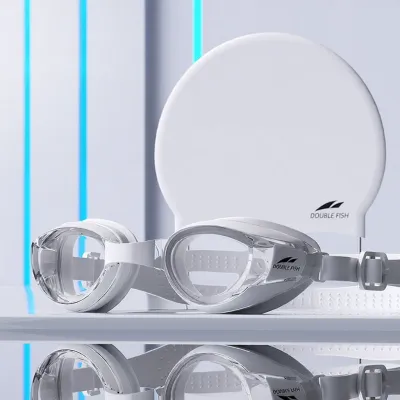
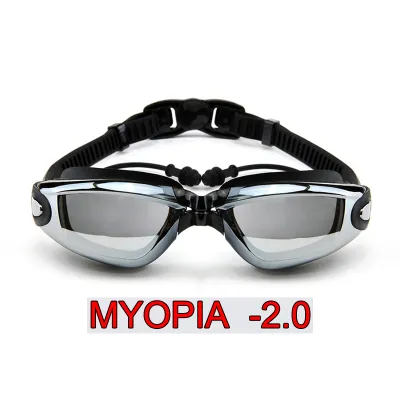
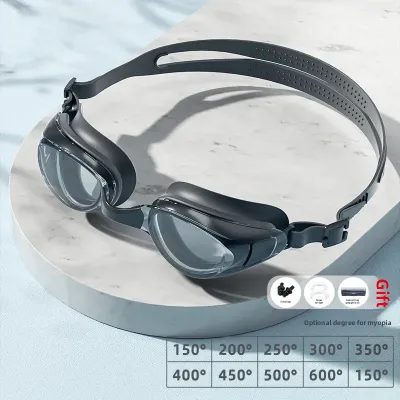
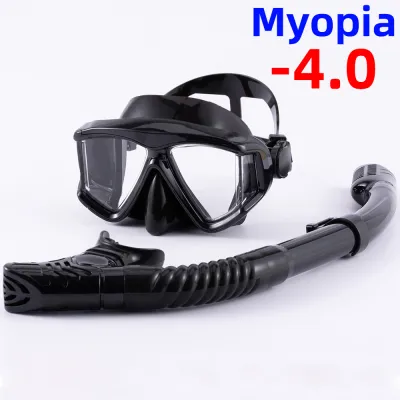
Prices are valid at publication and may change. Please refer to the product page for the latest price.
To compensate for this natural magnification, swimmers with myopia (nearsightedness) generally require a slightly lower diopter strength in their swimming goggles than in their daily eyeglasses. If you wear a mild prescription, this difference might feel negligible, but for moderate to high myopia, wearing your exact land prescription underwater can lead to eye strain, mild headaches, or distortion. A common practice is to reduce your spherical prescription slightly to account for this water refraction.
If your daily eyeglass prescription includes an astigmatism correction (measured as “cylinder” or “CYP” on your prescription sheet), you will need to calculate your spherical equivalent. Most off-the-shelf prescription swimming goggles only correct for spherical errors and do not feature astigmatism correction. To find your spherical equivalent, you take the cylinder value, divide it by two, and add that number to your sphere value.
For example, if your daily prescription is -4.00 Sphere and -1.00 Cylinder, you would divide the -1.00 Cylinder by two to get -0.50. Adding this to your -4.00 Sphere gives a spherical equivalent of -4.50. To adjust for water refraction, you would then typically round down to the nearest available diopter step, which would be -4.00 or -4.25 depending on the manufacturer’s options.
While these calculations serve as an excellent starting point for choosing pre-molded or modular goggles, they are not a substitute for professional advice. If you have a complex prescription, high astigmatism (typically a cylinder value greater than -1.50), or different corrective needs for each eye, consulting an optometrist or eye care professional in Singapore is highly recommended. A qualified professional can perform a precise conversion and recommend whether you can use standard spherical lenses or if you require custom-ground optical lenses for safe swimming.
Essential Features to Evaluate for Clear Vision
When shopping for prescription swim goggles, the optical quality of the lenses is only one part of the equation. The physical construction, materials, and protective coatings play an equally critical role in ensuring your vision remains unobstructed throughout your swim.

First, evaluate the lens material. High-quality prescription goggles almost exclusively use polycarbonate lenses. Polycarbonate is highly impact-resistant, lightweight, and offers inherent protection against ultraviolet (UV) rays. This UV protection is particularly important in Singapore, where high UV index levels are common year-round, especially during outdoor sessions in public pools or open-water environments. Always verify the manufacturer’s specifications to ensure the lenses block both UVA and UVB rays.
Anti-fog protection is another essential feature to verify. The temperature difference between your warm face and the cooler pool water causes moisture to condense on the inside of the lenses, quickly obscuring your view. Quality goggles feature an internal hydrophilic coating that prevents water droplets from forming. However, these coatings are delicate and temporary. When evaluating goggles, check if the manufacturer uses long-lasting factory-applied anti-fog coatings, and be prepared to supplement them with compatible anti-fog sprays or drops once the original layer begins to wear off over time.
The gasket and strap design directly determine how comfortable the goggles will be during extended swim sessions and how effectively they will prevent leaks. Gaskets are typically made from silicone, liquid silicone, or thermoplastic rubber (TPR). Liquid silicone gaskets are highly favored for prescription goggles because they are incredibly soft, hypoallergenic, and conform easily to various facial structures, creating a reliable seal without requiring excessive strap tension. A poor seal not only lets water in but can also misalign the optical center of the lenses relative to your pupils, causing visual distortion.
Finally, consider the field of view and the shape of the lenses. Flat lenses provide the most accurate optical clarity directly in front of you because they do not introduce lateral distortion. However, they limit your peripheral vision. Curved lenses offer a much wider field of view, which is highly beneficial for open-water swimmers who need to sight landmarks or avoid other swimmers. The trade-off is that curved prescription lenses can sometimes create a slight “bending” effect at the outer edges of your vision. Testing different lens shapes can help you find the right balance between peripheral awareness and central clarity.
Comparing Types of Prescription Swim Goggles
Prescription swim goggles are not a one-size-fits-all product; they are manufactured in several distinct structural designs to accommodate different budgets, prescription complexities, and swimming frequencies. Understanding these types will help you narrow down your choices.
Pre-molded prescription goggles, also known as optical swim goggles, are the most common and cost-effective option. These goggles come pre-assembled with lenses of a fixed diopter power, usually ranging from -1.50 to -8.00 in 0.50-diopter steps. They are ideal for swimmers who have identical or very similar prescriptions in both eyes and do not require astigmatism correction. Because they are mass-produced, they are highly affordable and readily available at most sporting goods stores.
Modular prescription goggles offer a step up in customization without the high cost of fully custom lenses. These systems consist of individual parts sold separately: a goggle frame kit (which includes the straps, nose bridges, and side clips) and individual prescription lenses. This design allows you to select a -3.00 lens for your left eye and a -5.00 lens for your right eye, making them an excellent choice for swimmers with anisometropia. If your prescription changes in only one eye over time, you only need to replace that single lens rather than buying an entirely new set of goggles.
Custom-fitted prescription goggles are the premium choice for swimmers with complex visual needs. These are crafted by specialized optical laboratories or select sports eyewear brands. The lenses are ground to your exact prescription, fully correcting for high astigmatism, prism requirements, and precise pupillary distance. While they represent a higher financial investment and require a longer lead time to manufacture, they provide unmatched visual clarity and comfort, making them highly suitable for competitive swimmers or those who spend hours in the water every week.
Where to Buy and What to Verify Before Purchasing
In Singapore, prescription swimming goggles can be purchased through specialized optical shops, major sports retailers, and reputable online marketplaces. Each channel offers distinct advantages depending on your specific needs and how confident you are in your prescription calculations.
Visiting a physical optical shop or a dedicated sports eyewear retailer allows you to consult directly with staff who can assist with diopter calculations and frame fitting. Trying on goggles in person is highly advantageous because facial anatomy varies widely. A frame that fits one swimmer perfectly might leak on another due to differences in nose bridge width, eye socket depth, or cheekbone structure. Many physical retailers will let you perform a dry fit test: press the goggles gently against your eye sockets without using the strap. If the goggles create a brief suction hold and stay in place for a second or two, the frame shape is compatible with your face.
If you choose to purchase modular or pre-molded goggles from online marketplaces or specialized e-commerce platforms, careful verification is essential before finalizing your order. First, check the retailer’s return and exchange policies. Because prescription goggles are personal hygiene items and optical products, some sellers do not accept returns once the packaging has been opened, while others may offer exchanges if the diopter strength is incorrect. Ensure you understand these terms, especially when ordering custom or modular components.
Additionally, verify the authenticity of the product and the manufacturer’s warranty. Reputable brands provide clear documentation regarding their lens materials, UV protection standards, and anti-fog care instructions. Avoid purchasing unbranded or extremely cheap optical goggles from unverified online sellers, as low-quality lenses can suffer from optical distortion, poor impact resistance, and inadequate UV protection, which can cause eye strain or long-term damage under the bright Singapore sun.
Frequently Asked Questions (FAQ)
Can I wear contact lenses under regular swimming goggles instead?
Wearing contact lenses under standard, non-prescription swimming goggles is highly discouraged by optometrists and eye care professionals due to significant safety risks. When swimming, water can easily seep into your goggles. If pool water or natural open water comes into contact with your lenses, it can trap harmful waterborne microorganisms, such as Acanthamoeba, against your cornea. This can lead to severe, rapid-onset corneal infections, painful inflammation, and in extreme cases, permanent vision loss.
Furthermore, contact lenses can easily swell, shrink, or become completely displaced from your eye when exposed to water, leaving you disoriented in the middle of your swim. Standard manufacturer guidelines for contact lenses explicitly advise against wearing them during water sports. Investing in a dedicated pair of prescription swimming goggles is a much safer, more hygienic, and more reliable solution for maintaining clear vision in the water.
How should I clean and store prescription swim goggles?
To preserve the optical clarity, anti-fog coatings, and silicone seals of your prescription swim goggles, proper maintenance is essential. After every swim, immediately rinse your goggles under cool, clean tap water to remove chlorine, salt, sand, and organic residues. Do not use hot water, dish soap, glass cleaners, or harsh chemicals, as these can rapidly degrade the delicate anti-fog coating on the inside of the lenses and dry out the silicone gaskets.
After rinsing, allow your goggles to air dry completely in a shaded, well-ventilated indoor area. Never wipe or rub the inside of the lenses with a towel, cloth, or your fingers, as this will scratch the anti-fog layer and leave smudges that impair visibility. Once dry, store your goggles in a hard protective case to prevent accidental scratches from other gear in your swim bag. Keep them away from direct sunlight, high heat, and humid environments—such as a closed car trunk—as extreme heat can warp the plastic frames and damage the silicone seals.

Community discussion
Share your experience or ask a question. Comments are reviewed before publication.