
Selecting your first tennis racket is a pivotal decision that directly shapes your early development, swing mechanics, and physical comfort on the court. While Wilson is one of the most prominent names in the sport, the brand offers a vast catalog of rackets tailored to highly diverse player profiles. For beginners, the ideal choice is not a single universal model, but rather a racket that aligns with your physical strength, athletic background, and playing goals. Generally, the Wilson Clash and Wilson Ultra series stand out as the most accessible entry points, offering a balanced combination of arm-friendly flexibility, power, and forgiving sweet spots.
To make an informed investment, you must look past professional player endorsements and focus on the technical specifications that match your current skill level. A racket that is too heavy or control-oriented can hinder your learning curve and increase the risk of injury, while a well-matched frame will help you build clean stroke habits. This guide breaks down how to navigate Wilson’s key beginner-friendly series and evaluate the core specifications that will set you up for success on the court.
Quick Guide: Match Your Beginner Profile to the Right Wilson Series
Before diving into the technical details of frame geometry and string patterns, it is helpful to map your personal physical profile and playing goals directly to Wilson’s primary racket families. Every player enters the sport with different physical attributes, upper-body strength, and athletic backgrounds, meaning a racket that feels perfect for one beginner might feel cumbersome or uncontrollable for another.
Products mentioned in this guide
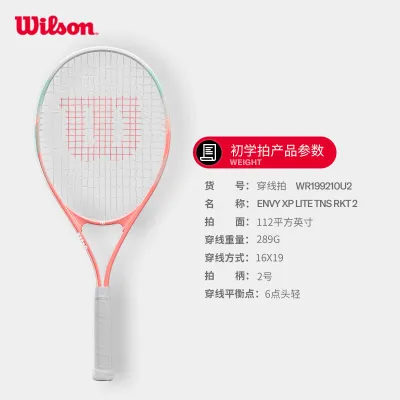
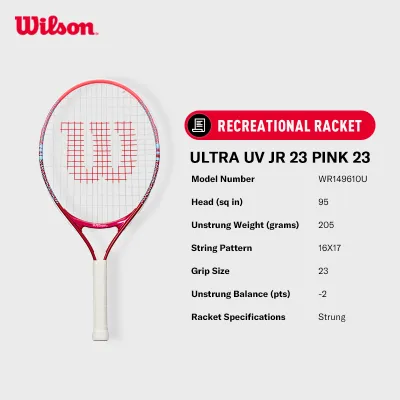
Prices are valid at publication and may change. Please refer to the product page for the latest price.
The following profiles highlight how different Wilson series cater to specific player needs:
- The Comfort-Focused or Injury-Conscious Player: If you prioritize arm comfort, have a history of joint sensitivity, or are an older adult starting the game, the Wilson Clash series is the premier choice. It is designed to flex dynamically during impact, absorbing shock before it reaches your elbow and shoulder.
- The Power-Seeking Beginner: If you have a shorter, slower swing and need help getting the ball deep into the opponent's court, the Wilson Ultra series is highly suitable. Its stiffer frame construction provides effortless power and a highly forgiving hitting area.
- The Lightweight Speed Seeker: For younger players, juniors transitioning to adult frames, or individuals with less upper-body strength, the Wilson Burn series offers a lightweight, highly maneuverable platform that makes it easy to generate swing speed.
- The Athletic Beginner with Racket Sports Experience: If you have played badminton, squash, or table tennis competitively and already possess strong hand-eye coordination, you may benefit from lighter versions of the Wilson Blade or Wilson Shift series. These provide a pathway to greater control and spin as your game quickly evolves.
Ultimately, selecting the right racket requires balancing these series characteristics with your physical comfort. The following sections will detail the exact specifications you need to verify before making your final selection.
Core Specs: How to Choose the Right Wilson Racket for Your Skill Level
Understanding racket specifications allows you to evaluate any frame objectively, ensuring you select a model that supports your learning process rather than working against your body.

Head Size and Sweet Spot
The head size of a tennis racket, measured in square inches, directly dictates the size of the sweet spot—the central area of the string bed that provides the most efficient energy transfer and minimal vibration. For beginners, a larger head size is highly recommended because it provides a greater margin of error for off-center hits. Wilson rackets generally fall into three head-size categories: mid-size (under 97 square inches), mid-plus (98 to 102 square inches), and oversize (103 square inches and above).
As a beginner, you should target a head size of at least 100 square inches, with 103 to 105 square inches being highly suitable for those who want maximum forgiveness. A larger string bed creates a trampoline effect that naturally generates more depth on your shots, allowing you to focus on developing proper stroke mechanics rather than struggling to clear the net. Always check the manufacturer specifications printed on the inside of the racket throat to verify the exact head size before purchasing.
Racket Weight and Maneuverability
Racket weight is a critical factor that balances swing speed with stability. Beginners often make the mistake of choosing a racket that is either too heavy, leading to rapid muscle fatigue and poor technique, or too light, which can transmit excessive shock to the arm when facing fast-moving balls.
When evaluating weight, it is vital to distinguish between unstrung weight (the weight of the frame alone) and strung weight (which includes strings, grip, and overgrip, adding roughly 15 to 20 grams).
- Lightweight Frames (255g to 275g unstrung): Highly maneuverable and easy to swing, making them excellent for players building baseline strength, but they can twist on heavy impacts.
- Midweight Frames (280g to 295g unstrung): The sweet spot for most healthy adult beginners, offering a stable blend of control, power, and maneuverability without causing premature fatigue.
- Heavy Frames (300g and above unstrung): Typically reserved for advanced players who possess the developed technique and physical conditioning required to swing a heavy frame consistently.
Verify the unstrung weight on the product label and aim for a range that allows you to swing comfortably for a full session without straining your shoulder or wrist.
Grip Size and Ergonomics
Using the incorrect grip size is one of the leading causes of tennis elbow and wrist strain. A grip that is too small forces your hand to squeeze the handle excessively tight to prevent the racket from twisting, while a grip that is too large limits your wrist snap and overall maneuverability.
Tennis grip sizes range from US size 1 to 4 (or European size 4 1/8 to 4 1/2 inches). Grip 1 is generally suitable for juniors and players with smaller hands, Grip 2 is the most common size for adult female players and male players with average-sized hands, and Grip 3 is standard for male players with larger hands.
To perform the standard finger test, hold the racket in your dominant hand using an Eastern grip. Slide the index finger of your opposite hand into the gap between your ring finger and your palm. If there is not enough room for your index finger, the grip is too small. If there is significant space left over, the grip is too large. If you are between sizes, always choose the smaller size; you can easily increase the grip size using an overgrip, but reducing a built-in grip is highly difficult.
Balance and Swingweight
A racket’s balance point refers to how its weight is distributed between the head (top of the frame) and the butt cap (bottom of the handle). This distribution is measured in millimeters from the butt cap or in points head-light (HL) or head-heavy (HH).
- Head-Light (HL): Most of the weight is concentrated in the handle. This setup makes the racket feel nimble, allowing for quick reactions at the net and easier swing acceleration. It is highly beneficial for beginners learning proper stroke paths.
- Head-Heavy (HH): More weight is placed in the hoop of the racket. This configuration helps generate significant momentum and power from the baseline, which can assist players with slower swings. However, it can place additional leverage stress on the wrist.
- Even Balance (EB): An equal distribution that offers a compromise between power and maneuverability.
For most beginners, an evenly balanced or slightly head-light racket (1 to 4 points HL) is recommended. This balance profile encourages the development of a complete, fluid swing path without forcing your wrist to compensate for an overly heavy hoop.
Top Wilson Racket Series for Beginners: Features, Fits, and Limitations
Wilson organizes its performance rackets into distinct families, each designed around a specific performance characteristic. Understanding the design philosophy behind these series will help you narrow down your choices.
Wilson Clash Series (Focus on Comfort and Flexibility)
The Wilson Clash series represents a significant shift in modern racket design, prioritizing flexibility without sacrificing stability. Traditionally, highly flexible rackets lacked stability and power, but the Clash utilizes unique frame geometry and carbon-mapping technologies to flex dynamically during both vertical and horizontal swing paths.
This series is highly suited for beginners who prioritize joint safety, older players, or anyone recovering from arm discomfort. By absorbing a substantial portion of the impact shock, the Clash allows you to practice for longer periods without experiencing muscle soreness or joint fatigue.
However, the Clash does have limitations. Because the frame is highly flexible, some players find that it lacks the crisp, direct feedback of stiffer rackets. The ball can feel like it sits on the strings for a long time, which some beginners find slightly unpredictable when trying to gauge depth. If you choose this series, models like the Clash 100 V2 or the lighter Clash 100L V2 are the most appropriate starting points.
Wilson Ultra Series (Focus on Power and Forgiveness)
The Wilson Ultra is engineered to deliver effortless power and high stability, making it a popular choice for baseline players who want to hit deep, penetrating shots with minimal physical strain. The frame features a stiffer construction and a thicker beam, which minimizes frame twisting on impact and maximizes energy return to the ball.
For beginners who struggle to generate depth or who have shorter, more compact swings, the Ultra provides an immediate performance boost. The sweet spot is generous, and the frame remains exceptionally stable even when you contact the ball slightly off-center.
The primary limitation of the Ultra series is its stiffness. If paired with stiff polyester strings or strung at an excessively high tension, the frame can transmit noticeable vibrations to the wrist and elbow, especially on mishits. Additionally, the power can be difficult to control if you have a naturally fast, long swing. Beginners looking at this line should focus on the Ultra 100L V4 or the oversize Ultra 108 V4 to balance power with maneuverability.
Wilson Burn Series (Focus on Lightweight Speed)
The Wilson Burn series is designed primarily for baseline players who rely on speed, maneuverability, and spin to control the point. Constructed with high-performance carbon fiber, these rackets feature a relatively stiff frame that offers a crisp feel and excellent energy transfer.
This series is highly suitable for younger beginners, teenagers transitioning to adult frames, or players who do not have the upper-body strength to swing a heavier racket comfortably. The lightweight design allows you to generate high head speed, which is crucial for learning how to brush up on the ball to create topspin.
The trade-off with the Burn series is its lack of mass. When playing against intermediate or advanced opponents who hit heavy, fast-paced balls, a lighter frame like the Burn 100LS can twist or feel unstable on impact. This can lead to a loss of control and increased shock transmission to the hand. It is an excellent developmental tool, but players may find they outgrow it as they transition to facing harder-hitting opponents.
Wilson Shift or Blade (Considerations for Athletic Beginners)
The Wilson Blade and Wilson Shift series are globally recognized as control- and spin-oriented frames, typically favored by intermediate, advanced, and professional players who swing fast and hit with high precision. The Blade features a thin beam and a flexible, control-first profile, while the Shift is designed with lateral flexibility to maximize spin.
For the vast majority of complete beginners, standard versions of these rackets are not recommended. They feature smaller sweet spots and require precise, consistent technique to generate depth. A beginner using a standard Blade 98 will likely struggle with short balls and arm fatigue.
However, if you are a highly athletic beginner—such as someone with a strong background in competitive badminton or squash—you may possess the coordination and swing speed to handle a lighter variant. Models like the Blade 100L V9 or the Shift 99L V1 offer a lighter weight profile while retaining the control-oriented characteristics of their parent lines. This provides a solid platform for athletic players who plan to practice intensively and want a racket that they will not outgrow quickly. Always verify the specifications and, if possible, test these frames on-court before committing.
Pre-Purchase Checklist: Strings, Sizing, and Buying Safely in Singapore
Once you have selected a racket frame, several practical steps remain to ensure your equipment is set up correctly for your playing environment and that you are purchasing a genuine product.
String Tension and Type The strings are the only part of the racket that makes contact with the ball, making them just as important as the frame itself. Beginners should generally avoid stiff co-polyester strings, which are designed for advanced players seeking durability and spin control. Instead, opt for multifilament strings or high-quality synthetic gut. These materials offer superior comfort, shock absorption, and easy power.
- Tension Recommendations: For beginners, a lower string tension between 50 and 53 pounds is ideal. Lower tension increases the trampoline effect, providing more depth and comfort.
- Environmental Factors: Singapore's tropical climate, characterized by high heat and humidity, accelerates tension loss in tennis strings. If you play frequently on outdoor courts, store your racket in a thermal-lined bag to protect it from extreme temperature fluctuations, and inspect your strings regularly for fraying or excessive movement.
Authenticity and Retailers Due to the global popularity of Wilson rackets, counterfeit frames are common on unverified online marketplaces and peer-to-peer selling platforms. Counterfeit rackets are often constructed with cheap materials that lack structural integrity, leading to poor playability and a high risk of cracking.
- To guarantee authenticity, purchase your racket from authorized sports retailers, official brand stores, or reputable tennis pro shops located at major Singapore tennis centers, such as the Kallang Tennis Centre or Queensway Shopping Centre.
- Buying from authorized sources also ensures you receive a valid manufacturer warranty, which can protect you against structural defects in the frame.
Demo and Testing Equipment specifications on paper can only tell you so much; the ultimate test is how the racket feels in your hand during an active rally.
- Before buying, check if your local tennis club, coach, or pro shop offers a demo program.
- When testing a demo racket, pay close attention to whether your wrist feels strained after twenty minutes of hitting, whether you can consistently clear the net without swinging aggressively, and how comfortable the grip feels during off-center hits. If a racket feels heavy or awkward during a brief trial, it will likely cause discomfort during a full match.
Frequently Asked Questions (FAQ)
Is a Wilson tennis racket good for a complete beginner?
Yes, Wilson is an excellent brand for complete beginners, provided you select a model from their beginner-friendly lines. The brand designs high-quality frames across all skill levels, meaning their entry-level and transitional rackets benefit from the same research and engineering as their professional lines. Beginners should focus on the Clash or Ultra series, which offer the forgiveness, comfort, and power needed to learn the game, while avoiding heavier, control-oriented models like the standard Pro Staff or Blade series.
How often should a beginner restring their Wilson racket?
As a general rule of thumb, you should restring your racket as many times per year as you play per week. For example, if you play twice a week, you should aim to restring your racket at least twice a year. However, even if you play less frequently, strings naturally lose their elasticity and tension over time due to exposure to air and humidity—especially in Singapore’s warm climate. If you notice your shots flying uncontrollably or feel increased vibration in your arm, it is likely time to restring, even if the strings have not broken.
Should a beginner buy a pre-strung or unstrung Wilson racket?
For absolute beginners, a pre-strung Wilson racket is highly recommended. Pre-strung models are cost-effective, ready to use immediately, and typically come strung with a versatile synthetic gut or multifilament string at a moderate, beginner-friendly tension. This allows you to focus on learning basic strokes without the added expense and complexity of selecting custom strings. As your game progresses, your swing speed increases, and you develop specific preferences for spin, control, or comfort, you can transition to purchasing unstrung frames and customizing your string setups.
Community discussion
Share your experience or ask a question. Comments are reviewed before publication.