
Quick Answer: Which Fan Zhendong Blade Should You Choose?
Selecting the right blade from the Butterfly Fan Zhendong signature series depends heavily on your technical proficiency, your preferred distance from the table, and how you generate spin. If you have been searching for a “Fan Zhendong FLC” blade, it is important to clarify that Butterfly does not manufacture an “FLC” model. This term is a common online search typo or a misunderstanding of the ZLC (Zylon Carbon) version.
To make a swift, reliable decision, you can evaluate your game against this conditional framework:
- Choose the Fan Zhendong ALC if you are a developing or advanced all-round attacker who prioritizes high ball safety, excellent dwell time, and maximum spin generation. It is the most forgiving blade in the lineup.
- Choose the Fan Zhendong Super ALC (SALC) if you are an experienced player with compact, highly explosive stroke mechanics who plays close to the table and demands flat-hitting speed and immediate counter-looping response.
- Choose the Fan Zhendong ZLC if you play a mid-distance looping game and want a highly elastic blade with a massive sweet spot that maintains deep, powerful trajectories with less physical effort.
The following detailed comparison of the actual ALC, SALC, and ZLC models will help you analyze their technical properties and select the perfect match for your playing style.
Products mentioned in this guide
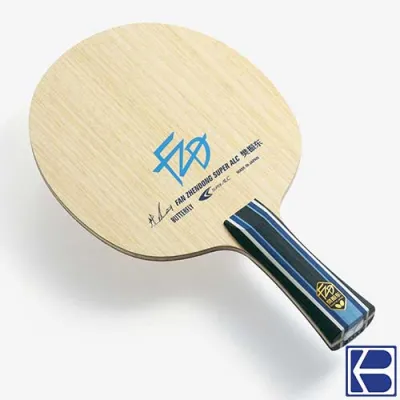
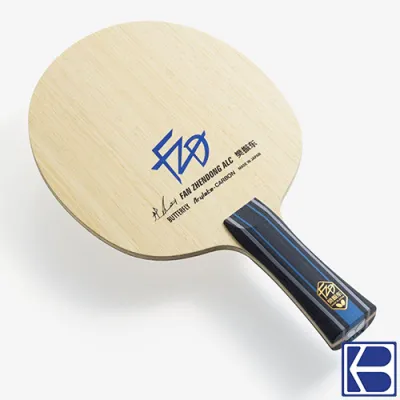
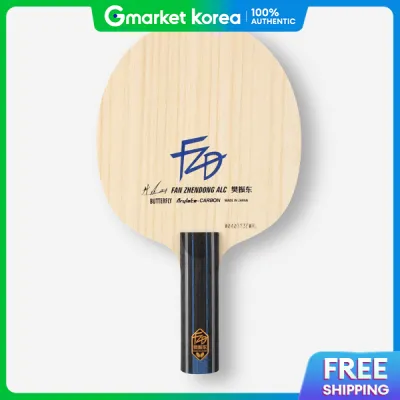
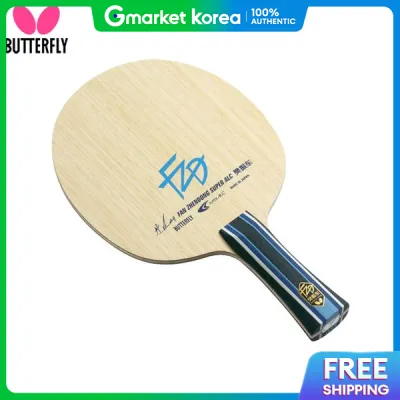
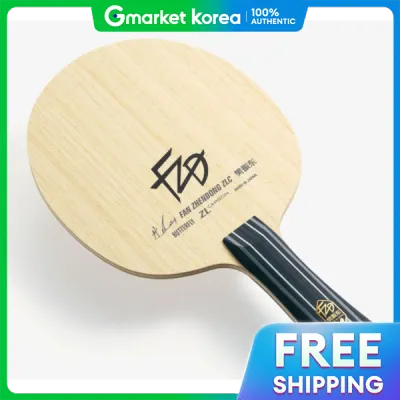
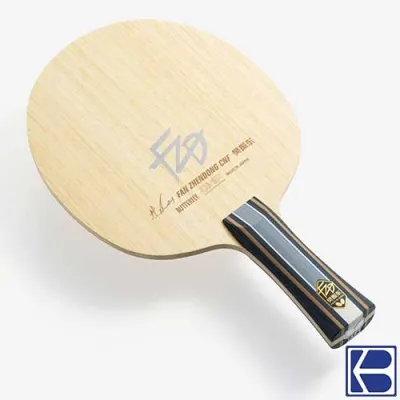
Prices are valid at publication and may change. Please refer to the product page for the latest price.
Clarifying the Lineup: ALC, SALC, ZLC, and the "FLC" Misconception
Designed to support the high-tempo, double-winged offensive play style of its namesake, the Butterfly Fan Zhendong series is built around an outer-fiber construction. In this design, the composite carbon layers are positioned directly beneath the outer wood plies, rather than next to the central core. This structural choice ensures a crisp, direct contact feel and high speed. Every blade in this carbon lineup utilizes a high-quality Koto outer ply, meaning the core differences in performance, elasticity, and vibration are determined by the specific composite fibers woven into the wood.

To choose the right blade, you must understand the three distinct composite materials used in the official series:
- Arylate-Carbon (ALC): A classic weave of blue Arylate fiber and carbon. Arylate dampens harsh vibrations and adds flexibility, while carbon provides speed and structural stability.
- Super Arylate-Carbon (SALC): A denser, more tightly woven version of Arylate-Carbon. By packing more fiber into the weave, it increases the rebound speed of the blade while retaining a highly dampened vibration profile.
- Zylon-Carbon (ZLC): A composite that weaves high-tensile Zylon fiber with carbon. Zylon is incredibly strong and highly elastic, producing a very springy, dynamic rebound and a wider sweet spot.
The frequent search for a “Fan Zhendong FLC” typically stems from two main sources. First, players often confuse the “FL” (Flared) handle designation with the fiber composition, blending “FL” and “Carbon” into “FLC.” Second, some players confuse Butterfly’s naming conventions with other brands that use terms like “Fiber Light Carbon” or “Fiber Long Carbon.” Because no official “FLC” model exists in the Fan Zhendong lineup, you should focus your comparison on the ALC, SALC, and ZLC models to find the right performance characteristics for your game.
Head-to-Head Comparison: ALC vs SALC vs ZLC
While all three blades share the same outer Koto wood plies and a 5-ply wood plus 2-ply composite structure, their playing characteristics differ significantly due to the physical properties of their respective carbon weaves.
Speed, Power, and Sweet Spot
Raw speed and power delivery vary across these three blades, altering how much physical effort you must exert to hit a winning shot.
The Fan Zhendong Super ALC (SALC) offers the highest direct speed when playing close to the table. The dense Super Arylate-Carbon weave minimizes energy loss during impact, resulting in a highly rigid surface. When you block or drive against an opponent’s heavy loop, the ball rebounds almost instantly. This makes the SALC exceptionally powerful for flat hits, active blocks, and quick off-the-bounce counter-attacks.
The Fan Zhendong ZLC provides a different dimension of power, characterized by high elasticity rather than rigid stiffness. The Zylon fibers stretch and snap back dynamically on hard impact. This creates a highly efficient catapult effect, making the ZLC the most powerful of the three blades when playing from mid-to-far distance. Furthermore, the high tensile strength of Zylon expands the blade’s sweet spot across a wider area of the racket face. Off-center hits with the ZLC retain a high percentage of their speed and depth, offering excellent recovery when you are forced out of position.
The Fan Zhendong ALC is the most moderate and linear blade in terms of speed. It does not possess the explosive, rigid rebound of the SALC, nor does it have the springy catapult effect of the ZLC. Instead, the ALC’s speed is highly predictable and directly proportional to the physical acceleration of your stroke. This linear power delivery makes it easier to control placement and depth, though it requires more physical effort from the player to hit outright winners from mid-distance.
Control, Dwell Time, and Spin
Dwell time—the fraction of a second the ball remains in contact with the racket face—is the primary driver for generating heavy topspin and maintaining control over the ball’s trajectory.
The Fan Zhendong ALC is the undisputed leader in dwell time. The standard Arylate-Carbon weave allows the blade to flex slightly on impact, letting the ball sink deeper into the rubber and wood plies. This extended contact window makes it highly forgiving, allowing you to easily adjust the angle of your racket mid-stroke. When opening up against heavy backspin, the superior dwell time helps you “grab” the ball and lift it safely over the net with heavy, dipping topspin.
Conversely, the stiffness of the Fan Zhendong SALC results in a significantly shorter dwell time. The ball leaves the racket face rapidly, leaving very little margin for adjustment. To generate heavy spin with the SALC, you must possess highly refined, explosive stroke mechanics and a fast, compact wrist brush. Without this advanced technical ability, loops can easily slip off the rigid surface, resulting in a flatter, less secure trajectory that is prone to overshooting the table.
The Fan Zhendong ZLC occupies a unique middle ground. Its high elasticity grabs the ball well when you strike with high physical force, producing a long, high-arcing loop that carries deep into the opponent’s court. However, during low-impact shots like short pushes, serves, and drop shots, the ZLC’s natural bounciness can make it difficult to keep the ball short and low. It requires precise touch and a relaxed grip to prevent the ball from popping up passively.
Vibration, Feel, and Feedback
The tactile feedback transmitted to your hand on impact is crucial for shot correction and developing a consistent feeling for the ball.
The Fan Zhendong ALC offers the classic, crisp, and slightly dampened feel that has made Arylate-Carbon the benchmark for modern offensive play. The Arylate fibers absorb high-frequency, harsh vibrations, leaving a clean, clear sensation in your palm. This balanced feedback tells you exactly where you contacted the ball on the racket face without causing hand fatigue over long training sessions.
The Fan Zhendong SALC feels noticeably stiffer and more solid. Because the dense weave blocks a massive amount of vibration, the feedback can feel somewhat “numb” or rigid. This solid-impact sensation is highly favored by players who prefer a rigid platform for blocking and driving, as it eliminates any hollow or flexible sensations in the handle.
The Fan Zhendong ZLC transmits a distinct, high-pitched feedback, often described as a metallic “ping.” Because Zylon is highly elastic and tense, it vibrates at a higher frequency than Arylate. This sharp feedback provides highly precise spatial information about the contact point, but it can feel overly springy or hollow to players who are accustomed to the softer, dampened feel of traditional wood or ALC blades.
Matching the Blade to Your Playstyle and Skill Level
Choosing the right blade requires a realistic assessment of your technical proficiency, physical fitness, and tactical style.
Finding Your Perfect Match
- The Developing or All-Round Looper (ALC): If you are actively working on your stroke consistency, transitioning from an all-wood blade to carbon, or prefer a balanced game of spin and placement, the Fan Zhendong ALC is your best choice. Its forgiving nature absorbs minor timing errors, and its superior dwell time provides the safety margin needed to execute consistent forehand and backhand loops.
- The Aggressive Close-Table Attacker (SALC): If you play right on the baseline, rely on lightning-fast counter-loops, and prioritize direct, flat-hitting speed over high-arcing spin, the SALC is built for your game. You must have quick footwork and a short, explosive stroke to control this blade's rigid rebound.
- The Mid-Distance Power Player (ZLC): If you frequently step back from the table to engage in long counter-looping rallies and require maximum assistance from your equipment to maintain deep, fast trajectories, the ZLC is the ideal tool. It is highly suited for players who want to dominate with power and a wide, forgiving sweet spot.
Adapting to Singapore's Humid Climate
When playing in Singapore, environmental conditions play a significant role in equipment performance. In non-air-conditioned community centers, sports halls, or school training venues, high relative humidity can cause moisture to settle on the rubber surface. This moisture reduces the friction between the ball and the rubber, leading to slippage and a lower launch angle.
In these humid conditions, a blade with excellent dwell time, like the Fan Zhendong ALC, provides a crucial safety margin. The slight flex of the ALC helps mechanical grip, allowing you to lift the ball safely even when the rubber surface is compromised by moisture. Conversely, using a stiff blade like the SALC in high humidity requires extreme technical precision, as the combination of a short dwell time and slippery rubber can lead to frequent unforced errors.
Optimizing Performance with Strategic Rubber Pairings
To maximize the performance of your chosen Fan Zhendong blade, you must pair it with rubbers that complement its physical characteristics:
- With the SALC: It is highly recommended to pair this stiff blade with hard-sponge, high-tack hybrid rubbers (such as Butterfly Dignics 09C or classic Chinese sticky rubbers). The tacky top sheet grabs the ball to compensate for the blade's short natural dwell time, while the stiff SALC core provides the necessary speed behind the hard sponge.
- With the ALC: Highly elastic tension rubbers (such as Butterfly Tenergy 05 or Dignics 05) create an excellent synergy. The ALC blade provides the control, dwell, and safety, while the springy tension rubber adds the dynamic speed and high throw angle needed to finish points.
- With the ZLC: Moderate-hardness rubbers with a linear, predictable response are preferred. Avoid pairing the ZLC with highly springy, soft-sponge rubbers, as this combination can make the overall setup uncontrollably bouncy, particularly during delicate short-game exchanges and serve returns.
Frequently Asked Questions (FAQ)
Is the Fan Zhendong ALC the same as the Viscaria?
While the Fan Zhendong ALC and the classic Butterfly Viscaria share the same basic composition—5 plies of wood, 2 plies of Arylate-Carbon, and a Koto outer ply—they do not feel identical. The Fan Zhendong ALC features a slightly redesigned handle shape that is generally perceived as slightly thicker and more ergonomic, filling the palm more completely than the modern Viscaria handle. Additionally, many players report that the Fan Zhendong ALC has a slightly more solid and dampened feel on impact, offering a touch more stability in high-speed rallies, whereas the Viscaria can feel slightly more flexible.
Do I need to upgrade from ALC to SALC as my rating improves?
No, you do not need to upgrade to a faster or stiffer blade simply because your rating improves. In table tennis, equipment choice is about playstyle compatibility rather than a linear progression of quality. Many world-class professional players prefer standard ALC blades because the modern plastic ball requires immense spin and control to keep aggressive shots on the table. You should only switch to the SALC if you find that your stroke mechanics are fully developed, your footwork is highly consistent, and you specifically require a stiffer, lower-vibration blade for close-table driving.
What handle shapes are available for the Fan Zhendong series?
The Fan Zhendong series is widely available in Flared (FL) and Straight (ST) handle shapes, with Chinese Penhold (CS) options also available in select markets. The Flared handle is the most popular choice, as it flares out at the bottom to prevent the blade from slipping out of the hand during wide, high-velocity loops. The Straight handle is favored by players who prefer a consistent grip thickness throughout the hand and those who frequently micro-adjust their racket angle between forehand and backhand transitions.
Community discussion
Share your experience or ask a question. Comments are reviewed before publication.