
To fit a cardio machine from the onetwofit store into a Singapore HDB flat, the ideal choice depends on whether you prioritize vertical folding capability or low-impact, quiet operation. While treadmills offer excellent foldability that minimizes their static footprint when not in use, ellipticals provide a low-impact workout with a fixed footprint but require greater vertical clearance. Deciding between the two requires a careful evaluation of your flat’s layout, ceiling height, and floor space to ensure your home gym remains functional without cluttering your living area.
Assessing Your HDB Flat's Available Space
HDB flats require efficient space budgeting. When planning for home fitness equipment, you must distinguish between the static footprint—the physical dimensions of the machine when stored—and the dynamic clearance zone, which is the active space required while you are exercising. For safety, a treadmill requires at least two meters of clear space behind the deck and one meter on either side to prevent injury in case of a fall. An elliptical requires lateral clearance for your arms and legs as they move through the stride path.
Beyond the workout area, consider the logistics of getting the machine into your home. Singapore’s HDB corridors, lift doors, and bedroom frames can be narrow. Before ordering from the onetwofit store, measure the width of your front door, hallway turns, and the lift entrance to ensure the delivery box can pass through safely.
Products mentioned in this guide
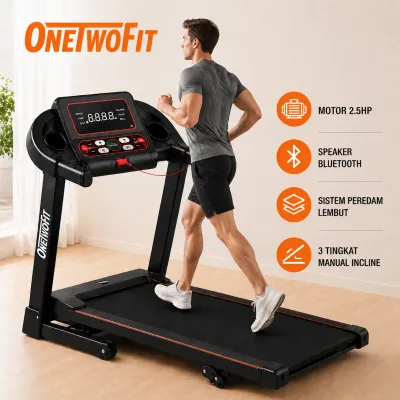
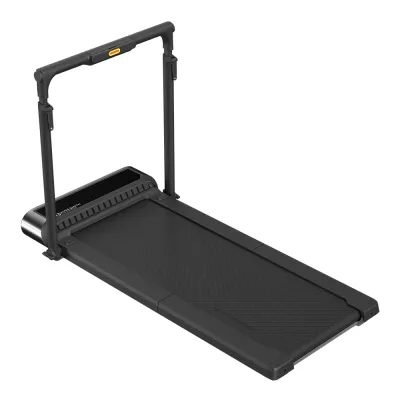
Prices are valid at publication and may change. Please refer to the product page for the latest price.
Ceiling height is another critical factor, particularly for elliptical trainers. Unlike treadmills, which keep you relatively close to the floor, ellipticals feature a pedal step-up height that raises your body significantly. You must add your height to the machine’s maximum pedal height and compare this to your flat’s ceiling height—typically around 2.6 meters in standard HDB flats—to ensure you do not hit your head during high-intensity workouts.
Finally, identify the structural limits of your chosen spot. Avoid placing heavy fitness equipment on uneven flooring, such as warped vinyl tiles or loose laminate, which can cause the machine to wobble. Ensure there is a dedicated, grounded power outlet nearby to avoid electrical hazards in tight living spaces.
Treadmill vs. Elliptical: Space and Clearance Trade-offs
Choosing between a treadmill and an elliptical for an HDB flat involves balancing storage convenience against operational noise. Treadmills are highly popular in compact homes because many models feature folding decks. This allows you to lift the running belt vertically, reducing the floor space occupied by the machine by up to seventy percent when you are not exercising. However, even the most compact folding treadmill still has a permanent footprint determined by its motor housing and console assembly, which cannot be folded away.

Ellipticals generally feature a fixed frame that cannot be folded flat. While they occupy a consistent amount of floor space day and night, they offer a distinct advantage in terms of visual bulk. Because they lack the high vertical console and wide running deck of a treadmill, some users find that a compact elliptical blends more naturally into a multi-purpose living room or study. However, you must account for the horizontal path of the pedals and handles, which extend beyond the physical frame during use.
Noise and vibration transfer are major considerations when exercising in multi-story HDB blocks. Treadmills generate significant impact noise from your feet striking the deck, which can easily travel through the concrete floor to the neighbors living below you. Ellipticals offer a smooth, continuous gliding motion that eliminates foot-strike impact, making them inherently quieter and more neighbor-friendly. Regardless of which machine you choose, using a high-density rubber isolation mat is essential to absorb vibrations and maintain peaceful relations with those downstairs.
Space-Saving Specifications to Check in the OneTwoFit Store
When browsing the onetwofit store, it is easy to get caught up in marketing terms like “ultra-slim” or “compact.” To ensure a machine will actually fit your HDB flat, you must look past the promotional copy and verify the exact folded and unfolded dimensions listed in the product specifications. Pay close attention to the folded height and depth if you plan to slide a treadmill under a bed or stand it up behind a wardrobe, as even a few centimeters of variance can prevent successful storage.
The type of folding mechanism is equally important for safety and ease of use in tight spaces. Look for machines equipped with a hydraulic soft-drop system, which slowly lowers the deck to the floor without manual lifting. This prevents sudden drops that could damage your flooring or cause injury. If a machine requires manual lifting, ensure you are comfortable handling the weight of the deck, especially if you need to fold and unfold it daily.
Portability features can make or break your home workout routine. Verify that the machine has integrated transport wheels on the base, allowing you to tilt and roll the unit out of the way after your session. Check the total base weight of the equipment; while a heavier machine offers greater stability during high-speed runs, it will be much harder to maneuver around tight corners in a bedroom or living room.
Lastly, examine the relationship between the machine’s physical footprint, its maximum user weight capacity, and its motor size. High-capacity machines with larger motors naturally require more robust frames and wider decks. If you require a high weight capacity, you must be prepared to allocate more floor space, as compact, lightweight models may not provide the structural stability needed for heavier users.
Step-by-Step Measurement and Layout Planning
To guarantee a seamless setup, follow a systematic layout planning process before making your purchase. Start by using painter’s tape to outline the exact unfolded dimensions of the machine on your floor. This physical template allows you to visualize how much space the equipment will occupy and helps you identify potential obstructions, such as swinging wardrobe doors, curtains, or furniture legs.
Next, mark out the required safety buffer zones around the taped outline. Ensure there is adequate ventilation space around the motor housing—typically located at the front of a treadmill—to prevent overheating during long workouts in Singapore’s warm, humid climate. Blocking the airflow around the motor can lead to premature component failure and void your warranty.
Plan the cable routing carefully to ensure the power cord reaches the wall socket without stretching or crossing high-traffic walkways. Loose cables are a major tripping hazard in small flats and can easily be damaged if stepped on or caught in the machine’s moving parts. Use cable protectors or low-profile clips to secure the cord along the baseboards if necessary.
If your taped layout reveals that the machine will block an emergency exit, crowd a doorway, or sit too close to furniture, do not compromise on safety. It is vital to stop and consult the manufacturer or customer support at the onetwofit store to ask about alternative configurations or more compact models. Never operate fitness equipment in a cramped layout where your movement is restricted or where a fall could cause you to collide with surrounding objects.
Frequently Asked Questions (FAQ)
Can I keep a treadmill permanently folded in an HDB bedroom?
Keeping a treadmill permanently folded in an upright position is a common space-saving tactic, but it requires careful attention to safety and mechanical wear. While modern folding treadmills are designed to stand vertically, leaving them folded for months on end can place continuous stress on the hydraulic cylinders, locking pins, and hinge joints. Over time, this constant tension can lead to premature wear of the folding mechanism, potentially causing it to stick or fail to lock securely.
There is also a safety risk to consider, particularly in households with young children or active pets. If the safety latch is not fully engaged or if the machine is bumped with significant force, there is a risk of accidental deployment, which could cause serious injury or property damage. Always double-check that the physical lock or safety pin is completely engaged every time you fold the machine, and consult the product manual for specific guidelines on long-term storage positions.
Do I need a floor mat for cardio machines in HDB flats?
Using a dedicated floor mat under your cardio equipment is highly recommended when living in an HDB flat. Heavy fitness machines can exert concentrated pressure on your flooring, leading to permanent indentations, scratches, or scuffs on vinyl, laminate, or parquet surfaces. A high-density rubber or PVC mat helps distribute the machine’s weight more evenly across the floor, preserving the appearance and value of your home’s flooring.
Additionally, a quality mat plays a crucial role in noise reduction. It acts as a barrier that dampens the impact vibrations generated by running or pedaling, preventing these sounds from resonating through the concrete slab of your HDB building to the neighbors below. When planning your layout, remember to measure the dimensions of the floor mat as well, as it should be slightly larger than the machine’s base footprint to catch sweat and protect the surrounding floor area.
Community discussion
Share your experience or ask a question. Comments are reviewed before publication.