
Finding the right badminton net for your home in Singapore depends heavily on your immediate living environment, available floor space, and local property regulations. For most residents living in Housing & Development Board (HDB) flats or condominiums, a portable, freestanding badminton net is the most practical and versatile choice. These systems require no permanent drilling, can be assembled and dismantled in minutes, and adapt easily to different flat surfaces like tiled living rooms, concrete void decks, or condo multi-purpose areas. While tensioned tie-down nets and wall-mounted systems exist, they often run into structural or regulatory limitations in shared residential spaces. Selecting the ideal setup requires balancing physical space constraints with ease of storage, durability under local weather conditions, and compliance with estate guidelines.
Assessing Your Apartment Space and Usage Needs
Before purchasing any equipment, you must measure the physical dimensions of your intended playing area. A standard singles badminton court measures 5.18 meters wide and 13.4 meters long, while a doubles court extends to 6.10 meters wide. While you might not need a full-sized court for casual recreational play, the net itself must fit comfortably within your designated space without blocking walkways or hitting walls. Measure the width of your living room, balcony, or corridor to ensure the net frame has at least half a meter of clearance on either side to prevent accidental collisions during intense rallies.
Ceiling clearance is another critical factor that dictates how you can play indoors. Standard residential ceilings in Singapore apartments typically range from 2.6 to 2.8 meters high, which severely limits high clears and deep lobs. If you plan to play indoors, your sessions will likely focus on flat drives, short serves, and net play. For those intending to use outdoor common areas like HDB void decks or condo open plazas, look upward to identify low-hanging beams, light fixtures, water pipes, or surveillance cameras that could interfere with the shuttlecock’s flight path or get damaged during play.
Products mentioned in this guide


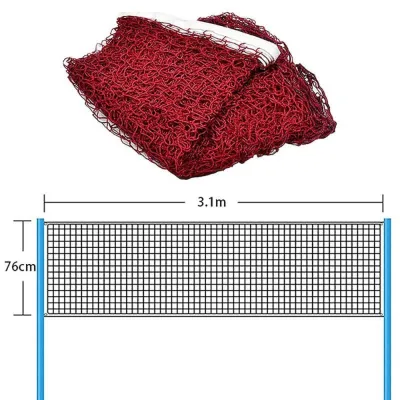
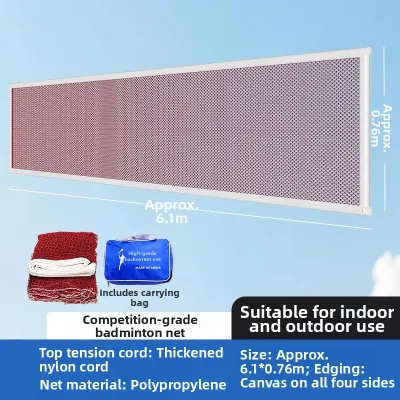
![[SG FREE ] 6.1mX0.76m Professional Sport Training Standard Badminton Net Outdoor Tennis Net Mesh Volleyball Net Exercis](https://img.lazcdn.com/g/p/2cc3f2f415b7b4810b7ff3f785fdb0cd.jpg_400x400q80.jpg_.webp)
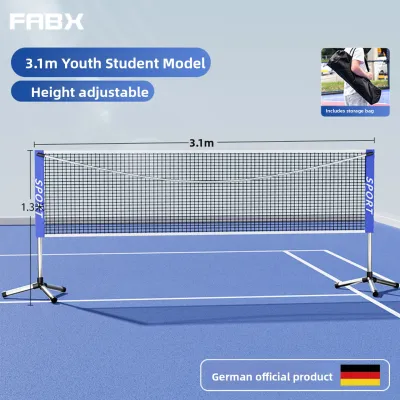
![[RCL BADMINTON NET] SHUTTLECOCK SHUTTLES BUNDLE SET BRAND NEW](https://img.lazcdn.com/g/p/18f6d4744b32ccd4cfc05f308e1e1b4c.png_400x400q80.png_.webp)
Prices are valid at publication and may change. Please refer to the product page for the latest price.
The ground surface of your chosen venue directly influences the stability of the net and the type of base you require. Smooth ceramic, homogenous, or marble tiles found inside apartments and modern corridors offer very little traction, causing lightweight net frames to slide during play or tip over from minor drafts. Conversely, concrete void decks and asphalt outdoor courts provide excellent grip but can quickly scratch or wear down plastic frame bases. If you plan to set up on the grass lawns of a condominium, you must ensure the net base can remain level on uneven soil without sinking or tilting.
Finally, consider your usage frequency and where the net will reside when not in use. A net that is difficult to assemble will likely end up gathering dust in your storeroom or bomb shelter. If you play multiple times a week, look for a system that can be partially folded or leaned against a wall without full disassembly. For occasional players, compact storage is paramount; the entire kit should pack down into a slim profile that fits easily alongside household items, suitcases, or inside standard built-in wardrobes.
Comparing Badminton Net Types for Compact Living
Portable and freestanding nets are the most popular choice for apartment dwellers due to their self-supporting design. These systems utilize a connected frame—often made of interlocking metal poles or flexible fiberglass rods—that keeps the net tensioned without requiring external support ropes or ground pegs. Because they stand on their own feet, you can set them up on virtually any flat surface, from living room tiles to concrete multi-purpose courts. When evaluating these models, pay close attention to the base design; wider feet or weighted base joints provide better stability against wind and accidental shuttlecock impacts, though they may add slightly to the overall carrying weight.

Tensioned or tie-down nets represent the traditional style of badminton setup, relying on high-tension ropes anchored to ground pegs, heavy posts, or existing structural pillars. While these nets are incredibly lightweight and easy to pack into a tiny bag, they are highly impractical for most Singapore apartment settings. Driving pegs into the ground is impossible on concrete void decks or tiled balconies, and tying ropes to common corridor railings or public pillars often violates estate safety rules. If you frequently visit public parks with dedicated grassy areas, a tensioned net can be a viable option, but you must always verify that the ground conditions allow for secure anchoring without damaging underground utility lines or landscaping.
Wall-mounted or retractable nets offer a semi-permanent solution for residents with dedicated indoor play areas, large private balconies, or private garages. These systems feature brackets mounted directly to opposite walls, allowing the net to be pulled across and tensioned when needed, and retracted or unhooked when play is finished. While this setup completely eliminates floor-level tripping hazards and saves valuable storage space, it requires careful structural verification. You must ensure the mounting walls can withstand the continuous lateral pulling force of a tensioned net, and you must obtain explicit permission from your condo’s managing agent or comply with HDB renovation guidelines before drilling into any structural concrete or external-facing walls.
Essential Features to Check Before You Buy
Singapore’s tropical climate, characterized by high humidity and sudden rain showers, demands highly durable materials. If you plan to store your net in a service yard, balcony, or outdoor storage box, look for frames constructed from rust-resistant materials. Powder-coated steel, anodized aluminum, or high-grade fiberglass are excellent choices that resist corrosion and structural weakening caused by moisture. Avoid cheap, untreated metal frames, as they can rust within months, leading to stiff joints that make assembly difficult and can leave unsightly rust stains on your apartment floors.
The quality of the net mesh and its borders determines how well the setup handles regular play. Standard badminton shuttlecocks have a feathered or synthetic skirt with a diameter of approximately 58 to 68 millimeters, meaning the net mesh must be significantly smaller to prevent the shuttlecock from getting stuck mid-rally. Look for a mesh size of 15 to 20 millimeters, constructed from durable nylon or polyester threads. Additionally, ensure the net features reinforced, double-stitched vinyl or canvas borders along the top and sides; these borders take the brunt of the tension and prevent the net from fraying or sagging over time.
Height adjustability is a highly valuable feature if you share your home with children or enjoy a variety of racket sports. While the official regulation height for a badminton net is 1.55 meters at the posts, this can be intimidating or physically challenging for younger family members. Opt for a frame that features telescoping poles or multi-stage push-button adjustment pins. This allows you to lower the net to 1.2 meters for children’s play, or even drop it further to double as a mini-tennis or pickleball net, maximizing the utility of your purchase.
Do not overlook the quality of the carry bag and the overall assembly mechanism. A flimsy, single-stitched plastic bag will quickly tear under the weight of metal poles, making transport a hassle. Look for a heavy-duty, zippered oxford fabric carry bag with reinforced handles and dedicated compartments to keep poles and the net separated. For the assembly itself, systems that feature elastic bungee cords running inside the poles—similar to modern camping tent poles—are highly recommended, as they guide the pieces into place automatically and prevent you from losing individual components.
Safety and Property Rules for Shared Spaces
Playing badminton in shared residential areas requires strict adherence to local estate rules to maintain harmony and safety. If you live in an HDB estate, be aware that Town Councils govern the use of void decks and common corridors. While casual play is often welcomed, setting up large equipment in narrow corridors is generally prohibited as it violates Singapore Civil Defence Force (SCDF) fire safety guidelines, which require a minimum clear escape passage of 1.2 meters. For condominium residents, the Managing Corporation Strata Title (MCST) bylaws typically restrict sports activities to designated areas like tennis courts or multi-purpose halls; setting up a net on common lawns or walkways without prior approval can result in warnings or fines.
Obstruction of emergency pathways is a serious safety hazard that must be avoided at all costs. When setting up your badminton net, ensure it is positioned far away from fire escape stairwells, emergency exit doors, electrical risers, and wheelchair accessibility ramps. Even a temporary setup can delay emergency personnel or residents during an evacuation. Always maintain a clear line of sight around your play area so that neighbors, elderly residents, and parents with strollers can pass by safely without having to step onto active play zones.
Tripping hazards are a common issue with freestanding and portable nets, especially in dimly lit areas or high-traffic zones. Choose a net with highly visible base poles—such as those painted in bright yellow, orange, or white—or wrap reflective tape around the base joints. Ensure that any stabilizing weights, sandbags, or water bags are placed directly over the frame feet rather than sprawling outward where they can trip unsuspecting passersby. If children are playing, supervise them closely to ensure they do not run into the metal support poles or trip over the low-lying center bar of the frame.
Finally, establish clear stop conditions and be prepared to pack up your equipment immediately when circumstances change. Singapore’s weather can shift rapidly from bright sunshine to heavy downpours accompanied by strong winds, which can easily catch a badminton net and turn it into a dangerous projectile. Additionally, if pedestrian traffic in your chosen area increases—such as during school dismissal hours or evening peak commute times—promptly dismantle the net to prevent accidents. Prioritizing the safety and comfort of your community ensures you can continue to enjoy your sport without friction.
Matching Net Types to Your Specific Scenario
To find the perfect badminton net, you must match the equipment’s specifications to your primary playing scenario. If you are a family living in an HDB flat who enjoys occasional weekend games at the nearby void deck, park, or open plaza, prioritize portability and rapid setup. Look for an ultra-lightweight freestanding net that weighs under 3 kilograms and packs down into a slim shoulder bag. These models typically use flexible fiberglass rods that bend into shape quickly, allowing you to start playing within minutes and pack up just as fast if the area becomes crowded or weather conditions deteriorate.
For residents who have access to a large private balcony, a spacious condo terrace, or a dedicated patio, stability is more important than extreme portability. In these semi-outdoor spaces, wind drafts can be surprisingly strong, especially on higher floors. A sturdy freestanding net with a heavier steel frame or wide, flat T-shaped feet is highly suitable. You can leave the frame partially assembled in a sheltered corner of the balcony, ready for quick deployment, and use small sandbags or rubber-weighted plates to keep the structure firmly anchored against sudden gusts of wind.
If you are among the fortunate few with a dedicated indoor playroom, a private garage, or a long, sheltered driveway, a wall-mounted retractable net or a heavy-duty tensioned system is the ideal choice. These setups provide a clean, professional playing experience with perfect net tension that mimics a real tournament court. Because the net can be retracted or unhooked and stored flat against the wall, it preserves your floor space for parking cars or other household activities, though you must perform a thorough check of your wall structure and mounting anchors before installation.
Before making your final purchase, conduct a quick pre-purchase verification checklist. Double-check the fully assembled width of the net against your measured play space to ensure a comfortable fit. Verify the folded dimensions of the carry bag to confirm it fits inside your designated storage cabinet or bomb shelter. Lastly, if you plan to play in any shared estate areas, take a moment to review your condo’s house rules or your local Town Council guidelines to ensure your recreational activities remain fully compliant and trouble-free.
Frequently Asked Questions (FAQ)
Can I drill holes to install a badminton net in my HDB corridor?
No, you should not drill holes into HDB corridor walls or structural columns. Town Council regulations strictly prohibit any unauthorized drilling, modifications, or fixtures in common property areas, as they can compromise structural integrity, damage concealed wiring, and violate fire safety codes. Additionally, permanent fixtures can obstruct the minimum 1.2-meter clear escape passage required by the SCDF. Instead, opt for a damage-free, portable freestanding net that can be set up and completely removed after your game, keeping the corridor safe and compliant.
How do I prevent a freestanding net from tipping over on smooth tiles?
To stabilize a freestanding net on slippery indoor tiles, place non-slip rubber mats or silicone pads under the frame’s feet to increase friction and prevent sliding. You can also drape small, fabric-covered sandbags, water-filled weight bags, or standard gym weight plates directly over the base joints of the frame. Avoid using makeshift weights with sharp edges that could scratch your flooring, and ensure all weights are placed flat to prevent creating additional tripping hazards for players.
What is the standard height for a badminton net, and can it be adjusted?
The official standard height for a badminton net is 1.55 meters at the outer posts and 1.524 meters at the center of the court. Many recreational freestanding nets designed for home use feature adjustable height settings, allowing you to lower the net to 1.2 meters or 1.0 meter. This adjustability is highly beneficial for younger children learning the game, and it also allows the net to be repurposed for other low-net sports like pickleball or tennis.
Community discussion
Share your experience or ask a question. Comments are reviewed before publication.