
Selecting the right Bullz kettlebell for a Housing & Development Board (HDB) flat requires balancing your current physical strength with the spatial and structural realities of high-density apartment living. Because HDB flats feature shared walls, concrete floors with various overlays, and compact layouts, your choice of weight and material directly impacts both your training progress and your home environment. Finding a suitable setup involves assessing your movement mechanics, verifying your floor protection, and selecting a weight that allows you to maintain strict form without risking damage to your property or disturbing your neighbors.
How to Select the Right Kettlebell Weight for Your Current Fitness Level
Kettlebell training is highly dynamic, meaning a single weight may not suit every movement in your routine. For those starting their fitness journey in an HDB setting, selecting an initial weight requires a conservative approach. Beginners often find that starting with a lighter weight—typically ranging from 6 kg to 12 kg depending on individual physical background and comfort level—allows them to master the fundamental hip hinge before moving to heavier loads. This initial phase is crucial for building the necessary joint stability and neural pathways required for more complex ballistic exercises.
As you progress to intermediate and advanced levels, your strength requirements will naturally diverge based on the specific exercises you perform. Foundational lower-body movements, such as the kettlebell swing and the goblet squat, leverage the large muscle groups of the posterior chain and thighs. These exercises generally allow for heavier weights, often progressing to 16 kg, 20 kg, or more as technique stabilizes. Because these movements rely on momentum and large muscle groups, a weight that feels challenging for an overhead press may feel relatively light during a swing.
Products mentioned in this guide
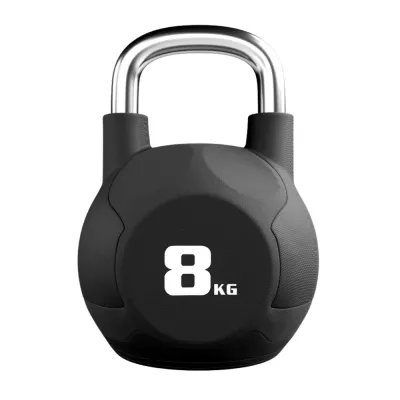
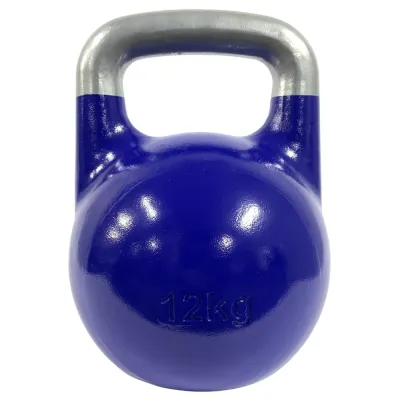
Prices are valid at publication and may change. Please refer to the product page for the latest price.
Conversely, upper-body and overhead movements like the strict press, snatch, or Turkish get-up demand significantly more shoulder stability and core control. For these exercises, a lighter weight is essential to prevent joint strain. Attempting to press a weight that is too heavy can compromise your posture, leading to lower back arching or loss of control, which is particularly hazardous in a confined home environment. A practical way to test if a weight is appropriate for overhead work is to verify if you can press it smoothly for five repetitions with proper alignment and no lateral leaning.
Prioritizing form and technique over rapid weight progression is a practical way to prevent injury when training unsupervised. Without a coach present to correct your alignment, you must rely on self-monitoring and sensory feedback. Starting with a manageable weight ensures you can execute each repetition with a neutral spine, active shoulders, and a stable base. If your form begins to break down, your grip slips, or you experience joint discomfort, it is a clear stop condition to end the set and rest rather than forcing additional repetitions.
Evaluating Kettlebell Materials and Coatings for HDB Living
The material and coating of your kettlebell play a critical role in preserving your HDB flat’s flooring and maintaining a peaceful relationship with your downstairs neighbors. Standard bare cast iron kettlebells offer a classic, textured feel and high durability, but their hard metal surfaces can easily scratch, chip, or dent unprotected vinyl, laminate, or parquet floors if set down too quickly. Additionally, bare iron is highly susceptible to surface rust when exposed to Singapore’s high humidity and sweat, requiring regular wiping and occasional oiling to maintain its condition.

To mitigate these risks, many home fitness enthusiasts opt for kettlebells with protective coatings, such as vinyl or neoprene. These synthetic sleeves act as a buffer, dampening the metallic clatter when the weight touches the floor and reducing the risk of minor surface scratches. However, even coated weights can cause structural floor damage or transmit low-frequency vibrations through the concrete slab if dropped, meaning they do not eliminate the need for dedicated floor protection. Over time, lower-quality vinyl coatings may also crack or peel if subjected to repeated impacts or stored in direct sunlight.
Adjustable kettlebell designs present another alternative for compact spaces, allowing you to change weights using an internal locking mechanism or stackable plates. While highly space-efficient, adjustable models require careful inspection of their mechanical parts. You should regularly verify that the locking mechanism is secure and that the plates do not rattle during dynamic movements, as loose components can create distracting noise and pose safety risks. Furthermore, the physical size of an adjustable kettlebell remains constant regardless of the weight selected, which can affect the balance and feel of certain exercises.
Handle characteristics are equally important when training in Singapore’s warm, humid climate. Sweat can quickly compromise your hold on a smooth, painted, or vinyl-coated handle, increasing the risk of the kettlebell slipping during high-velocity swings. Bare cast iron or powder-coated handles generally offer a more reliable, porous texture that helps maintain traction even when damp.
Because using loose gym chalk can create a messy cleanup in a residential living room, managing your grip requires alternative strategies. You can look for handles with a matte or textured powder finish, which provides natural friction without the need for chalk. Additionally, verifying that the handle diameter matches your hand size and that the horn clearance allows for a comfortable, two-handed grip is essential for maintaining control throughout your workout.
Space, Clearance, and Safety Planning for Compact Flats
Executing dynamic kettlebell exercises safely in an HDB flat requires careful spatial planning. Before beginning any workout, you should establish a clear training zone that accounts for the full range of your movements. A safe guideline is to measure a clearance zone of at least two meters by two meters, free of furniture, coffee tables, or low-hanging decor. This buffer ensures that if you lose your balance during a lateral lunge or need to step back quickly during a swing, you will not collide with hard edges or knock over household items.
Vertical clearance is another critical factor that is easily overlooked in standard residential layouts. Standard HDB ceiling heights typically range from 2.6 to 2.8 meters, which can feel restrictive during overhead exercises like presses, snatches, or Turkish get-ups. Before lifting a kettlebell overhead, physically verify that your knuckles and the top of the weight will clear any ceiling fans, light fixtures, or false ceiling features. Operating a kettlebell near an active ceiling fan poses an immediate, high-risk hazard and must be avoided entirely; always ensure the fan is switched off and completely stationary before starting your session.
When your workout is complete, storing your equipment properly is vital for maintaining home safety. Heavy kettlebells left in high-traffic walkways present a severe tripping hazard for family members. Furthermore, storing heavy weights on a single, concentrated spot on sensitive flooring can lead to permanent indentation or warping over time. To prevent rolling accidents and distribute the load safely, store your kettlebells on a flat, low-profile rack or a dedicated heavy-duty rubber mat in a designated corner of the room.
Pre-Purchase Verification Checklist for Bullz Kettlebells
Before finalizing your purchase of a Bullz kettlebell from an online marketplace or local distributor, completing a thorough pre-purchase check ensures the equipment fits your physical needs and home setup. First, verify the physical dimensions of the specific model, focusing on the base flatness and diameter. A wide, flat machined base is essential for exercises like renegade rows or push-ups on the kettlebell, as it prevents the weight from tipping or rolling unexpectedly on your floor.
Next, examine the handle specifications, specifically the handle gap (the distance between the underside of the handle and the bell body) and the horn width. If you plan to perform two-handed swings, the horn must be wide enough to accommodate both hands comfortably without pinching your fingers. For single-handed movements like cleans and snatches, the handle gap must provide sufficient clearance so the bell can rotate smoothly around your wrist without striking your forearm awkwardly. You should also inspect product photos or user reviews to ensure the handle is free of rough casting seams that could cause blisters or tears on your palms.
Finally, review the logistics and customer policies associated with purchasing heavy fitness equipment. Shipping fees for heavy iron items can vary significantly, so confirm the delivery terms to your HDB block, including whether the courier delivers directly to your doorstep or if additional charges apply for non-lift-accessible levels. Additionally, check the retailer’s return policy and warranty terms regarding manufacturing defects, such as rough seams on the handle or uneven coatings, to ensure you can exchange the product if it does not meet quality standards upon arrival.
Frequently Asked Questions (FAQ)
Can I use a kettlebell on HDB vinyl or laminate flooring without a mat?
Operating a kettlebell directly on HDB vinyl or laminate flooring without a protective barrier is not recommended. While modern vinyl and laminate overlays are designed to resist daily wear, they are susceptible to deep scratches, scuffs, and impact dents from heavy, metallic objects. Furthermore, setting down a kettlebell directly on the floor transmits vibrations and noise directly through the concrete slab, which can disturb neighbors living below you. To protect your flooring and maintain a quiet home environment, always use a high-density rubber gym mat or a specialized shock-absorbing drop pad to cushion the impact and distribute the weight safely.
Is an adjustable kettlebell better for small HDB spaces?
An adjustable kettlebell can be a practical space-saving solution for compact HDB flats, as it replaces multiple individual weights with a single unit. This design significantly reduces physical clutter and allows you to gradually increase the resistance as your strength improves. However, adjustable models often have trade-offs that you should verify before buying. They may feature a larger overall physical footprint at lower weights, different handle thicknesses compared to standard cast iron models, and internal mechanical parts that require regular maintenance. If you prefer a traditional, solid feel and high durability for dynamic movements, a few well-chosen fixed-weight kettlebells may still be the more reliable choice.
Community discussion
Share your experience or ask a question. Comments are reviewed before publication.