
When shopping for a table tennis table, it is easy to get lost in a sea of marketing buzzwords like “championship grade” or “pro-level.” However, the actual playing experience—how the ball bounces, how stable the surface remains, and how long the table lasts—depends entirely on a few objective engineering specifications. Understanding these technical details allows you to identify a high-performing table that fits your space, budget, and playing style without overpaying for unnecessary labels.
Quick Guide: The Specs That Actually Define Gameplay
To bypass the marketing noise and make a quick, informed decision, focus on three primary structural specifications:
- Table Top Thickness: Look for a top thickness between 19mm and 25mm. This is the single most critical factor for achieving a consistent, true ball bounce.
- Undercarriage Strength: Ensure the frame has steel legs with a minimum diameter of 1 inch (approx. 25mm). A heavy, sturdy frame prevents the table from wobbling or shifting when bumped.
- ITTF Certification: Do not pay a premium for official International Table Tennis Federation (ITTF) approval unless you are hosting sanctioned tournaments. Non-certified tables with identical physical specifications offer the exact same playing experience for home and recreational club use.
Table Top Thickness and Material: Decoding the Bounce
The table top dictates ball speed, bounce height, and spin response.
Products mentioned in this guide
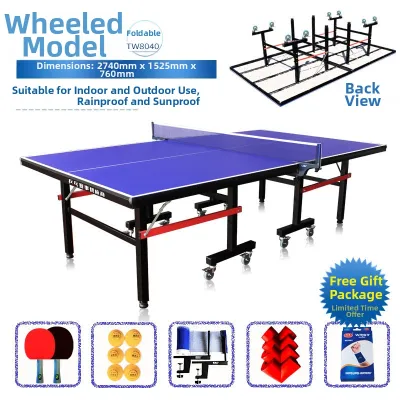
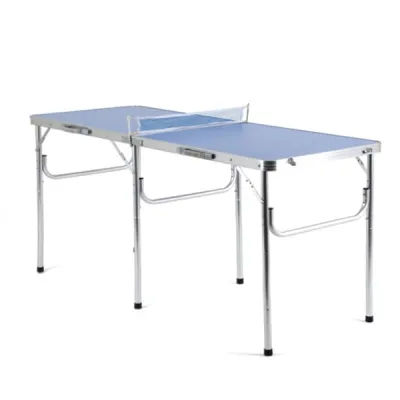
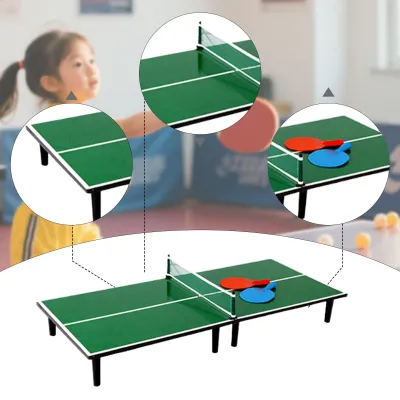
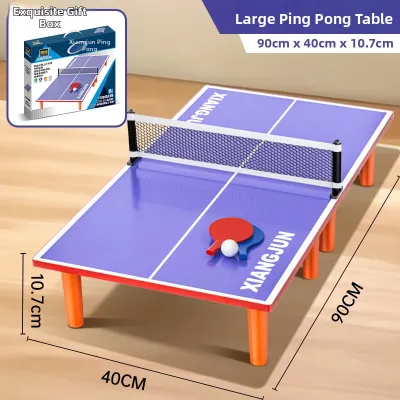
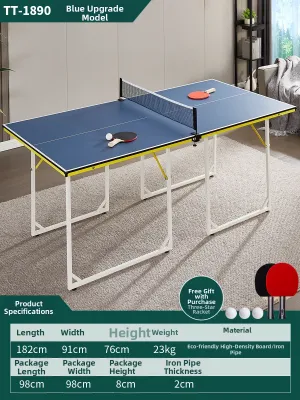
Prices are valid at publication and may change. Please refer to the product page for the latest price.

Thickness Tiers Table tops generally fall into three categories:
- 12mm to 15mm: These entry-level tables absorb too much of the ball's energy, resulting in a slower, lower, and inconsistent bounce.
- 16mm to 19mm: This is the sweet spot for intermediate players, home games, and local clubs. A 19mm top provides a reliable, uniform bounce that allows players to practice proper stroke mechanics.
- 20mm to 25mm+: These professional-grade surfaces offer a fast, crisp, and completely uniform bounce. If you are training seriously, a 22mm or 25mm table is the gold standard.
Material Reality Most high-quality indoor tables are constructed from Medium-Density Fibreboard (MDF) due to its uniform density and smooth texture, which prevents “dead spots.” Plywood is occasionally used in cheaper models but is prone to warping. For outdoor play, tables utilize aluminum, melamine, or resin composites. While durable, these synthetic materials must be engineered carefully to match the bounce characteristics of standard MDF.
Surface Finish The paint finish serves a functional purpose beyond aesthetics. High-quality tables feature multiple layers of glare-resistant, matte finish to prevent overhead lighting or bright sunlight from blinding players. Furthermore, the finish must provide a slight texture; if a surface is too glossy, the ball will skid instead of gripping, neutralizing spin.
Undercarriage and Frame: Why Stability Dictates Playability
A premium table top is useless without a sturdy frame to absorb energy from player contact and folding.
Leg Diameter and Shape Look for square or thick round steel legs ranging from 1.5 to 2.5 inches (approx. 38mm to 60mm). Thicker steel legs absorb vibrations instantly, ensuring the table remains rock-solid. Avoid thin, hollow aluminum or plastic legs, which easily bend and cause the playing surface to sway.
Crossbars and Braces A stable table relies on horizontal support beams and diagonal bracing to prevent lateral movement. Check the depth of the steel undercarriage apron (the metal rim directly beneath the outer edge of the table top); a deeper apron (ideally 1.5 to 2 inches) prevents the wood top from sagging or warping over time.
Levelers and Mobility Because very few floors are perfectly flat, adjustable leg levelers are essential for fine-tuning the height of individual corners. If you need to store your table, look for large, heavy-duty caster wheels (at least 3 to 4 inches in diameter) made of durable polyurethane or rubber, with at least half of the wheels featuring reliable locking mechanisms.
Net Systems and Markings: Ensuring Consistent Play
The finer details of a table tennis setup directly impact game flow and compliance with standard rules.
Net Attachment Nets generally attach via clamp-on systems or permanent fixed mounts. Clamp-on systems feature heavy-duty spring or screw clamps that grip the sides of the table, allowing for precise tension adjustments and easy replacement. Permanent fixed nets stay attached during folding, which is convenient but can limit tension adjustments and make replacement difficult if parts break.
Tension and Height Standard rules dictate that a net must stand exactly 15.25 cm (6 inches) high across its entire width. Premium net systems feature adjustable cord tensioners and height adjustment screws on the posts to eliminate middle sagging.
Line Markings A standard table features a 2 cm wide white line along the outer edges and a 3 mm wide white center line for doubles play. High-quality manufacturers screen-print or paint these lines directly into the surface coating so they are flush with the table. Avoid tables that use adhesive tape, as the tape creates a physical ridge that alters the ball’s bounce and eventually peels off.
Marketing Fluff: Specs You Can Safely Ignore
Manufacturers often use clever marketing to inflate the perceived value of lower-end tables. Knowing what to ignore can save you money.
Unverified Labels Terms like “Championship Edition” or “Tournament Grade” are frequently printed on packaging without regulatory backing. Unless a table explicitly carries an official ITTF approval stamp, these labels are purely cosmetic. Evaluate the table based on its actual top thickness and steel frame specifications instead.
Proprietary Coatings and Bundles Some brands advertise patented, “spin-enhancing” surface coatings. In reality, spin is almost entirely determined by the rubber on your paddle; as long as a table top has a matte, non-slip finish, proprietary paint formulas offer no advantage. Similarly, ignore bundled accessories like free paddles and balls, which are almost always low-quality. Focus your entire budget on the physical table structure and buy rackets separately.
Indoor vs. Outdoor: Matching the Build to Your Environment
Choosing between indoor and outdoor tables depends on how materials handle local environmental conditions, which is vital in tropical climates like Singapore.
Indoor Tables Indoor tables are built with MDF tops to deliver the absolute best bounce consistency. However, MDF is highly sensitive to moisture. In humid environments, an unprotected indoor table will absorb moisture from the air, causing the wood fibers to swell, warp, and permanently ruin the flat playing surface. Consequently, indoor tables should only be used in fully enclosed, climate-controlled spaces.
Outdoor Tables Outdoor tables are engineered to withstand rain, direct sunlight, and extreme humidity. Their tops are made from weatherproof materials such as melamine resin, galvanized steel, or aluminum composites, supported by rust-resistant powder-coated frames. While they do not offer the ultra-crisp bounce of a premium indoor MDF board, modern high-end outdoor tables provide a highly playable, durable alternative for patios, balconies, or backyards.
Storage Mechanisms Consider how the table folds. Rollaway designs feature two independent halves that fold up vertically and nest together, which is highly space-efficient. Playback or fold-up designs allow you to fold just one half of the table vertically, leaving the other half flat for solo practice sessions.
Frequently Asked Questions (FAQ)
Does a heavier table always mean better quality?
While a heavier table often correlates with a thicker playing top and a more robust steel frame, weight alone is not a guarantee of quality. Poorly engineered tables can be heavy simply due to low-grade, dense materials, yet still suffer from weak joints or thin bracing. Instead of relying solely on shipping weight, verify the specific thickness of the steel legs and the presence of cross-bracing.
Can I use an indoor table in a covered patio or garage?
It is highly discouraged to use an indoor MDF table in a garage or covered patio, especially in humid regions like Singapore. Even if the table is completely shielded from direct rain, the high ambient humidity and temperature fluctuations will gradually warp the MDF top, causing inconsistent bounces and rendering the table unusable.
Is ITTF approval necessary for home or club use?
No, ITTF approval is not necessary for home or recreational club use. ITTF certification simply guarantees that a table meets the strict, uniform standards required for official international tournaments. Many manufacturers produce high-quality 19mm and 22mm tables without paying for the ITTF certification process, offering identical playability and bounce consistency at a much more affordable price point.
Community discussion
Share your experience or ask a question. Comments are reviewed before publication.