
Understanding the technical specifications of the Li-Ning Halbertec 9000 Power is essential for maximizing your badminton performance. Rather than treating these numbers as mere marketing jargon, translating parameters such as weight, balance point, shaft stiffness, and string tension into real-world court dynamics is essential. This understanding allows you to determine whether the racket’s physical properties align with your swing mechanics, helping to prevent injury and maximize your tactical efficiency on the court.
Every badminton player possesses a unique biomechanical profile, meaning a racket that excels in one hand might feel sluggish or overly demanding in another. By analyzing the engineering behind these specifications, you can make an informed decision before purchasing or customizing your setup. Let us break down what these core metrics mean for your performance and how to verify them for your specific style of play.
Weight and Balance Point: Managing Swing Speed and Power
A racket’s weight and balance point are the primary factors governing its swing weight, which is the perceived weight of the racket when in motion. In badminton, weight is typically categorized into standard classes like 3U (heavier) or 4U (lighter). A heavier racket offers greater momentum and stability, allowing for more powerful smashes, but it demands higher physical conditioning and can accelerate muscle fatigue during extended matches. Conversely, a lighter racket enhances maneuverability and defense, making it easier to react to quick drives at the net.
Products mentioned in this guide
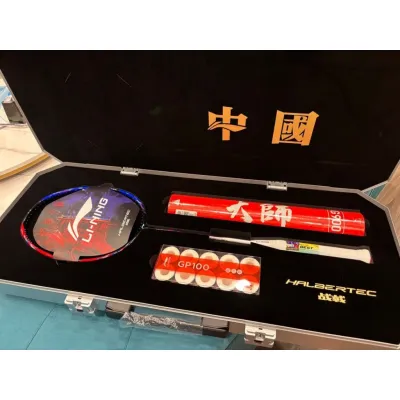
Prices are valid at publication and may change. Please refer to the product page for the latest price.
The balance point, measured in millimeters from the bottom of the handle, dictates where the mass is concentrated. Head-heavy rackets shift the weight toward the frame, leveraging centrifugal force to generate steep, powerful downward shots. However, this head-heavy distribution slows down defensive recovery times, making it harder to defend against rapid body attacks. Head-light rackets offer the opposite trade-off, prioritizing rapid frame manipulation and quick defensive blocks at the expense of raw offensive power.
Because individual manufacturing tolerances can lead to slight variances, you should always check the official specification sheet or the cone label of your specific unit. This label typically displays the designated weight class and balance range. Verifying these details ensures that the racket in your hand matches the exact physical profile you expect for your playing style.
Shaft Stiffness: Aligning Flex with Your Swing Mechanics
Shaft stiffness acts as the transmission system of your racket, determining how efficiently energy transfers from your arm to the shuttlecock. A stiff shaft bends very little during a swing, requiring rapid wrist action and high swing speeds to generate power. For players with explosive mechanics, a stiff shaft provides exceptional control and precise placement, as the frame recovers almost instantly without unwanted twisting.

On the other hand, a flexible shaft is far more forgiving, bending easily during the swing to create a whip-like effect that aids in power generation. This flexibility is highly beneficial for players with slower swing speeds or those developing their technique, as it reduces the physical effort required to clear the shuttle to the backcourt. Using a shaft that is too stiff for your current physical strength can lead to joint strain in the wrist, elbow, or shoulder, while a shaft that is too flexible for a fast swing can result in a loss of control and inconsistent shot placement.
To avoid injury and optimize performance, evaluate your own physical capabilities objectively rather than relying solely on subjective court feel. Different brands use varying scales to define stiffness, so it is crucial to consult the manufacturer’s official material descriptions and flex ratings. This objective data helps you select a racket that complements your natural swing speed rather than forcing you to alter your mechanics.
String Tension Limits: Balancing Control and Frame Safety
String tension is a critical variable that directly influences the racket’s sweet spot and the duration of shuttle contact. High string tension, typically favored by advanced players, tightens the string bed to offer crisp feedback and precise control over shot placement. However, this high tension shrinks the sweet spot, meaning off-center hits will feel stiff, transfer more vibration to your arm, and result in a significant loss of power.
Lower string tension creates a more elastic string bed, often referred to as a trampoline effect. This elasticity enlarges the sweet spot and provides greater repulsion power with less physical effort, making it highly suitable for defensive play and intermediate players. The trade-off is a slight reduction in control, as the shuttle remains on the strings longer, making delicate net shots more challenging to execute consistently.
Every racket frame is engineered to withstand a specific range of tension, which is clearly marked on the shaft or cone. Exceeding the manufacturer’s maximum recommended tension limit places immense structural stress on the carbon fiber frame, making it highly susceptible to cracking or collapsing during high-impact collisions or off-center hits. Furthermore, stringing a racket beyond its certified limits typically voids the manufacturer’s warranty, making it essential to operate strictly within the official guidelines.
Optimizing Your Setup: Strings and Grips for the Halbertec 9000 Power
Once you understand the core specifications of your racket, you can fine-tune its performance using complementary accessories like strings and grips. The choice of string gauge and material should align with your primary objective. For instance, thin strings offer excellent repulsion and feel but wear out quickly, whereas thicker strings prioritize durability and tension retention, which is highly practical for players training frequently in humid climates.
Grips also play a subtle yet profound role in altering the racket’s overall balance and swing weight. Adding a thick replacement grip or multiple overgrips adds mass to the handle, effectively shifting the balance point downward and making a head-heavy racket feel more balanced or head-light. Conversely, using a very thin grip keeps the weight concentrated in the head, preserving its offensive characteristics but potentially reducing shock absorption.
To achieve the perfect balance for your game, consider consulting a professional stringer or a certified coach. These experts can analyze your playing style alongside the verified manufacturer specifications to recommend the ideal string tension, string type, and grip configuration. This personalized approach ensures your equipment works in harmony with your physical mechanics.
Frequently Asked Questions (FAQ)
Is the Halbertec 9000 Power suitable for beginners?
Generally, rackets with advanced, power-oriented specifications are not ideal for beginners. Novice players typically benefit from more flexible shafts and balanced or head-light profiles, which offer greater forgiveness and assist in power generation while basic swing mechanics are still being developed. Before purchasing, beginners should verify the official specifications of the model to ensure it does not demand a level of swing speed and physical conditioning that could lead to early fatigue or joint strain.
How can I verify the authentic specifications of my racket?
To ensure your racket is authentic and matches the manufacturer’s engineered specifications, inspect the shaft and cone for laser-engraved serial numbers and official specification stickers. Genuine products feature clean, aligned typography and secure security labels, often including scratch-off verification codes. You can input these codes directly into the brand’s official website or verification portal. Purchasing exclusively from authorized retailers or reputable online marketplaces is the most reliable way to avoid counterfeit products that misrepresent their true weight, balance, and structural safety.
Community discussion
Share your experience or ask a question. Comments are reviewed before publication.