
Selecting your first tennis racket can feel like learning a completely new language. When looking at a model like the Wilson Heritage V2, the frame is covered in technical terms—head size, unstrung weight, balance point, and string pattern. For a beginner, these specifications are not just technical details; they directly dictate how easy it is to hit the ball over the net, how quickly your arm tires, and whether you can avoid common injuries like tennis elbow.
The Wilson Heritage V2 is designed with specific geometries that cater to developing players. By breaking down these physical attributes, you can understand how the racket behaves during a stroke and whether it aligns with your current physical strength and coordination. Let’s decode these specifications to see how they translate from the spec sheet to your actual performance on the court.
Decoding the Core Specifications of the Wilson Heritage V2
When you pick up a tennis racket, the most critical specifications are usually printed directly on the inside of the frame’s throat or along the shaft. Manufacturers display these numbers so players can quickly assess the racket’s physical blueprint. For beginners, the four pillars of racket design to focus on are head size, weight, balance, and string pattern.
Products mentioned in this guide

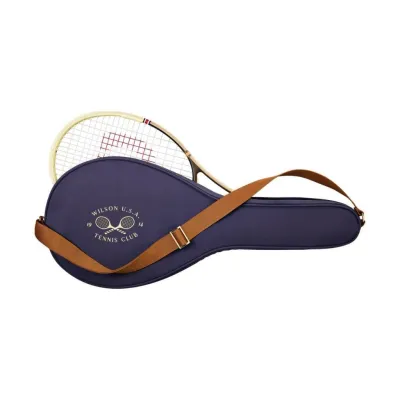

Prices are valid at publication and may change. Please refer to the product page for the latest price.
Head size refers to the total surface area of the hitting string bed, typically measured in square inches. A larger head size provides a larger hitting area, which inherently increases the racket’s power and forgiveness. Weight, usually measured in grams when unstrung, determines how much mass you have to swing. Balance indicates how that weight is distributed along the length of the racket—whether it sits closer to the head (head-heavy), closer to the handle (head-light), or is evenly distributed. Finally, the string pattern denotes the number of main (vertical) and cross (horizontal) strings.
For someone just starting out, head size and unstrung weight are the two most critical specifications to evaluate. A beginner-friendly frame typically features an oversized head and a lighter overall weight. This combination minimizes the physical strain of swinging while maximizing the chances of making clean contact with the ball. As you inspect the frame of the Wilson Heritage V2, look for these printed metrics to verify how they align with standard beginner ranges, which generally favor a head size over 100 square inches and an unstrung weight under 300 grams.
Understanding the trade-offs between these dimensions is essential. A racket that leans heavily toward power—featuring a large head and a stiffer, lighter frame—will help you depth-control your shots with minimal effort. However, this comes at the expense of directional control. Conversely, a heavier racket with a smaller head offers precise control but requires excellent technique and physical strength to generate depth. Balancing these trade-offs is the key to selecting a frame that supports your learning curve.
How These Specs Translate to On-Court Playability
On the court, these technical specifications transform into immediate physical feedback. A larger head size, which is common in beginner-focused frames like the Wilson Heritage V2, dramatically expands the “sweet spot”—the central area of the string bed where energy transfer is most efficient and vibrations are minimized. For a novice player whose timing and footwork are still developing, this larger sweet spot means that off-center hits still clear the net rather than dying on your side of the court.

Racket weight and balance work together to determine what players call “swingweight,” or how heavy the racket feels when in motion. A lighter frame is highly maneuverable, allowing you to prepare your backswing quickly and react to fast incoming balls. However, extremely light rackets can twist in your hand when contacting a heavy, fast-paced ball. A slightly head-heavy balance in a light racket can offset this, providing enough plow-through stability to keep the frame steady without making it feel sluggish to swing.
The string pattern also plays a subtle but important role in how the ball behaves upon impact. An open string pattern, such as a 16×19 configuration, has wider spacing between the strings. This allows the strings to grip the ball more effectively, promoting natural spin and a higher launch angle to help clear the net. Open patterns also offer a softer, more cushioned feel on impact, which is highly beneficial for players who are still building up their forearm and shoulder strength.
To test if these specifications translate well to your personal mechanics, perform a few simple observable checks during a practice session. Hold the racket and execute slow, full shadow swings. Pay attention to whether you can easily control the racket head throughout the entire swing path. If the racket head lags behind your wrist, or if you feel a sudden strain in your forearm when stopping the swing, the weight distribution may not be suited to your current strength.
Evaluating if the Wilson Heritage V2 Matches Your Skill Level
The ideal player profile for a racket with the Wilson Heritage V2’s characteristics is a beginner or recreational player who prioritizes comfort, ease of use, and rapid skill acquisition. If your primary goals are to establish consistent rally play, develop clean stroke mechanics, and enjoy casual matches without physical exhaustion, a forgiving frame geometry is highly advantageous. It acts as a supportive tool, allowing you to focus on footwork and court positioning rather than struggling to generate ball speed.
However, it is vital to monitor how your body responds to the racket over time. Physical signs that a frame is poorly matched to your body include persistent soreness in the elbow, wrist, or shoulder after play. If you find yourself consistently hitting the ball late, or if your wrist feels unstable at the moment of contact, the racket may be too heavy or its balance point may be putting undue leverage on your joints. Never ignore these warning signs, as playing through discomfort can lead to chronic repetitive strain injuries.
As your skills progress, your equipment needs will naturally evolve. You will know it is time to transition to a more advanced, player-specific frame when your swing speed increases and you find your shots consistently flying long. Advanced frames feature smaller head sizes, thinner beams, and heavier weights, which provide the control needed to swing fast without fear of overhitting. This transition typically occurs once you can reliably direct your shots and generate your own pace.
Regardless of the racket you choose, personal customization can greatly enhance your playing experience. It is highly recommended to consult with a certified tennis coach or a professional racket stringer. They can help you select the correct grip size, recommend a string tension that balances comfort and control, and suggest minor adjustments like overgrips or dampeners to tailor the frame to your unique physical needs.
Frequently Asked Questions (FAQ)
Does the Wilson Heritage V2 come pre-strung, and does it matter?
Many beginner-oriented rackets are sold pre-strung from the factory, typically using a durable synthetic gut or nylon string at a medium tension. This is highly convenient for beginners, as it allows you to take the racket straight to the court. However, factory strings can lose tension while sitting on retail shelves. You can check for tension loss by pressing your fingers against the center strings; if they move very easily or feel mushy, the tension has dropped. If you find yourself struggling with control or if the strings feel dead, having a professional restring the racket at a lower tension can instantly restore comfort and playability.
How do I choose the right grip size for this racket?
Choosing the correct grip size is essential for preventing wrist strain and tennis elbow. To perform the standard finger test, hold the racket handle with your dominant hand using an Eastern grip (where your palm is flat against the same bevel as the string face). Place the index finger of your opposite hand in the space between your ring finger and palm. If there is not enough room for your finger, the grip is too small, which forces you to squeeze too tightly. If there is a large gap, the grip is too large, preventing proper wrist snap. If you are between sizes, choose the smaller size, as you can easily increase the thickness using a temporary overgrip.
Community discussion
Share your experience or ask a question. Comments are reviewed before publication.