
The evolution of the modern table tennis game, accelerated by the introduction of the plastic 40+ ball, has forced offensive players to seek equipment that delivers both maximum spin and high-speed safety margins. Butterfly addressed this demand by introducing the Dignics series, featuring their advanced Spring Sponge X technology. For competitive players looking to optimize their forehand, the decision frequently narrows down to two flagship options: the hybrid, micro-tacky Dignics 09C and the high-tension, non-tacky Dignics 05.
Choosing between these two premium rubbers is not a matter of identifying which is objectively superior, as both represent the absolute pinnacle of modern rubber engineering. Instead, the correct choice depends entirely on your stroke mechanics, physical conditioning, preferred playing distance from the table, and current blade composition. A mismatch between your physical capabilities and these highly technical rubbers can hinder your development, whereas the correct pairing can elevate your offensive consistency.
Dignics 09C is designed specifically for players who prioritize extreme spin variation, dominate the short game over the table, and possess the physical power and technical stroke mechanics to generate their own pace. Dignics 05 is tailored for players who rely on mechanical grip, prefer a higher, safer ball trajectory, and want a pronounced catapult effect that provides effortless depth and speed during mid-distance counter-looping rallies.
Products mentioned in this guide
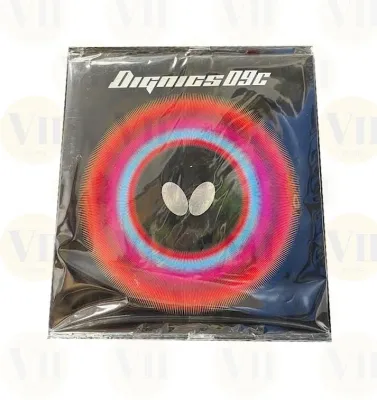
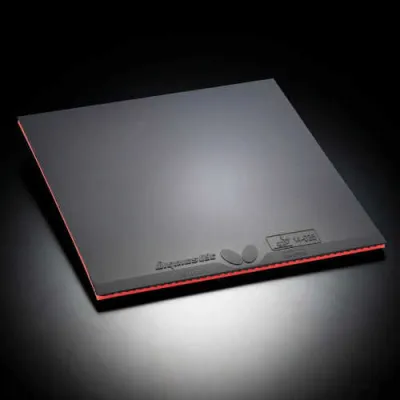
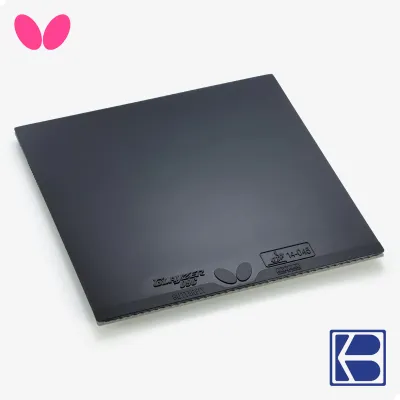
Prices are valid at publication and may change. Please refer to the product page for the latest price.
While both rubbers share the same foundational Spring Sponge X technology, they deliver fundamentally different playing experiences. The secret lies in how their unique top sheets interact with the underlying sponge, altering everything from dwell time and throw angle to passive control and physical power requirements.
Surface Grip: Micro-Tacky 09C vs. Non-Tacky 05
The most significant physical distinction between these two rubbers lies in the composition and texture of their top sheets. Dignics 09C features a hybrid “micro-tacky” surface, which represents Butterfly’s successful attempt to merge the sticky characteristics of traditional Chinese rubbers with the high elasticity of European and Japanese tension rubbers. This micro-tackiness allows the rubber to literally grab the ball’s surface upon contact, providing a unique sensation of adhesion during slow, brushing strokes.
This adhesive grip is highly advantageous for executing precise, heavy-spin serves, low-lying short pushes, and aggressive over-the-table banana flicks. Because the top sheet holds the ball momentarily, you can brush the ball at extremely thin contact angles without the risk of it slipping off the racket. This characteristics allows for highly deceptive spin variations, as subtle changes in your wrist acceleration translate directly into drastic differences in ball rotation.
In contrast, Dignics 05 utilizes a purely non-tacky, highly tensioned top sheet that relies entirely on mechanical grip. Instead of adhering to the surface, the ball must sink into the rubber and deform the underlying pimple structure to generate spin. This mechanical bite requires a slightly thicker contact angle and a faster, more decisive stroke, but it rewards the player with an incredibly clean, crisp ball release and immense speed.
Maintaining these distinct surfaces requires careful consideration, particularly when playing in humid climates like Singapore’s. High relative humidity, especially in non-air-conditioned sports halls or community club rooms, creates a thin layer of moisture condensation on the rubber surface. Tacky rubbers like Dignics 09C are exceptionally sensitive to this environmental factor; the moisture layer can neutralize the surface tack, causing the ball to slip off unexpectedly during delicate touches.
To preserve the playing characteristics of Dignics 09C, you must commit to a strict maintenance routine. After every training session, clean the rubber using a specialized, VOC-free foam cleaner and a soft, lint-free sponge, allowing it to dry completely before applying a non-adhesive protective sheet. Dignics 05, while still requiring regular cleaning to remove dust and sweat, is generally more forgiving in humid and dusty conditions because its mechanical grip is less dependent on surface-level adhesion.
Sponge Dynamics and Speed: Activating Spring Sponge X
To fully appreciate how these rubbers perform during high-speed rallies, you must understand how their top sheets interact with the Spring Sponge X. This sponge technology features a highly resilient pore structure designed to compress and rebound with immense energy. However, the sponge hardness and top sheet thickness differ between the two models, resulting in contrasting energy transfer profiles.

Dignics 09C features a firmer sponge rated at 44 degrees on the Butterfly scale. When combined with the micro-tacky top sheet, this setup creates a highly linear, player-dependent speed profile. The rubber does not possess a massive, automatic “trampoline” effect; instead, the speed of your shot is directly proportional to the physical effort and acceleration you put into your swing.
To activate the hard 44-degree sponge of the 09C, you must execute correct weight transfer, core rotation, and rapid forearm acceleration. When you strike the ball with sufficient force to penetrate the hard sponge, the rubber rewards you with incredible power and a low, direct, and penetrating trajectory. However, if your stroke is lazy or poorly timed, the ball will often fall short, landing shallow in the opponent’s court or failing to clear the net entirely.
Dignics 05 is paired with a slightly softer 40-degree Spring Sponge X, which, when coupled with the highly elastic, non-tacky top sheet, creates a highly active catapult effect. The ball penetrates this sponge much more easily, resulting in a longer perceived dwell time and a significantly higher throw angle. This setup acts like a built-in engine, generating high speed and deep, arcing trajectories with relatively little physical exertion.
This high catapult effect makes Dignics 05 incredibly forgiving when you are caught out of position or forced to make a hurried stroke. The rubber naturally helps propel the ball deep into the opponent’s court, keeping you in the rally. However, this high elasticity can make passive play, such as short blocking or push-blocking, more challenging to control, as the ball has a natural tendency to pop up or carry long if you do not actively cushion the contact.
Blade Pairing: Matching Rubber to Your Racket Setup
Selecting the right rubber is only half the battle; you must pair it with a compatible blade to create a balanced, high-performing racket setup. The stiffness, flex, and material composition of your blade will either complement or clash with the physical properties of your chosen Dignics rubber.
For Dignics 09C: Stiffer, Outer-Fiber Blades
Because Dignics 09C has a hard sponge and a low inherent catapult effect, pairing it with a flexible, slow, all-wood blade can result in a setup that feels sluggish, heavy, and lacking in finishing power. To unlock the full potential of 09C, it is highly recommended to pair it with stiffer, outer-fiber composite blades.
- Outer Arylate-Carbon (ALC) Compositions: Blades featuring ALC directly beneath the outer wood veneer provide the crispness, direct feedback, and high sweet spot necessary to offset the dampening effect of the tacky top sheet.
- Tamca 5000 Carbon or ZL Carbon (ZLC): These highly rigid compositions offer immediate energy transfer, ensuring that flat hits, active blocks, and counter-loops carry sufficient speed without requiring professional-level physical exertion.
For Dignics 05: Flexible, Inner-Fiber and All-Wood Blades
Dignics 05 is a highly versatile rubber, but its high built-in catapult and high throw angle require a blade that offers excellent control and dwell time to prevent your shots from flying long. It pairs exceptionally well with inner-fiber composite blades or high-quality all-wood blades.
- Inner Arylate-Carbon (Inner ALC) Compositions: Placing the carbon layers directly around the center core allows the outer wood plies to flex naturally during light contact, maximizing the rubber's dwell time and creating an incredibly heavy, safe arc on forehand loops.
- Limba-Outer All-Wood Blades: The natural elasticity and soft touch of premium wood plies combine beautifully with the springiness of Dignics 05, offering unmatched control and spin variation for traditional loopers.
Before purchasing, carefully evaluate your current blade’s stiffness. If you currently play with a highly flexible, head-heavy blade and do not wish to change it, choosing Dignics 05 will likely yield a much more playable and dynamic setup than the demanding Dignics 09C.
Playstyle Match: Close-to-Table Spin vs. Mid-Distance Power
Your tactical approach to matches and your preferred positioning relative to the table should be the ultimate deciding factors when choosing between these two rubbers. Each rubber excels in distinct zones of the court and supports different strategic goals.
Close-to-Table and Tactical Players (Dignics 09C)
If your game is built around serving dominance, aggressive receiving, and winning the point within the first three to five shots, Dignics 09C is your ideal weapon. Its micro-tacky surface allows you to keep your serves incredibly short and low, preventing your opponent from opening with an aggressive attack.
When receiving, the 09C provides unparalleled control over the opponent’s spin. You can execute tight drop shots that bounce twice on the opponent’s side, or perform aggressive, over-the-table flicks with a high degree of safety. In fast, close-to-the-table counter-looping exchanges, the lower, more linear throw angle of the 09C keeps your shots dipping sharply onto the table, while the firm sponge allows you to block heavy topspin attacks with precise directional control.
Mid-to-Long Distance and Power Loopers (Dignics 05)
If you prefer to step back slightly from the table and engage in spectacular, high-speed looping duels, Dignics 05 is unmatched in its performance. When you are pushed two to three meters behind the table, the natural catapult of the 40-degree Spring Sponge X ensures that your counter-loops carry sufficient depth and speed to pressure your opponent.
The higher throw angle of Dignics 05 creates a large safety margin over the net, allowing you to swing with maximum upward force without worrying about the ball clipping the tape. This makes it much easier to sustain continuous, heavy topspin rallies, even when your physical positioning or footwork is less than perfect.
Quick Comparison Table
| Feature / Dimension | Dignics 09C | Dignics 05 |
|---|---|---|
| Surface Type | Micro-Tacky (Hybrid Sticky/Elastic) | Non-Tacky (High-Tension Grippy) |
| Sponge Hardness | 44 Degrees (Firm) | 40 Degrees (Medium-Firm) |
| Throw Angle | Lower, Linear, and Direct | Higher, Arcing, and Forgiving |
| Catapult & Speed | Player-Dependent (Linear Gears) | Built-In Catapult (High Trampoline Effect) |
| Best Playstyle | Close-to-table tactical play, short game, precise spin | Mid-to-long distance looping, open rallies, easy power |
| Ideal Blade Pairing | Stiffer, Outer-Fiber (Outer ALC/ZLC) | Flexible, Inner-Fiber (Inner ALC) or All-Wood |
| Maintenance Needs | High (Highly sensitive to dust and humidity) | Moderate (Standard cleaning and protection) |
Final Decision Framework: Choose 09C or 05?
To finalize your decision, conduct an honest self-assessment of your current skill level, training frequency, and physical conditioning. Both rubbers are premium investments, typically priced in the upper echelon of table tennis equipment, making it crucial to select the one that genuinely matches your game.
Choose Dignics 09C if:
- You have refined, technically correct stroke mechanics with a complete, forward-brushing motion.
- You rely heavily on spin variation, short serves, and aggressive over-the-table flicks to win points.
- You prefer a highly linear rubber that only goes fast when you swing hard, offering maximum safety during passive blocks and short pushes.
- You play predominantly close to the table and rarely step back into mid-distance looping duels.
- You are committed to a strict post-play maintenance routine to protect a tacky surface from dust and humidity.
Choose Dignics 05 if:
- You want a highly responsive, forgiving rubber that generates easy power and deep depth with less physical effort.
- You prefer a high-arching, safe ball trajectory that easily clears the net during topspin-against-topspin rallies.
- You frequently play from mid-to-long distance and enjoy sustaining high-speed counter-looping exchanges.
- You want a versatile rubber that pairs well with a wide variety of blade compositions, including flexible all-wood and inner-carbon setups.
- You want a high-performance rubber that is slightly less demanding to maintain in humid playing conditions.
If you are transitioning from a traditional non-tacky tension rubber (such as the Tenergy series) to a hybrid tacky rubber like Dignics 09C, be prepared for a significant adjustment period. You will need to open your racket angle slightly on forehand loops and focus on brushing upward and forward with faster forearm acceleration to prevent the ball from falling into the net.
Before making your final purchase, consider testing a teammate’s racket or visiting an authorized table tennis specialty retailer to feel the weight and hardness of these setups in hand. Remember that premium equipment cannot replace consistent training, proper footwork, and coaching; select the rubber that supports your current physical capabilities rather than the one you hope to grow into in the distant future.
Community discussion
Share your experience or ask a question. Comments are reviewed before publication.