
Quick Answer: Which Cone Type Fits Your Training Needs?
When planning a football session, selecting the right cones training setup is essential for structuring drills that build player agility, spatial awareness, and technical skill. There is no single “best” cone for every scenario; the ideal choice depends entirely on your specific drill objectives, the age group of your players, and the pitch conditions.
To make the right selection, consider this conditional decision framework:
- Choose disc cones if you need low-profile markers for tight agility, rapid footwork, and close-control dribbling drills where players must move over the markers without tripping.
- Choose tall cones if you need high-visibility markers to establish clear pitch boundaries, mark out wide running tracks, or set up passing gates that require players to keep their heads up.
- Choose flexible cones if you are running high-traffic, physical drills (such as 1v1s or youth sessions) where players are highly likely to step directly on the markers.
By matching the physical profile of the cone to the physical demands of your session, you can maximize safety, keep the game flowing, and ensure your training setups withstand the elements.
Products mentioned in this guide
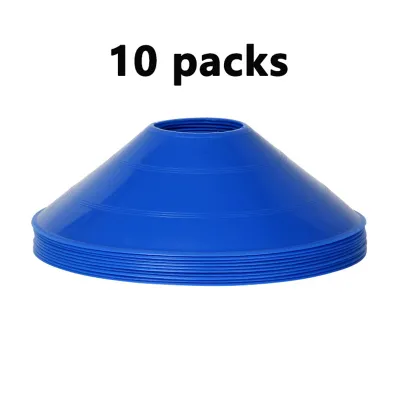
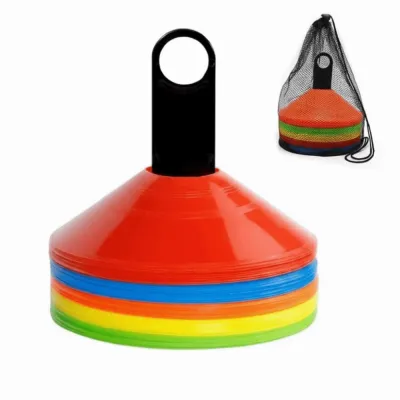
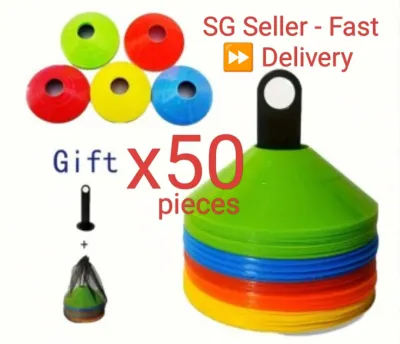
![[SG] Set Plastic Cone Sports Exercise Workout Football Soccer Drills Agility Speed General Purpose](https://img.lazcdn.com/g/p/0b7619dda357d1938ca39666095ef523.png_400x400q80.png_.webp)
![[SPORTS CONE] MARKING CONES TRAINING MARKER PLASTIC MARKER](https://img.lazcdn.com/g/p/56ef18dfacff7cdbdbbb6228d80de111.png_400x400q80.png_.webp)
![[SPORTS CONE WITH HOLES] SKITTLES MARKING CONES TRAINING MARKER PLASTIC MARKER](https://img.lazcdn.com/g/p/dffe1837899729a8c8daac331ee42448.png_400x400q80.png_.webp)
![[MARKING CONE][SET OF 6 PCS] SPORTS MARKING CONES TRAINING MARKER PLASTIC MARKER](https://img.lazcdn.com/g/p/5320820bf2de642e1d6f156627e7cd4d.png_400x400q80.png_.webp)
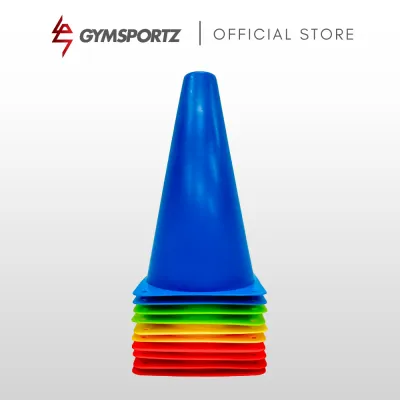
Prices are valid at publication and may change. Please refer to the product page for the latest price.
The 3 Main Types of Football Training Cones Compared
Before purchasing training equipment, it is important to understand how different cone designs influence player movement and drill execution. Training markers are not merely passive indicators; they dictate how closely a player can turn, how high they must lift their feet, and how easily they can visualize boundaries while scanning the pitch.

The market is dominated by three primary categories: disc cones, tall cones, and flexible cones. Each category features distinct physical profiles, heights, and structural behaviors under impact. By comparing these designs, coaches and players can select the most appropriate tools to achieve specific technical outcomes on the pitch.
Disc Cones (Flat Cones)
Disc cones, often referred to as flat cones or saucer cones, are the most ubiquitous marking tools found on football pitches worldwide. These markers typically feature a low-profile design, standing between 2 cm and 5 cm in height with a wide, circular base. Their low rise is intentional, allowing the ball to roll smoothly over them with minimal deflection and preventing players’ boots from catching on the edges.
The primary benefit of disc cones is the minimization of trip hazards during high-speed, fast-paced footwork. Because they sit so close to the ground, players can focus entirely on their stride patterns and ball manipulation without fearing an ankle roll if they accidentally step on a marker.
These low-profile markers are exceptionally well-suited for setting up small grids, acting as alternatives to agility ladders, and creating tight dribbling slaloms. They allow for highly dense layouts where players must execute rapid direction changes in confined spaces. However, their low height means they can easily be obscured by longer natural grass or by other players standing in the line of sight.
Tall Cones (Speed Cones / Hurdle Cones)
Tall cones, also known as speed cones or hurdle cones, stand in stark contrast to their flat counterparts, with heights ranging from 15 cm to over 40 cm. These markers feature a classic conical shape, often with a square base for stability, and some models include pre-drilled holes to hold hurdle poles.
The standout advantage of tall cones is their exceptional visibility from a distance. Because they rise significantly off the ground, they force players to keep their heads up while scanning the field, promoting better spatial awareness and decision-making. Players can easily spot these markers even when sprinting at full speed or when positioned on the opposite side of a large pitch.
Coaches typically deploy tall cones to mark out large pitch boundaries, establish shuttle run turning points, and create physical obstacles for passing lanes. While they are excellent visual aids, they carry a significantly higher trip risk than disc cones. If a player collides with or steps on a rigid tall cone at high speed, it can cause a fall or lead to equipment damage, making them less suitable for tight-space agility drills.
Flexible Cones (Pop-up / Rebound Cones)
Flexible cones, sometimes called pop-up or rebound cones, are engineered to bridge the gap between low-profile safety and high-profile visibility. These markers are manufactured using springy, soft, or highly pliable elastomeric materials that instantly collapse or bend flat when stepped on, kicked, or run over, before immediately returning to their original shape.
The primary benefit of flexible cones is their outstanding safety profile and long-term durability in high-traffic training environments. By absorbing the impact of a player’s weight rather than resisting it, these cones virtually eliminate the risk of ankle injuries and cracking, which are common issues with rigid plastic markers.
These resilient markers are highly recommended for youth training sessions, intense 1v1 physical drills, and any scenario where players are likely to trample the layout. While they are generally more expensive than standard rigid plastic cones, their ability to survive hundreds of impacts without breaking makes them a highly cost-effective investment for schools and clubs over the long term.
Matching Cones to Specific Football Drills
Selecting the right equipment is only half the battle; the true value of your training gear lies in how effectively you apply it to actual sessions on the pitch. Different football drills demand different physical interactions with the markers, meaning a setup that works perfectly for a fitness circuit might fail during a tactical passing exercise.
To optimize your training sessions, it is helpful to pair specific cone types with the exact movement patterns and technical skills you want to develop. Let us look at how to deploy these three cone types across standard training scenarios to maximize player performance and safety.
Agility and Footwork Drills
Agility and coordination drills require rapid, explosive changes of direction where foot placement must be incredibly precise. During these exercises, players focus on quick lateral steps, backward shuffles, and sudden accelerations, leaving very little room for visual distractions or physical obstacles.
Low-profile disc cones are the industry standard for agility work because they allow players to step extremely close to, or even slightly over, the markers without catching their studs. This minimizes the risk of tripping or rolling an ankle during intense, high-speed footwork sequences.
To set up a basic agility grid, place a series of disc cones in a zig-zag pattern spaced approximately 1 to 1.5 meters apart. This forces players to plant their feet firmly and explode outward at sharp angles. Alternatively, you can line up ten disc cones in a straight row with 30 cm intervals to mimic an agility ladder, allowing players to practice high-knees and quick-feet patterns safely.
Dribbling and Ball Control
Dribbling drills require players to manipulate the ball in tight spaces, requiring constant adjustments to their touch, pace, and body positioning. The markers in these drills act as simulated defenders, forcing the ball carrier to weave, cut, and shield the ball.
For tight slalom dribbling where the ball and feet remain in constant close proximity, disc cones are highly effective. Their low height allows the ball to pass over the edges of the cone if a touch is slightly off-target, preventing the drill from grinding to a halt every time a mistake is made.
However, for dynamic 1v1 dribbling exercises where attackers try to beat defenders in a confined zone, flexible cones are the superior choice. These physical contests often result in players and the ball crashing into the markers. Using flexible rebound cones ensures that when a player steps on a marker during a tackle, the cone collapses safely underfoot, maintaining the flow of the drill and preventing injuries.
Pitch Marking and Passing Obstacles
Tactical drills, small-sided games, and passing patterns require players to maintain spatial awareness across larger areas of the pitch. In these scenarios, the markers must define clear boundaries and represent realistic defensive blocks that players must play around or through.
Tall cones are the ideal choice for marking the outer boundaries of a 5v5 or 7v7 grid, especially on large natural grass fields where low-profile disc cones might be swallowed up by the turf. Their height ensures that players can easily spot the sidelines and endlines while keeping their heads up to scan for open teammates.
You can also use tall cones to construct “passing gates”—pairs of cones spaced 1 to 2 meters apart that players must pass the ball through. The height of the tall cones forces the passing player to lift their gaze, assess the target, and deliver an accurate ground pass, simulating the challenge of playing a through-ball past an opponent’s outstretched leg.
Key Features to Verify Before Buying Cones Training Equipment
When browsing online marketplaces or local sporting goods stores in Singapore, it is easy to assume that all training cones are created equal. However, sub-standard materials can quickly degrade, fade, or crack, leading to frequent replacements and unexpected costs. To ensure you purchase durable, high-quality gear, you should verify several physical and material specifications on the product label or manufacturer description.
- Material and Weather Resistance: Always check the product specifications for UV-resistant and weather-proof materials, such as high-density polyethylene (HDPE) or flexible vinyl. This is particularly crucial for equipment used in Singapore's tropical climate, where intense daily UV exposure can make cheap plastics brittle within months, and sudden heavy downpours can waterlog poorly designed gear. Look for labels that explicitly state "UV-stabilized" or "weather-resistant" to ensure the cones will not crack or warp under the hot sun.
- Visibility and Color Contrast: Opt for high-contrast, fluorescent colors such as neon yellow, bright orange, hot pink, and electric blue. These shades stand out clearly against natural green grass as well as the dark green or black rubber infill of artificial turf pitches commonly found at local commercial futsal venues. Having a mix of contrasting colors in your kit bag also allows you to color-code different elements of a single drill, such as using orange cones for boundaries and yellow cones for internal agility gates.
- Base Design and Wind Resistance: On exposed outdoor fields, wind can easily blow lightweight cones out of position, disrupting your session. To prevent this, look for cones featuring aerodynamic shapes with wind-vent holes or those designed with slightly weighted bases. Some premium tall cones feature a wider, heavier square base that lowers the center of gravity, helping them remain upright even when buffeted by strong gusts or clipped by a stray ball.
- Portability and Storage: Transporting dozens of cones to and from the pitch can be a logistical hassle without the right storage solutions. Verify whether the cone set includes a dedicated carrying strap, a plastic stacking cone holder, or a breathable mesh bag. Stackable designs with a central hole are highly desirable, as they allow you to slide fifty or more disc cones onto a single metal or plastic carrier, keeping your gear organized and easy to transport in a backpack or car boot.
Frequently Asked Questions (FAQ)
Can I use the same cones for both football and other sports?
Yes, training cones are highly versatile and universally applicable across a wide range of sporting disciplines. Whether you are setting up agility courses for rugby, marking out boundaries for field hockey, or running fitness conditioning drills for track and field, these markers serve the same fundamental purpose.
While the physical cones remain identical, the spacing, layouts, and drill setups will vary significantly depending on the specific movement patterns and spatial requirements of the sport. For instance, a football slalom might require tight 1-meter spacing, whereas a rugby agility drill might utilize 5-meter gates to accommodate wider running angles and passing arcs.
How many training cones do I need for a full team session?
For a standard football squad of 15 to 20 players, a comprehensive kit should ideally contain between 40 and 60 disc cones and at least 8 to 12 tall cones. This quantity allows you to set up multiple simultaneous training stations, preventing players from standing around in long lines and maximizing active participation time.
Purchasing these items in bulk sets is highly cost-effective, often saving you significant money compared to buying individual pieces. For example, a bulk pack of 50 disc cones with a carrying strap typically costs between S$15 and S$30 on local online marketplaces, making it an affordable and essential investment for coaches, schools, and recreational teams alike.
Do I need to clean and maintain my training cones?
To maximize the lifespan of your training equipment, performing simple, low-risk maintenance after outdoor sessions is highly recommended. After training on muddy natural grass or artificial turf, rinse the cones with clean water to remove dirt, mud, and black rubber pellets that can accumulate on the surfaces.
Always allow the cones to air dry completely in a shaded, well-ventilated area before stacking and packing them away in a storage bag. Storing damp cones in a sealed container can lead to mold growth and accelerate the degradation of flexible plastics. Additionally, periodically inspect your cones for deep cracks or permanent deformation, replacing any damaged markers to maintain a safe training environment.
Community discussion
Share your experience or ask a question. Comments are reviewed before publication.