
Quick Answer: Which Badminton Shuttlecocks Should You Buy?
Choosing the right badminton shuttlecocks depends primarily on your skill level, where you play, and how much you are willing to spend over time. For beginners, recreational players, and those playing outdoors, nylon shuttlecocks are the superior choice because of their incredible durability and low running costs. Conversely, intermediate and advanced players who train or compete indoors on proper courts should opt for feather shuttlecocks, which offer the authentic flight trajectory, precise control, and tactile feedback required for high-level play.
The choice boils down to a fundamental trade-off between flight performance and structural longevity. While feathers provide unparalleled accuracy and a satisfying, crisp feel on impact, they degrade quickly and require consistent, clean hitting technique to prevent premature damage. Nylon, on the other hand, withstands repeated mishits and offers highly predictable, forgiving performance, making it the practical option for casual rallies in Singapore’s community spaces or neighborhood courts.
Flight Characteristics and Playability
The aerodynamic behavior of a shuttlecock determines how you control the game, execute strategies, and feel each shot on your racket strings. Natural feathers and synthetic nylon interact with the air in fundamentally different ways, creating distinct flight paths that directly impact your playing experience. Understanding these aerodynamic variations helps players understand why a specific shuttlecock behaves the way it does during different strokes.
Products mentioned in this guide
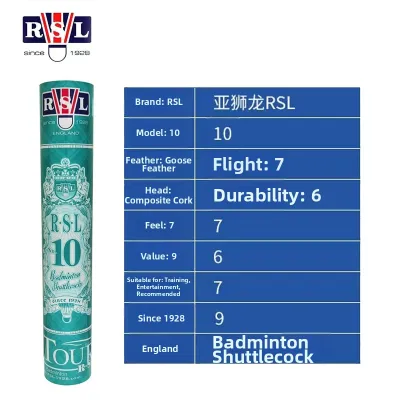
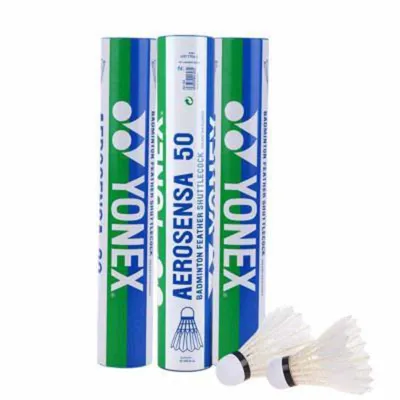
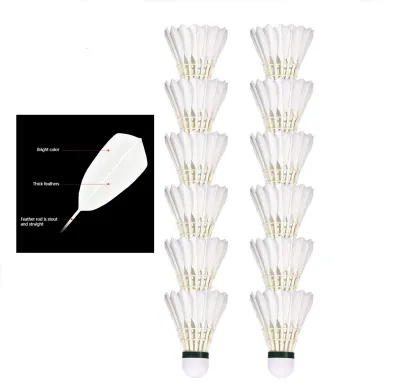
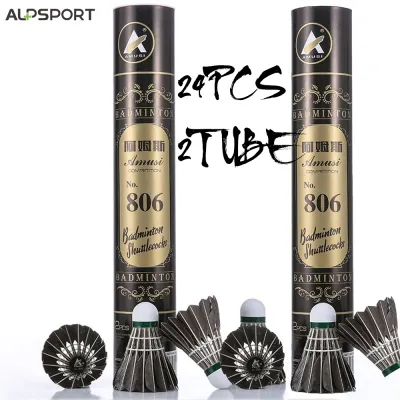
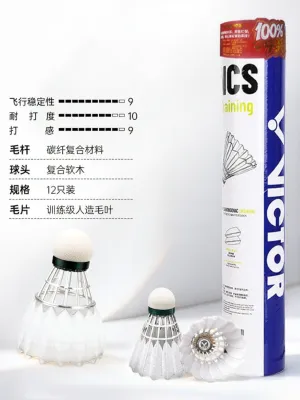
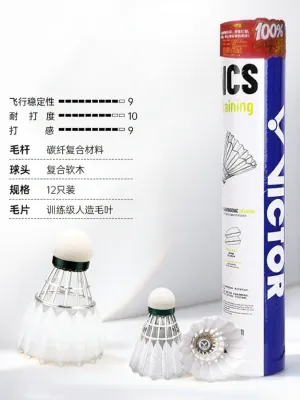
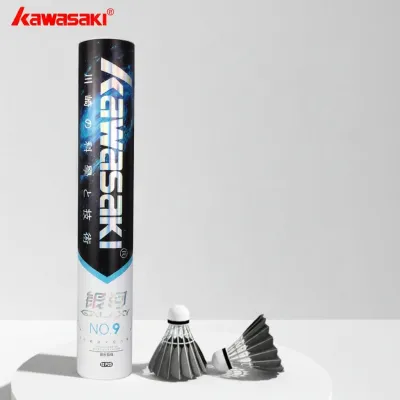
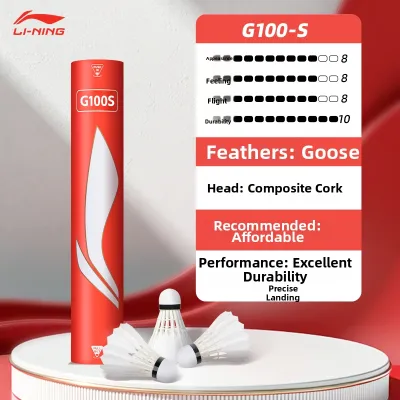
Prices are valid at publication and may change. Please refer to the product page for the latest price.

Feather Shuttlecocks: Precision and Control
Natural feather badminton shuttlecocks, typically constructed from goose or duck feathers, offer a highly sophisticated aerodynamic profile. When struck, the overlapping feathers create a natural spin that stabilizes the shuttlecock quickly in mid-air. This rotation allows the shuttlecock to climb rapidly and then decelerate sharply, resulting in a steep, near-vertical drop angle at the end of its trajectory.
This rapid deceleration is crucial for advanced tactical play. It enables players to execute tight net drops that tumble closely over the tape, and precise clears that land safely within the baseline boundaries without sailing out. Additionally, the natural cork base combined with the feather skirt provides a soft, cushioned feel upon impact, giving the player immediate tactile feedback. However, achieving this level of precision requires consistent racket speed and clean contact, as off-center hits can easily disrupt the delicate feather alignment.
Nylon Shuttlecocks: Stability and Forgiveness
Nylon shuttlecocks, often referred to as plastic shuttles, feature a synthetic skirt molded to replicate the shape of natural feathers. Because the synthetic skirt is a single continuous piece of material, it does not compress or expand in the air the same way individual feathers do. This structural difference results in a flatter, more parabolic flight trajectory with slower initial deceleration, meaning the shuttlecock retains its speed longer and travels further before dropping.
On impact, nylon shuttlecocks present a noticeably stiffer feel against the racket strings. This stiffness can feel less forgiving on the wrist, but the physical durability of the synthetic skirt is highly forgiving of poor technique. When a beginner mishits the shuttlecock on the plastic skirt rather than the cork, the nylon simply deforms temporarily and recovers its shape. While this stability is excellent for keeping rallies going, it lacks the delicate aerodynamic responsiveness needed for advanced maneuvers. Executing complex spin shots or sharp, tumbling net drops is significantly more difficult with nylon because the synthetic skirt does not grip the air or spin with the same nuance as natural feathers.
Durability and Lifespan
The physical longevity of badminton shuttlecocks is one of the most significant practical considerations for any player. The materials used in construction dictate not only how many games a single shuttlecock can survive, but also how its performance degrades over its lifespan.
Feather shuttlecocks are notoriously fragile. Each shuttlecock relies on 16 individual feathers inserted into a cork base and secured with thread and glue. If even a single feather shaft cracks, splits, or loses its natural vane structure, the aerodynamic balance is compromised. For intermediate players, a single hard smash or a slight mishit on the feather skirt can ruin a brand-new shuttlecock instantly. In competitive scenarios, it is common to use multiple feather shuttlecocks within a single match, as the high-velocity impacts gradually weaken the feathers, causing them to fray and lose their flight stability.
In contrast, nylon shuttlecocks are engineered for exceptional resilience. The synthetic polymer skirt can withstand hundreds of high-impact hits and severe mishits without structural failure. When struck off-center, the nylon skirt bends and flexes, immediately springing back into its original shape. This durability makes nylon the go-to option for training sessions, multi-feed drills, and casual matches where players are still developing their timing and sweet-spot accuracy. A single quality nylon shuttlecock can easily last for several full sessions of intense play before needing replacement.
Recognizing when to retire a shuttlecock is essential for maintaining a fair and enjoyable game. For feather models, look for broken shafts, missing feather segments, or a noticeable wobble during flight; once the shuttlecock starts spinning unevenly or slowing down prematurely, it should be replaced. For nylon models, wear is typically indicated by visible tearing along the lattice of the synthetic skirt, a softening of the plastic material, or a persistent warp in the skirt’s shape that causes the shuttlecock to veer off-course.
Cost and Value Over Time
When evaluating the financial aspect of badminton shuttlecocks, players must look beyond the initial retail price and consider the long-term cost per hour of court time. The rapid consumption rate of fragile materials can quickly turn a seemingly minor expense into a significant ongoing investment.
Feather shuttlecocks sit at the premium end of the market. A standard tube typically contains 12 shuttlecocks, and because of the complex manufacturing process involving natural materials, the upfront cost is relatively high. When you factor in their short lifespan—where a single game might consume one or two shuttles—the cost per hour of play rises dramatically. For a group of recreational players who frequently mishit, playing with feathers can become an expensive habit, requiring multiple tubes over just a few weeks of regular play.
Nylon shuttlecocks offer a much more economical profile. Although a tube of high-quality nylon shuttles may have a moderate upfront cost, their extreme durability means a single tube can easily last for months of casual play. This high survivability drives the cost-per-game down to a fraction of what you would spend on feathers. For families, casual groups, and social clubs operating on a tight budget, nylon is almost always the most sensible financial choice.
However, the value equation shifts slightly for advanced players. Experienced players with consistent racket technique rarely mishit the shuttlecock on the skirt, contacting the cork base almost exclusively. This clean contact extends the lifespan of a feather shuttlecock significantly, allowing a single shuttle to last for several games. For these players, the superior flight performance and tactical control of feathers justify the higher cost, as they are able to extract maximum value from each unit.
To find the best balance for your budget, it is advisable to check current prices at local sporting goods stores or online e-commerce platforms in Singapore. Premium feather brands often carry a high price premium, and prices can fluctuate based on material availability and shipping costs. Opting for mid-range feather options or high-durability nylon models can help manage expenses without sacrificing too much playability.
How to Choose Based on Your Profile
Selecting the ideal badminton shuttlecocks requires matching the material properties to your personal playing habits, environment, and goals. By identifying where you fit within specific player profiles, you can make a choice that maximizes your enjoyment on the court while respecting your budget.
Choose Nylon if:
- You are a beginner or casual player still mastering racket timing and clean contact.
- You primarily play outdoors, such as in HDB void decks, parks, or open-air community courts, where wind resistance and durability are paramount.
- You want to minimize ongoing replacement costs and avoid the frustration of discarding damaged shuttlecocks after a few rallies.
- You are using the shuttlecocks for school physical education classes, family recreation, or light fitness sessions.
Choose Feather if:
- You are an intermediate, advanced, or competitive player who relies on precise drop shots, net spins, and accurate clears.
- You play exclusively indoors on dedicated courts, such as ActiveSG sports halls or private club facilities, where air currents are controlled.
- You are training for tournaments or participating in organized club sessions where standard tournament rules apply.
- You have developed consistent racket technique that minimizes off-center hits on the shuttlecock skirt.
Neither may fit if:
- You are playing in highly windy outdoor environments, such as Singapore's breezy coastal parks. In these extreme conditions, standard badminton shuttlecocks of any material will drift wildly; instead, you should look for specialized, heavier outdoor shuttlecocks designed specifically to resist wind.
- You are engaging in purely recreational backyard games where the racket sport rules are not strictly followed, and any lightweight foam or plastic toy ball would suffice.
| Skill Level | Primary Venue | Budget Priority | Flight Characteristic | Recommended Type |
|---|---|---|---|---|
| Beginner / Casual | Outdoor / Indoor | Low Cost / High Durability | Flatter trajectory, slower decay | Nylon |
| Intermediate / Advanced | Indoor Courts | Performance-focused | Steep drop, fast spin decay | Feather |
| Professional / Tournament | Indoor Courts | Maximum Precision | Perfect aerodynamic consistency | Premium Feather |
| Outdoor Recreational | Windy Parks / Open Spaces | Wind Resistance | Heavy, wind-resistant path | Specialized Outdoor |
Frequently Asked Questions (FAQ)
Can I use feather shuttlecocks for outdoor badminton?
It is highly recommended to avoid using feather shuttlecocks for outdoor play. Natural feathers are extremely light and aerodynamically sensitive, meaning even a gentle outdoor breeze will drastically alter their flight path, making controlled rallies nearly impossible. Furthermore, Singapore’s outdoor environments present challenges like high humidity, sudden rain, and rough ground surfaces. Moisture from the air or damp grass can quickly weigh down the feathers, ruining their structural integrity and warping the cork base upon impact with hard concrete. For outdoor sessions, nylon shuttlecocks or specialized wind-resistant outdoor models are far more durable and practical.
How should I store feather shuttlecocks to make them last longer?
Proper storage is essential to prevent natural feathers from becoming dry and brittle, which leads to premature cracking during play. In Singapore’s climate, while the natural humidity generally keeps feathers moist, storing them in constantly air-conditioned rooms can dry them out. Keep your shuttlecock tubes in a cool, dry place away from direct sunlight and extreme heat, avoiding hot areas like a car boot parked in the sun. To extend their lifespan, some players use specialized humidifying infusers or briefly expose the open ends of the tube to gentle steam before sealing them, ensuring the feathers retain their elasticity and structural strength.
Community discussion
Share your experience or ask a question. Comments are reviewed before publication.