
Fitting dedicated cardio equipment into an HDB flat requires balancing your fitness goals with strict spatial limitations. Choosing between a Kiprun treadmill and an elliptical depends on accurately measuring your available floor area, understanding safety clearances, and verifying the machine’s storage features against the manufacturer’s specifications. Because HDB layouts prioritize efficient space utilization, you must evaluate how each equipment type operates, folds, and moves within your home before making a purchase. By focusing on verifiable product specifications, such as active footprints, folded dimensions, and clearance requirements, you can select a machine that supports your training routine without disrupting your household. This guide outlines the essential spatial, structural, and environmental checks you need to perform to ensure your new cardio machine integrates seamlessly into your living space.
Assessing Your HDB Space and Clearance Needs
Before selecting a Kiprun model, establish a precise map of your planned workout area. Measure the length and width of the designated floor space using a standard tape measure. Recording these dimensions accurately is vital, as even a small discrepancy can prevent a machine from fitting safely into a room or corridor.
Ceiling height is also critical, especially for ellipticals. As you exercise, your body rises and falls with the pedal stride, making your peak height during a workout significantly higher than your standing height. To calculate the required ceiling height, add your height to the machine’s maximum pedal height, then add a safety buffer of twenty to thirty centimeters to avoid overhead fixtures.
Products mentioned in this guide
Prices are valid at publication and may change. Please refer to the product page for the latest price.
Safety clearances are equally important. Manufacturers specify mandatory clearance zones behind and beside cardio equipment for safe mounting, dismounting, and emergency stops. For treadmills, a clear safety zone of at least two meters behind the belt is recommended to prevent injury during a fall, while a clearance of half a meter on both sides is standard.
Finally, plan the physical path from the delivery vehicle to your flat. Measure the width and height of your HDB main door, internal doorways, corridors, and the passenger lift. Cardio machines are delivered in large, heavy boxes requiring ample turning space; verifying these entry points beforehand prevents delivery delays or unboxing in public corridors.
Treadmill vs. Elliptical: Footprint and Usage Constraints
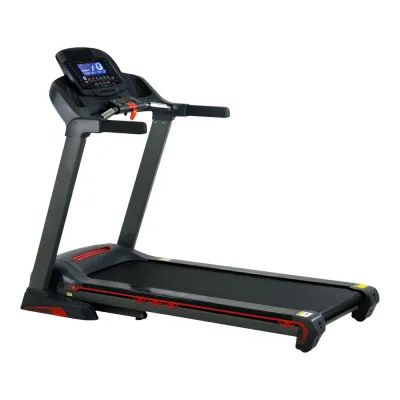
When comparing a treadmill and an elliptical for an HDB flat, the way each machine occupies space during use is a primary differentiator. Treadmills generally require a long, rectangular active footprint to accommodate the running deck and the necessary rear safety clearance. While many modern treadmills feature folding decks to save space when idle, their active footprint remains fixed and substantial during your workout.

In contrast, an elliptical trainer typically occupies a more compact but taller volume of space. The physical frame of an elliptical is often shorter than a treadmill deck, but the moving handlebars and foot pedals require lateral and vertical clearance that extends beyond the static frame. You must ensure that the elliptical’s stride path does not interfere with nearby furniture, walls, or low-hanging decorative items when the machine is in motion.
Noise and vibration transfer are significant considerations when operating fitness equipment in a multi-story HDB block. Treadmills generate high-impact noise and structural vibrations every time your foot strikes the running belt, which can easily travel through the concrete floor slab and disturb neighbors living in the unit directly below you. Ellipticals, on the other hand, utilize a continuous, low-impact gliding motion that produces minimal impact noise, making them a quieter alternative for early morning or late-night workouts.
Your choice should also align with your workout style and how the machine’s physical presence affects daily household traffic. If your flat has a dedicated study or a spacious living room corner, a treadmill can be positioned to allow for safe running while keeping the rest of the room accessible. If space is exceptionally tight, the smaller static footprint of an elliptical may allow it to sit unobtrusively in a bedroom corner, provided you have verified that the moving parts do not block access to wardrobes or doorways.
Space-Saving Features to Verify on Kiprun Models
To maximize the usability of your HDB flat, you should carefully verify the space-saving design features listed in the product specifications of Kiprun models. The folding mechanism is one of the most important features to evaluate. Many modern treadmills utilize a hydraulic assist or soft-drop system that allows you to lift and lower the heavy deck with minimal physical effort, while other models may require manual lifting and locking pins. Always check the user manual to confirm whether the folding process requires tools or if it can be performed quickly by a single person.
Integrated transport wheels are another essential feature for apartment settings, as they allow you to move the machine out of the way when it is not in use. When reviewing product specifications, check the number and orientation of the transport wheels, as some machines only roll forward and backward, while others feature multi-directional wheels for easier maneuvering in tight corners. Additionally, verify the stability of the machine when stored in its upright position, ensuring that the base footprint is secure and does not pose a tipping hazard to children or pets.
Before making a final decision, compare the manufacturer’s listed folded dimensions against the exact measurements of your intended storage area, such as a utility closet, a niche behind a door, or a designated corner of your living room. Keep in mind that even when folded, some machines may still have protruding parts, such as handlebars or console brackets, that extend beyond the main frame. You must also ensure there is adequate ventilation and clearance around the motor housing and electrical components when the machine is stored to prevent heat buildup or moisture accumulation.
Delivery, Assembly, and Floor Protection
Installing heavy cardio equipment in an HDB flat requires careful preparation to protect your home’s interior and ensure a smooth setup process. Begin by planning a dedicated assembly area close to the machine’s final location. Unboxing a treadmill or elliptical requires sufficient space to lay out all the components, hardware, and tools systematically, so clearing a temporary workspace in your living room or hallway is highly recommended before the delivery team arrives.
To safeguard your HDB flooring from scratches, indentations, and structural wear, you should select a high-density equipment mat to place underneath the machine. Heavy fitness equipment can exert significant pressure on vinyl, laminate, parquet, or tiled floors, potentially causing permanent damage over time. A specialized mat not only distributes the weight of the machine more evenly but also acts as a barrier that dampens operational vibrations and reduces the transmission of noise to the units below.
Once the machine is assembled and placed on the mat, you must verify that it is completely level. Most cardio machines feature adjustable leveling feet or stabilizers on the base frame to compensate for slightly uneven apartment floors. Refer to the manufacturer’s instructions to adjust these feet until the machine sits completely flat without rocking or swaying when you apply weight. An unlevel machine can cause uneven wear on the internal belt or drive mechanisms, leading to premature mechanical issues and increased operational noise.
Frequently Asked Questions (FAQ)
Can I place a Kiprun treadmill or elliptical on an HDB balcony?
Placing a Kiprun treadmill or elliptical on an HDB balcony is generally not recommended due to the environmental risks associated with semi-outdoor spaces. Singapore’s high humidity, intense direct sunlight, and exposure to wind-driven rain can quickly damage the sensitive electronic consoles, wiring, and motor components of your fitness equipment. Moisture can lead to rust on the metal frame and internal bearings, while UV exposure can degrade plastic parts and digital screens.
Furthermore, keeping cardio equipment on a balcony may void the manufacturer’s warranty, as standard warranties typically cover indoor residential use only. You should also verify the structural weight limits of your balcony and ensure that placing a heavy machine there does not obstruct emergency escape routes or access to utility ledges. To protect your investment and ensure safe operation, it is recommended to keep your fitness equipment within the main, climate-controlled living areas of your flat.
Do I need a specialized equipment mat for Kiprun cardio machines?
Yes, using a specialized, high-density equipment mat is highly recommended when installing a Kiprun treadmill or elliptical in an HDB flat. A dedicated mat serves multiple protective functions, such as preventing the heavy metal feet and rollers of the machine from leaving permanent indentations or scratches on your vinyl, laminate, or timber flooring. It also catches any sweat, water, or mechanical lubricant drips that may occur during workouts, making cleanup easier and protecting your floors from moisture damage.
When choosing a mat, ensure that its dimensions are slightly larger than the maximum active footprint of your machine to provide complete coverage. The mat should be made of a dense, non-slip material like heavy-duty rubber or PVC, which helps keep the machine stable during intense workouts. Check your equipment manual for any specific recommendations regarding mat thickness, as a mat that is too soft or thick can compromise the stability of the machine, while one that is too thin may not provide adequate vibration dampening.
Community discussion
Share your experience or ask a question. Comments are reviewed before publication.