
A single bike pump rarely satisfies every cycling need. Your choice hinges on whether you prioritize home maintenance, roadside emergency recovery, or rapid, competitive tire inflation.
To determine which tool fits your routine, consider this conditional decision framework:
- Choose a floor pump if you want accurate, high-volume inflation for regular home maintenance, pre-ride checks, and seating tubeless tires. This is the foundation of any rider's toolkit.
- Choose a portable hand or frame pump if you want a reliable, reusable emergency tool for on-road or trail repairs without carrying single-use consumables.
- Choose a CO2 inflator if you prioritize ultra-fast, low-effort inflation during races or fast-paced group rides, and do not mind the ongoing cost of cartridges.
Many cyclists in Singapore adopt a two-pump system. They keep a robust floor pump in their HDB flat or condominium storeroom for weekly pressure checks, and carry a compact portable hand pump or a CO2 inflator in their saddlebag when riding along the Park Connector Network (PCN) or climbing Mount Faber.
Products mentioned in this guide
![[LH7W] Bike Air Pump Portable Bicycle Pump Hand Air Pumps with Schrader Valve for Bike Tires Balls Balloons](https://img.lazcdn.com/g/p/a25ed6b70dc7d6221dfcf03b31a98d23.jpg_400x400q80.jpg_.webp)
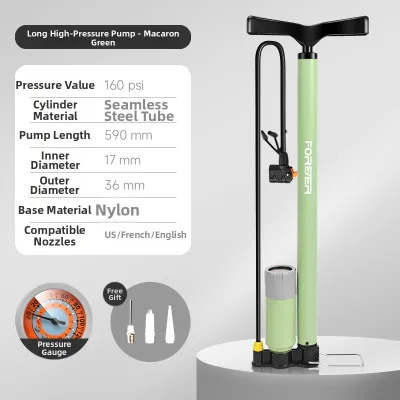
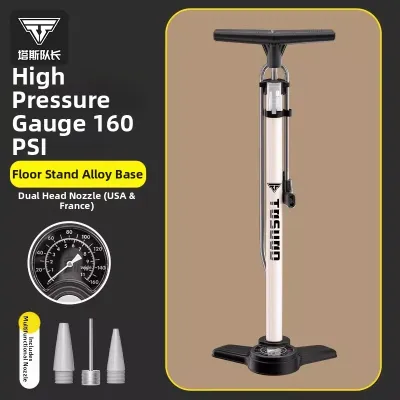
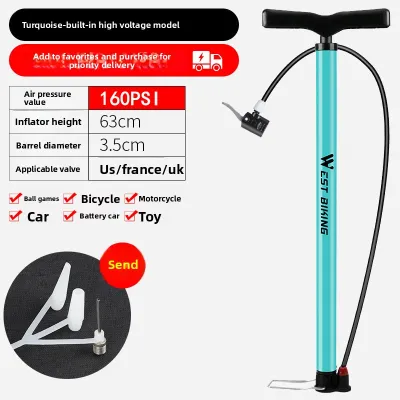
Prices are valid at publication and may change. Please refer to the product page for the latest price.
Understanding the Three Main Bike Pump Types
Before investing in inflation gear, it is essential to understand the physical design, mechanics, and primary use cases of each form factor. Choosing the wrong type can lead to unnecessary physical strain or a tool that is too bulky to carry.
Floor Pumps (Track Pumps)
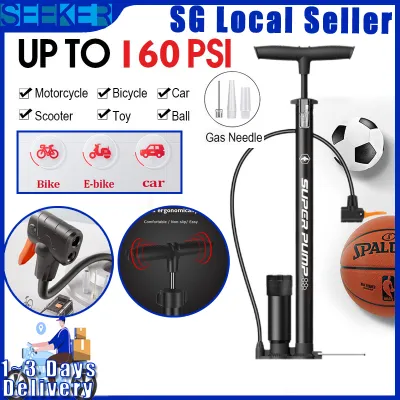
Floor pumps are the workhorses of bicycle maintenance. They feature a tall metal or composite barrel, a wide, stable baseplate for your feet, an ergonomic T-handle, and a long, flexible rubber hose.
Because of their large internal chamber, floor pumps deliver a high volume of air per stroke. This mechanical advantage allows you to inflate tires quickly and with minimal physical exertion.
These pumps are designed to remain stationary. In space-conscious Singapore apartments, they are easily stored in an entryway corner, a balcony, or a dedicated utility closet.
Portable Pumps (Hand and Frame Pumps)
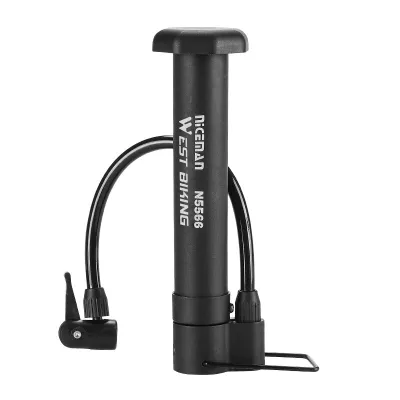
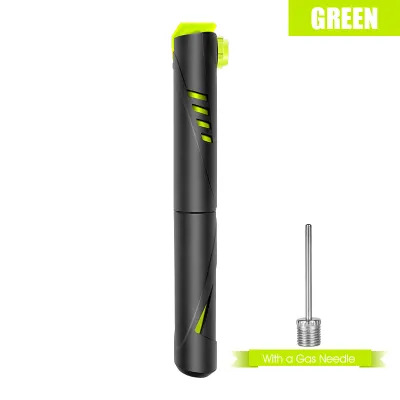
Portable pumps are designed specifically for on-the-go emergency use. They range from tiny, pocket-sized mini-pumps (typically 15 to 25 centimeters long) to longer frame-mounted pumps that sit securely under your top tube.
The primary trade-off with portable pumps is size versus efficiency. Because the internal piston chamber is small, these pumps deliver a low volume of air per stroke. Reaching high pressures requires hundreds of manual strokes and significant arm strength.
To mitigate this, some manufacturers offer dual-action designs. These models pump air into the tire on both the push and pull strokes, doubling the inflation efficiency during roadside repairs.
CO2 Inflators
CO2 inflators are minimalist, high-speed inflation systems. They consist of a small, lightweight metal inflator head that screws onto a pressurized steel cartridge filled with liquid carbon dioxide ($CO_2$).
When you attach the inflator head to a tire valve and trigger the release mechanism, the pressurized gas expands instantly, inflating a flat tire in seconds. This eliminates all manual pumping effort.
However, CO2 systems have clear limitations. The cartridges are strictly single-use and must be recycled after discharging. Additionally, the rapid expansion of gas causes the cartridge to drop to sub-zero temperatures instantly, presenting a risk of cold burns if handled without a protective foam sleeve or thick riding gloves.
Key Comparison Dimensions for Cyclists
To help you weigh your options, this section compares the three pump types across the critical dimensions of portability, speed, physical effort, accuracy, and long-term running costs.

| Feature | Floor Pump | Portable Pump | CO2 Inflator |
|---|---|---|---|
| Portability | Low (Stationary home use) | High (Frame mount or pocket) | Excellent (Fits in tiny saddlebags) |
| Inflation Speed | Fast (1–2 minutes) | Slow (5–10 minutes manual) | Near-Instant (2–3 seconds) |
| Effort Required | Low (Uses body weight) | High (Repetitive manual arm work) | Zero (Pressurized gas discharge) |
| Pressure Accuracy | High (Large analog/digital gauge) | Low to Medium (Small inline gauge) | Low (Requires separate gauge) |
| Running Costs | One-time purchase | One-time purchase | Ongoing (Single-use cartridges) |
Portability and Storage
Floor pumps require dedicated storage space and are too heavy and bulky to carry during a ride. They are strictly home-based tools.
Portable pumps are highly versatile. They typically come with mounting brackets that bolt onto your bottle cage bosses, or they can be tucked into a jersey pocket or frame bag.
CO2 inflators are the ultimate space-saving solution. An inflator head and two cartridges take up less space than a spare inner tube, easily fitting into a minimalist saddlebag.
Inflation Speed and Effort
A floor pump utilizes your body weight as you push down on the T-handle, making it easy to inflate a tire to 80 PSI in under a minute.
A portable hand pump relies entirely on upper-body strength. In Singapore’s hot, humid climate, spending five minutes vigorously pumping a tire on the side of the road can leave you exhausted and drenched in sweat.
A CO2 inflator bypasses physical labor entirely. It inflates a tire to riding pressure in two to three seconds, allowing you to resume your ride almost immediately.
Maximum Pressure and Accuracy
Floor pumps are engineered to reach high pressures (often up to 120 to 160 PSI, depending on the model) and feature large, highly legible pressure gauges. This allows you to dial in your exact target pressure before heading out.
Portable pumps struggle to reach high pressures. While some models are rated for 100 PSI, the physical resistance becomes incredibly high as you approach that limit. Inline gauges on portable pumps are often small, difficult to read, or non-existent.
CO2 inflators do not allow for precise pressure regulation. The final pressure is determined by the size of the cartridge (usually 16g or 25g) and the volume of your tire. You must check the pressure later with a dedicated gauge to ensure it falls within safe riding limits.
Maintenance and Running Costs
Both floor and portable pumps are highly durable, one-time investments. With basic maintenance, such as lubricating the internal piston chamber and replacing worn rubber O-rings, a quality pump can last for a decade.
CO2 inflators have low initial costs, but the cartridges are ongoing consumables. In Singapore, a pack of threaded CO2 cartridges typically costs between S$15 and S$30 depending on the quantity. Additionally, you must verify valve compatibility (Presta vs. Schrader) for all pump types, as some cheaper CO2 heads only support Presta valves.
Matching the Pump to Your Cycling Routine
Your primary cycling discipline, typical riding distances, and local environmental conditions should dictate your pump setup.
Road Cycling and High-Pressure Tires
Road tires have narrow profiles and require high pressures (typically 70 to 100+ PSI) to prevent pinch flats and minimize rolling resistance. Before inflating your tires, always check the recommended minimum and maximum pressure ranges printed on your tire’s sidewall.
For on-the-road puncture repairs, road cyclists often prefer CO2 inflators. They are lightweight, aerodynamic, and get you back into a fast-moving group ride without delay.
If you prefer self-reliance without worrying about empty cartridges, a high-pressure-specific (HP) mini-pump is an excellent alternative. These pumps have narrower barrels that make reaching high pressures manually much easier.
Mountain Biking and Trail Riding
Mountain bike tires are wide and operate at low pressures (typically 20 to 35 PSI) but require a massive volume of air. A high-volume floor pump is ideal for home maintenance and seating tubeless tires.
When riding trails like those at Chestnut Nature Park or Kent Ridge, a high-volume (HV) portable hand pump is highly recommended. Look for a model with a flexible, extendable hose. A direct-mount pump can put severe lateral stress on the valve stem while you pump, risking a torn valve on rough terrain.
While CO2 inflators can be used, a standard 16g cartridge may not provide enough volume to fully inflate a wide 29-inch trail tire, often requiring a larger 25g cartridge or multiple canisters.
Commuting and Urban Folding Bikes
For daily commuters navigating Singapore’s Park Connector Network (PCN) or riding folding bikes, reliability and low maintenance are paramount.
A compact floor pump kept at home and a reliable frame-mounted mini-pump are the ideal combination. Since commuting is utility-focused, the reliability of a manual pump outweighs the speed of CO2, ensuring you are never stranded with an empty canister.
Folding bike riders should look for ultra-compact mini-pumps that can mount discreetly to the frame or fit inside a small commuter backpack without adding noticeable weight.
Gravel and Mixed-Terrain Riding
Gravel riding involves transitioning between smooth tarmac and loose dirt, where tire pressure is highly sensitive. A difference of just 5 PSI can dramatically alter your traction and comfort.
Gravel riders benefit from carrying a portable pump equipped with an integrated digital gauge, or carrying a separate pocket-sized digital pressure gauge. This allows you to make precise, on-the-fly pressure adjustments when transitioning from paved roads to rough gravel paths.
Essential Features to Verify Before Buying
Before purchasing any bike pump, review this checklist of critical specifications and build qualities to ensure long-term usability and safety.
- Valve Compatibility: Ensure the pump head supports both Presta (the thin valves found on most road and modern mountain bikes) and Schrader (the wider valves common on commuter and children's bikes) natively. Look for "smart" heads that automatically adjust to either valve type without requiring you to disassemble internal rubber grommets.
- Build Materials: Prioritize metal construction. Aluminum or steel barrels and bases offer superior durability over plastic alternatives, which can flex, crack, or strip their threads under high pressure.
- Hose Quality: A long, flexible, reinforced rubber hose is crucial for floor pumps. It allows you to pump with the bike mounted on a workstand. For portable pumps, an extendable hose relieves physical stress on the valve stem during frantic roadside pumping.
- Gauge Placement and Readability: On floor pumps, top-mounted gauges near the handle are significantly easier to read than base-mounted ones, especially in dim garage lighting. Look for high-contrast dials or clear digital screens.
- Rebuild Kits and Spare Parts: Before buying a premium pump, check if the brand sells replacement parts like rubber gaskets, hose assemblies, and internal piston O-rings. This ensures your pump remains a lifetime tool rather than a disposable item.
Frequently Asked Questions (FAQ)
Can I use a CO2 inflator for tubeless bike tires?
Yes, a CO2 inflator can be used to seat a tubeless tire in an emergency because the sudden, high-volume blast of gas forces the tire bead against the rim. However, there is a critical caveat: the extreme cold of expanding CO2 can freeze or coagulate certain liquid tubeless sealants. Always check your sealant manufacturer’s guidelines. If you must use CO2 on the trail, it is recommended to release the CO2 once you return home and refill the tire with regular air, checking if fresh sealant needs to be added.
Do portable bike pumps work for both road and mountain bikes?
While most portable pumps can physically connect to both Presta and Schrader valves, they are usually optimized internally for either high pressure or high volume. High-pressure (HP) pumps have narrow barrels designed to reach 80–100+ PSI with manageable force, but they push very little air per stroke, making them tedious for large mountain bike tires. High-volume (HV) pumps have wider barrels that push more air per stroke but become extremely difficult to pump as pressures exceed 40–50 PSI. Choose a pump rated specifically for your tire type.
Community discussion
Share your experience or ask a question. Comments are reviewed before publication.