
Setting up a home gym in a Singapore Housing & Development Board (HDB) flat requires a careful balance between fitness goals and spatial reality. A roman chair—essential for targeting the lower back, glutes, and hamstrings—can easily dominate a room if you choose the wrong design. To find a model that fits seamlessly into your home, you must prioritize a flat-folding mechanism, a compact footprint of under 1.2 square meters during use, and a frame weight that balances stability with easy portability.
Quick Selection Criteria for Compact Home Gyms
Typical HDB bedrooms range from 9 to 12 square meters, leaving very little clearance once a bed and wardrobe are in place. Therefore, any fitness equipment must either occupy a highly restricted active zone or be easily stowed away when not in use. The ideal footprint for an active roman chair in these spaces should not exceed 120 cm in length and 70 cm in width, allowing you to perform extensions without blocking walkways.
Flat-folding mechanisms are far superior to merely collapsible frames for tight living quarters. A true flat-folding frame collapses into a single linear profile, usually under 30 cm in height, allowing it to slide under a bed frame or stand vertically behind a wardrobe. Collapsible frames often fold only partially, leaving awkward angles that still consume valuable floor space and make storage difficult.
Products mentioned in this guide
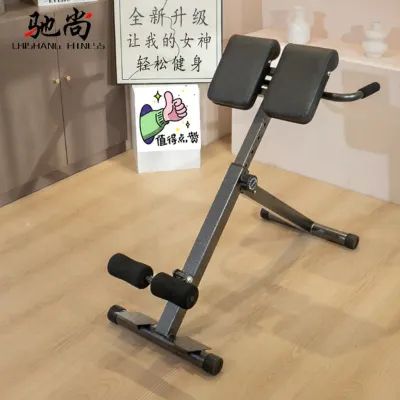
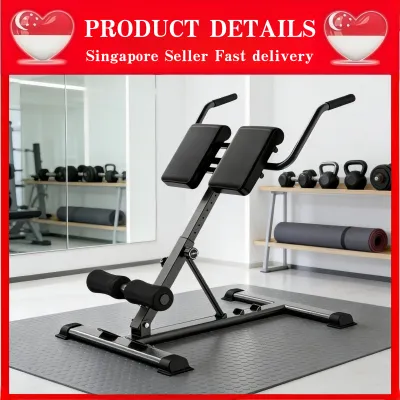
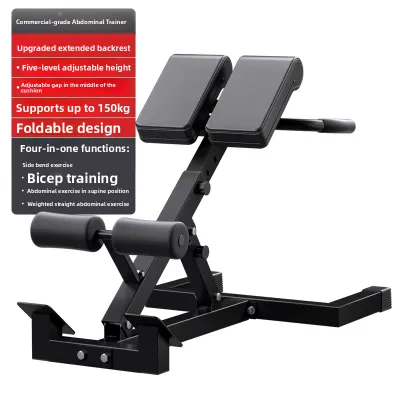
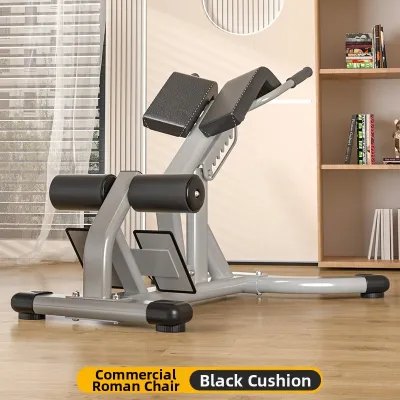
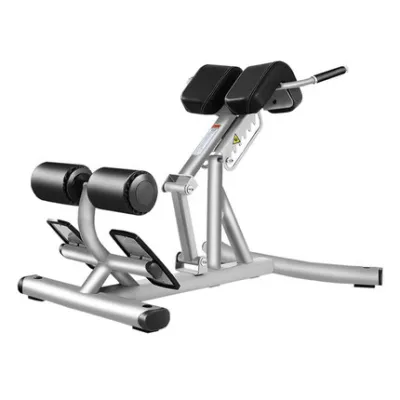
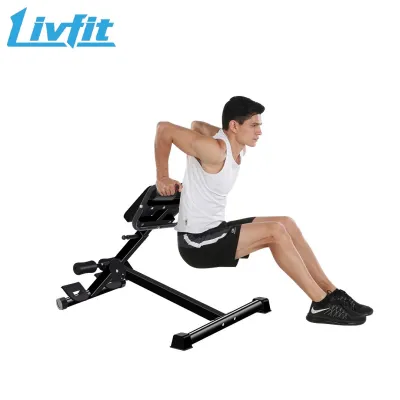
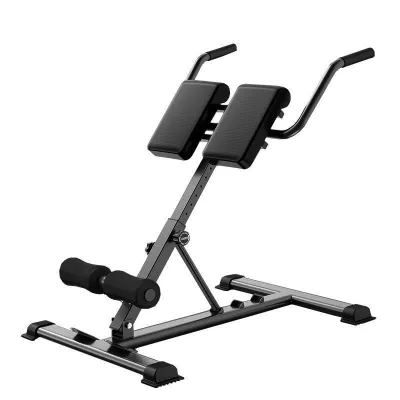
Prices are valid at publication and may change. Please refer to the product page for the latest price.
When selecting a space-saving model, you must navigate the trade-off between lightweight portability and structural rigidity. Ultra-lightweight frames are easy to carry but can wobble or tip during intense hyperextensions. Conversely, heavy steel frames offer rock-solid stability but are difficult to drag across the room daily, making built-in transport wheels a non-negotiable feature for home use.
Essential Features for Small-Space Roman Chairs
Folding Mechanism
Folding mechanisms generally fall into two categories: pin-lock systems and quick-release hinges. Pin-locks use a solid steel pin inserted through aligning holes, offering high security but requiring manual alignment that can be tedious. Quick-release hinges feature spring-loaded pull pins that speed up the process, though you must regularly inspect the spring tension to ensure secure locking. Single-person operation is crucial; you should be able to fold and unfold the unit safely without needing another person to support the frame.

Footprint and Clearance
There is a significant difference between a machine’s static footprint and its active clearance zone. While the physical frame might only measure 100 cm by 60 cm, your body will extend beyond these dimensions during a hyperextension. You must account for handlebar swing and your head clearance at the bottom of the movement. Ensure you have at least 1 meter of open space in front of the machine to prevent your head or hands from striking walls or furniture.
Weight and Portability
A stable home-use roman chair typically weighs between 15 kg and 25 kg. To make daily room conversions manageable, look for frames equipped with integrated transport wheels on the front stabilizer bar. This allows you to tilt the folded unit and roll it into a closet rather than lifting its entire weight, protecting both your lower back and your flooring.
Adjustability
To ensure proper biomechanics, the hip pads and ankle rollers must adjust to your height. However, every adjustment point introduces a potential source of play or instability. Look for tight tolerances in the telescoping tubes to minimize wobbling. Additionally, check if the adjustment knobs must be completely removed to fold the unit flat, as this significantly increases setup and teardown times.
Space-Saving Roman Chair Designs Compared
Flat-Folding 45-Degree Models
These are dedicated hyperextension benches designed specifically for lower back training. They position your body at a fixed 45-degree angle, which provides excellent tension on the posterior chain while minimizing spinal loading. When folded, the rear support leg collapses flat against the main frame. This design is highly space-efficient, often folding down to a thickness of just 20 cm, making it ideal for sliding under a sofa or bed.
Compact Vertical/Horizontal Hybrids
These are multi-functional utility benches that can be adjusted from a flat or incline position into a 45-degree or 90-degree roman chair. While they offer superior exercise variety—allowing you to perform dumbbell presses, sit-ups, and hyperextensions on a single piece of equipment—they are significantly heavier and have a larger stored footprint. They also require more time to reconfigure between exercises.
Minimalist Fixed-Frame Alternatives
These models do not fold at all but feature an ultra-short base and a highly compact vertical design. They rely on heavy-gauge steel and a wide base to maintain stability without a long footprint. Choose this option only if you have a permanent, dedicated gym corner and do not mind the equipment remaining visible at all times.
| Design Type | Stored Footprint | Setup Time | Exercise Variety | Best Suited For |
|---|---|---|---|---|
| Flat-Folding 45-Degree | Minimal (under 25 cm flat) | Under 1 minute | Low (primarily hyperextensions) | Under-bed or behind-door storage |
| Compact Hybrid Bench | Moderate (requires dedicated closet space) | 2 to 3 minutes | High (presses, core, hyperextensions) | Multi-purpose home workouts |
| Minimalist Fixed-Frame | Constant (cannot be folded) | None (always ready) | Low to Moderate | Dedicated, permanent gym corners |
Safety and Stability Checks for Folding Frames
Before committing to a workout, you must verify that space-saving compromises do not introduce safety hazards. Over time, the pivot points on folding equipment can loosen. Before every workout, inspect the hinge bolts and ensure the locking pins are fully engaged and locked into place. Any play in the hinges can amplify under load, leading to structural failure or a sudden collapse.
HDB flats commonly feature smooth ceramic tiles, polished marble, or vinyl laminate flooring. A narrow base can slide or tip sideways during lateral movements. Look for wide stabilizer bars equipped with non-slip rubber end caps. Avoid hard plastic caps, which slide easily on smooth surfaces and can scratch your flooring.
Always verify the manufacturer’s maximum weight rating. This rating must cover your body weight plus any extra load, such as a weight plate or dumbbell held to your chest. For safety, aim for a frame rated for at least 1.5 times your total working weight. If you weigh 80 kg and plan to hold a 20 kg plate, your equipment should be rated for at least 150 kg.
During your initial assembly and test phase, watch out for critical red flags. Lateral sway—side-to-side movement when you mount the machine—is a major warning sign of poor hinge tolerances. Creaking joints or popping sounds from the welds indicate structural stress under load. If you observe any of these issues, stop using the equipment immediately and consult the manufacturer.
Practical Setup and Storage for HDB Living
To integrate a roman chair into your daily routine without damaging your home, start by placing a high-density rubber mat beneath the equipment. Dropping your body weight onto the ankle rollers can transmit vibrations through the concrete slab of an HDB flat. A mat that is at least 6 mm to 10 mm thick protects your tiles from scratches and dampens sound for the neighbors living below you.
Identify unused spaces in your layout to establish a dedicated storage zone. The gap behind a bedroom door, the space adjacent to a wardrobe, or the void under a raised platform bed are excellent storage spots. Ensure the storage path is clear of obstacles to make retrieval effortless, which encourages consistent use.
Singapore’s tropical climate features high relative humidity, which accelerates rust on steel frames, especially around folding hinges and adjustment holes where paint can chip. Wipe down the frame and vinyl pads with a dry cloth after every session to remove corrosive sweat. Store the equipment in a well-ventilated room rather than a damp utility closet to prolong its lifespan.
Frequently Asked Questions (FAQ)
Can I use a roman chair on an HDB balcony?
Using a roman chair on an HDB balcony is generally not recommended unless the area is fully enclosed and climate-controlled. Exposure to Singapore’s high humidity, rain spray, and direct sunlight will rapidly degrade the vinyl padding and cause the steel frame and folding hinges to rust. Additionally, typical balconies offer very limited clearance, increasing the risk of striking the safety railing during your workout.
Is a foldable roman chair stable enough for weighted hyperextensions?
Yes, high-quality foldable models are stable enough for weighted hyperextensions, provided you stay well within the manufacturer’s specified weight limits. When you hold extra weight, your center of gravity shifts forward, increasing the load on the front stabilizer bar. Always ensure the locking pins are completely engaged and the unit is placed on a non-slip rubber mat to prevent the frame from sliding during heavy lifts.
Community discussion
Share your experience or ask a question. Comments are reviewed before publication.