
Selecting the ideal mugwort hammer for home use requires a close look at the quality of its herbal filling, the durability of its outer fabric, the ergonomics of its handle, and the overall balance of its construction. Unlike electronic massage devices that rely on motorized percussion, a traditional herbal hammer leverages natural materials and manual leverage to deliver therapeutic benefits. By understanding what to look for, you can find a durable tool that fits your physical needs and provides a soothing, aromatic wellness routine at home.
A high-quality mugwort hammer relies entirely on the integrity of its raw components. Because this tool is designed for direct contact with your body, every detail—from the tightness of the herbal packing to the smoothness of the handle—influences both the comfort of the massage and the longevity of the hammer itself. Investing a few moments to evaluate these features ensures a safe, effective, and deeply relaxing experience.
Understanding How a Mugwort Hammer Supports Wellness
A mugwort hammer is a traditional wellness and self-care tool featuring a dense, fabric-wrapped head packed with dried mugwort (Artemisia argyi) attached to a sturdy handle. Originating from ancient Eastern wellness traditions, this tool is designed for rhythmic tapping along the body’s meridians, muscles, and pressure points. The physical tapping action acts as a manual percussion therapy, helping to stimulate local blood flow, ease muscle tension, and promote overall physical relaxation.
Products mentioned in this guide
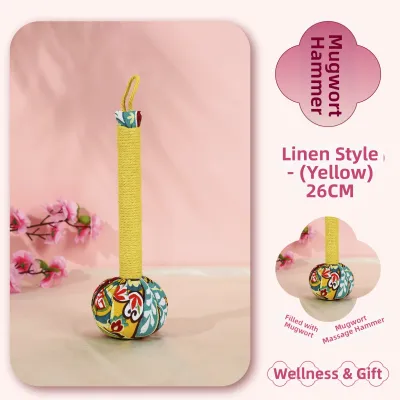
Prices are valid at publication and may change. Please refer to the product page for the latest price.
Beyond the physical impact, the hammer incorporates a sensory, aromatic element. When the hammer strikes the body, the mechanical friction and natural body warmth help release the volatile oils trapped within the dried mugwort leaves. This releases a distinctive, earthy, and herbal aroma that supports mental relaxation and stress relief during your massage session.
Unlike modern electronic massage guns that deliver rapid, mechanical vibrations, a mugwort hammer offers a gentler, more resonant impact. Its effectiveness depends on natural weight, manual leverage, and the quality of its natural components. Because there are no cords, batteries, or motors, a well-constructed hammer provides a quiet, portable, and low-tech way to manage daily muscle fatigue without the harshness of high-frequency mechanical devices.
Evaluating the Herbal Filling and Outer Fabric Quality
Herbal Quality and Aromatic Profiles
The core of any mugwort hammer is its herbal filling. High-quality hammers are packed with genuine, aged dried mugwort leaves, which typically have a soft, wool-like texture when processed. When evaluating a hammer, gently squeeze the head and inhale. It should emit a clean, earthy, and distinctly herbal scent. Avoid products that smell strongly of artificial perfumes, as manufacturers sometimes use synthetic fragrances to mask low-grade, old, or improperly dried herbs. Similarly, a musty or damp odor is a major warning sign, indicating that the filling has absorbed moisture and may contain mold.

Density and Compression
The tightness of the herbal packing directly dictates how the hammer feels against your muscles. The filling must be compressed tightly enough to retain its shape and deliver a solid, resonant impact, yet remain resilient enough to cushion the blow.
- Under-packed heads: If the filling is too loose, the herbs will shift during use, resulting in an uneven, hollow strike that fails to stimulate the muscle tissue effectively.
- Over-packed heads: If the filling is packed too tightly without any natural give, the head will feel as hard as a solid wooden mallet, which can cause bruising or soft tissue discomfort.
- The ideal feel: When pressed firmly with your thumb, the head should feel like a very dense stress ball—solid and structured, but with a small amount of springy compression.
Fabric Selection and Skin Safety
The outer fabric casing must be exceptionally durable to withstand thousands of repetitive impacts without tearing. Natural, tightly woven fabrics such as heavy-duty cotton, linen, or canvas are the gold standard. These materials are highly breathable, allowing the herbal aroma to escape freely, and are gentle on the skin. Synthetic fabrics like polyester are less breathable, can trap sweat, and are more prone to pilling or static buildup.
Ensure that the fabric surface is smooth and free of rough seams, coarse embroidery, or abrasive decorative elements. Because you will often tap the hammer over bare skin or thin clothing, any rough textures can cause friction burns or skin irritation over a multi-minute session. Additionally, check that the dyes used on the fabric are stable and colorfast; low-quality dyes can bleed onto your skin or clothing when exposed to body heat and sweat.
Choosing the Right Handle Material, Length, and Grip
Handle Materials and Flexibility
The handle of a mugwort hammer is typically crafted from natural wood or bamboo. Solid wood handles, such as those made from beech, ash, or oak, offer a solid, rigid feel and excellent durability. Wood naturally dampens a portion of the rebound shock, protecting your wrist from repetitive strain. Bamboo handles are lighter and offer a slight, natural flexibility. This springiness allows for a whip-like tapping action, which can reduce the physical effort required to swing the hammer over longer sessions.
Regardless of the material, inspect the handle thoroughly to ensure it is completely smooth and free of splinters, cracks, or rough grain. The handle should be sealed with a light, non-toxic oil or a thin matte wax rather than a thick, glossy chemical varnish. Heavy chemical varnishes can feel sticky when warm and become incredibly slippery if your hands begin to sweat.
Length and Reach Dynamics
The length of the handle determines how easily you can target different areas of your body without straining your shoulders or back. Choosing the right length depends on your primary wellness goals:
- Short handles (20 to 30 cm): These provide excellent control and precision. They are ideal if you plan to use the hammer primarily on easily reachable areas like your neck, shoulders, chest, and arms.
- Long handles (35 to 45 cm): These are essential if you want to perform self-massage on your mid-back, lower back, hamstrings, and calves. The extra length provides the leverage needed to reach these areas comfortably without awkward twisting or overextending your joints.
Grip Security and Ergonomics
Repetitive swinging motions can quickly fatigue your hand and wrist if the handle is difficult to hold. Look for handles that feature ergonomic contours, such as a slight flare at the base or a gently tapered middle section, which naturally prevents the tool from slipping out of your hand. Many premium hammers feature handles wrapped in cotton cord, linen thread, or non-slip textured grips. A wrapped grip is highly recommended because it absorbs palm moisture, provides a secure hold, and significantly reduces the hand-grip strength required to maintain control during a session.
Assessing Weight, Head Size, and Tapping Impact
Weight Balance and Leverage
A well-designed mugwort hammer should feel balanced in your hand, with the majority of the weight concentrated in the herbal head. Most home-use hammers weigh between 150 and 300 grams. If the hammer is too light, you will have to swing it with active muscle force to feel any impact, which can strain your forearm. If the head is excessively heavy, your wrist will tire within a few minutes of use. The ideal weight should allow gravity to do most of the work; a simple, relaxed drop of the wrist should deliver a satisfying, penetrating tap.
Head Geometry and Target Areas
The size and shape of the hammer head determine how the impact force is distributed across your body. Matching the head shape to your physical needs ensures a more comfortable and effective session:
- Large, flat-faced heads (8 to 10 cm in diameter): These distribute the impact force over a broader surface area. They are perfect for treating large muscle groups, such as the quadriceps, glutes, and upper back, providing a soft, diffused sensation.
- Small, rounded or spherical heads (5 to 7 cm in diameter): These concentrate the tapping force into a smaller area. They are excellent for targeting specific acupressure points, working along narrow muscle pathways like the forearms, or massaging the soles of your feet.
The Mechanics of Impact Feel
When testing a mugwort hammer, pay close attention to the quality of the physical feedback. A high-quality hammer should produce a deep, low-frequency “thud” that resonates into the deeper muscle layers. It should never produce a sharp, stinging “smack” on the surface of the skin. A stinging sensation indicates that the fabric casing is too thin, the herbal filling is too sparse, or the head lacks the structural density required to absorb surface shock and project force inward.
Inspecting Craftsmanship and Structural Durability
Stitching Integrity and Seams
Because a mugwort hammer is subjected to thousands of physical impacts, its structural seams are under constant stress. Carefully inspect the stitching around the herbal head. Look for tight, uniform, and straight stitch lines. Double-stitched or reinforced seams are highly desirable. If the stitching is loose, uneven, or uses thin thread, the seams will quickly stretch and unravel, leading to messy leaks of fine herbal dust and dried leaf fragments.
Handle-to-Head Connection Points
The junction where the handle meets the herbal head is the most common failure point in poorly made wellness hammers. Check this connection point closely before purchasing. The handle should extend deep into the core of the herbal head and be anchored securely. Look for models where the base of the head is tightly bound to the shaft with heavy-duty, multi-layered cord wrapping, a reinforced collar, or secure mechanical fasteners. Avoid hammers where the head is simply glued to the tip of the wooden handle, as the head will quickly begin to wobble and eventually fly off during a swing.
Surface Finish Quality
Take a moment to examine the overall finish of the tool. A premium product will showcase neat, clean craftsmanship. There should be no loose threads hanging from the seams, no visible glue residues at the connection points, and no exposed staples or sharp metal fasteners that could snag your clothing or scratch your skin. The wood should be sanded to a satin-smooth texture, and the fabric should feel thick, robust, and durable to the touch.
Safe Usage, Maintenance, and Storage in Humid Climates
Safe Tapping Techniques and Boundaries
To enjoy the benefits of a mugwort hammer safely, you must follow proper tapping techniques. Always target fleshy, muscular areas of the body, such as the shoulders, upper back, thighs, and calves.
- Avoid bone and joints: Never tap directly on bones, joints, the spine, the face, or the front of the neck.
- Avoid sensitive organs: Do not strike the lower back directly over the kidneys with heavy force.
- Check skin conditions: Avoid tapping over open wounds, bruises, rashes, varicose veins, or localized skin infections.
- Use gentle force: Tapping should always feel pleasant and stimulating. Start with very light, rhythmic taps and gradually increase the force slightly if comfortable. If you experience sharp pain, pinching, or discomfort, stop immediately.
Cleaning and Spot Maintenance
Because the head of the hammer is packed with dried organic herbs, you must never submerge the hammer in water, place it in a washing machine, or saturate it with liquid cleaners. Getting the internal mugwort wet will ruin the herbal filling, cause the leaves to rot, and trigger rapid mold growth.
To clean the outer fabric, gently spot-clean the surface using a slightly damp cloth with a tiny drop of mild, diluted soap. Wipe the area clean with a second damp cloth to remove any soap residue, and then immediately dry the surface with a clean towel. Allow the hammer to air dry completely in a warm, well-ventilated area before storing or using it again.
Storage Strategies for Humid Environments
In highly humid environments, such as Singapore, natural herbal products require extra care to prevent mold, mildew, and insect infestation. Proper storage is essential to preserve the dried mugwort and extend the lifespan of your hammer:
- Avoid damp areas: Never store your hammer in a bathroom, under a sink, or in any damp, unventilated cupboard.
- Use breathable storage: Store the hammer in a breathable cotton or linen drawstring bag. Avoid sealing it in airless plastic bags immediately after use, as any trapped body moisture can encourage mold growth.
- Utilize desiccants: Place one or two food-grade silica gel desiccant packets inside the storage bag with the hammer to actively absorb excess moisture from the air.
- Long-term storage: If you do not plan to use the hammer for several weeks, store it in an airtight plastic container along with a fresh desiccant packet to seal out ambient humidity.
- Sunlight exposure: Periodically expose the hammer to indirect sunlight or a dry, warm breeze for an hour. This helps dissipate any accumulated moisture and keeps the dried herbs smelling fresh and clean.
Frequently Asked Questions (FAQ)
Can I use a mugwort hammer every day?
Yes, daily use is generally safe and highly beneficial for muscle relaxation and stress relief. For best results, limit your tapping sessions to 10 to 15 minutes per target muscle group. Always listen to your body; if your muscles feel slightly tender or if you notice any persistent skin redness, take a break for a day or two to let your tissues rest.
How long does the mugwort scent last?
The natural, earthy aroma of the dried mugwort typically lasts between 6 to 12 months, depending on how frequently the hammer is used and how well it is protected from humidity. While the aromatic strength will gradually fade over time as the volatile oils dissipate, the physical tapping benefits of the hammer remain fully functional. If the herbal aroma is a primary part of your wellness experience, you may want to replace the hammer once the scent is no longer noticeable.
Is a mugwort hammer suitable for elderly users?
Yes, a mugwort hammer can be an excellent, low-impact tool to help older adults support local circulation and ease joint and muscle stiffness. However, elderly users should choose a lightweight hammer (under 200 grams) with a highly secure, non-slip grip to prevent hand and wrist fatigue. Because older skin can be thinner and more fragile, tapping should be exceptionally gentle and light. Older adults with severe osteoporosis, fragile skin, cardiovascular conditions, or deep vein thrombosis should always consult a healthcare professional before introducing any percussion or tapping wellness devices into their routine.
Community discussion
Share your experience or ask a question. Comments are reviewed before publication.