
To select the ideal exercise ladder for football training, look for adjustable rung spacing (typically 38 to 45 cm), a total length of 4.5 to 6 metres, flat, tear-resistant nylon straps, and shatterproof, semi-flexible plastic rungs. These specifications ensure the ladder can withstand the impact of football cleats, adapt to different training drills, and remain stable on various surfaces. Selecting the correct specifications prevents tripping hazards and ensures your footwork drills directly translate to on-pitch performance.
Why the Right Exercise Ladder Matters for Football Footwork
Football is a game defined by rapid micro-movements, sudden changes of direction, and explosive accelerations. An exercise ladder, often referred to as an agility ladder, serves as a vital neuromuscular training tool. It trains the brain and muscles to communicate more efficiently, sharpening foot-eye coordination, balance, and the rapid ground-contact times required to beat defenders on the pitch.
Using an unsuitable ladder, however, can actively disrupt your training rhythm. Flimsy, ultra-lightweight options with fixed, overly wide rungs easily slide out of position at the slightest touch. If a player wearing studs clips a rung, a poorly designed ladder will bunch up, instantly halting the drill and creating a tripping hazard that can lead to ankle rolls or joint strains.
Products mentioned in this guide
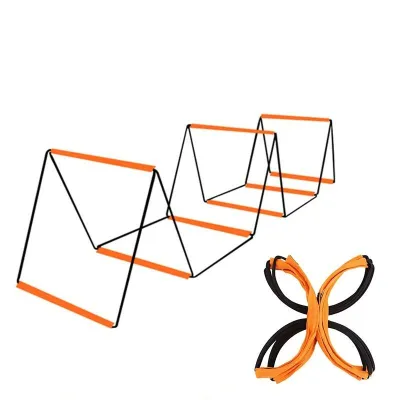
![[SG] Nylon Strap Agility Ladder Speed Training Football Fitness Flexibility Plyometric Workout Equipment](https://img.lazcdn.com/g/p/f631eecb7b6fe53488efffcb083d2930.jpg_400x400q80.jpg_.webp)
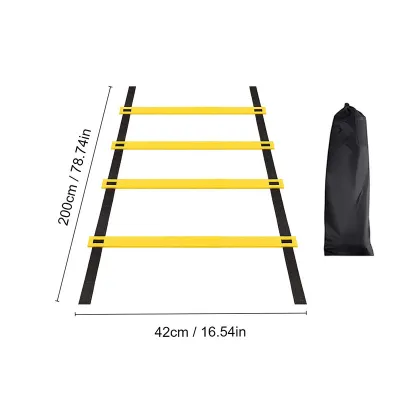
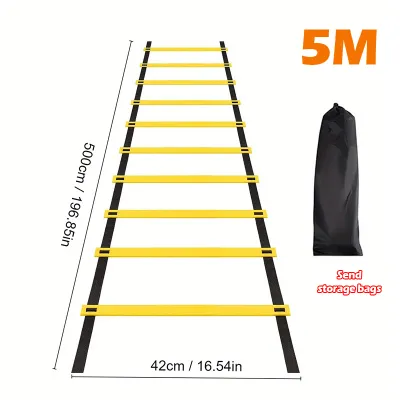
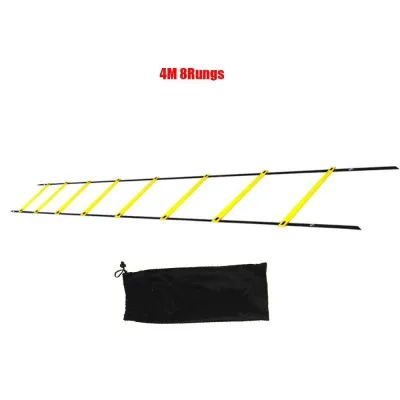
Prices are valid at publication and may change. Please refer to the product page for the latest price.
Furthermore, fixed-rung ladders limit your ability to scale the difficulty of your footwork drills. A junior player attempting rapid lateral taps on a standard adult-spaced ladder will be forced to overextend their stride, compromising their low centre of gravity and athletic posture. Choosing a high-quality ladder with the right physical specifications ensures your training remains safe, progressive, and directly transferable to matchday performance.
Core Specifications to Evaluate Before Buying
Selecting an exercise ladder requires looking past generic product labels and examining specific physical dimensions, adjustment mechanisms, and structural materials. Here is a breakdown of the core specifications that dictate how a ladder performs under the pressure of football boots.

Rung Spacing and Adjustability
Standard spacing for most commercial agility ladders is between 38 and 45 cm (approximately 15 to 18 inches). This distance mimics the natural stride length of an adult athlete during high-frequency, short-step movements. For traditional linear runs and simple high-knees, this standard spacing provides a reliable baseline that helps build consistent muscle memory.
However, fixed-space ladders can be highly restrictive. Adjustable ladders feature rungs that slide along the side straps, allowing you to customize the distance for different training scenarios. For instance, narrowing the spacing to 30 cm forces incredibly rapid, micro-touch footwork, simulating the tight ball control needed in congested midfield areas. Conversely, widening the rungs to 50 cm or more lets you practice explosive bounding steps and transition drills where you accelerate out of an agility pattern.
When evaluating adjustable models, pay close attention to the locking mechanism. Some ladders rely on simple friction, which can easily slip when kicked. Look for ladders equipped with secure locking clips, snap-on rungs, or heavy-duty plastic slide locks. These mechanisms keep the rungs firmly in place even during intense, high-speed lateral movements like the Ickey Shuffle.
Ladder Length and Total Rungs
The overall length of the ladder directly influences the focus of your training sessions. Standard football agility ladders typically measure between 4.5 and 6 metres (15 to 20 feet) in length and feature 10 to 12 rungs. This length is widely considered the sweet spot for balance and conditioning, as it provides enough repetitions to challenge a player’s coordination without inducing excessive cardiovascular fatigue before they reach the end of the drill.
Shorter ladders (around 2 to 3 metres with 5 to 6 rungs) are highly portable and excellent for quick, explosive bursts or targeted warm-ups. However, they do not offer enough runway to test sustained speed-endurance or complex multi-step patterns. On the other hand, extra-long ladders (7.5 metres or more) are great for endurance but can become tedious to set up, prone to tangling, and difficult to keep straight on uneven grass.
A highly effective strategy for coaches and serious players is to purchase multiple shorter or standard-length ladders (e.g., two 4.5-metre ladders) that feature quick-release plastic buckles or metal snaps at the ends. This modular design allows you to link them together for extended, high-intensity drills when needed, or split them into separate stations to run multiple players through shorter drills simultaneously, balancing portability with training versatility.
Material Durability and Strap Design
The durability of an exercise ladder is tested every time a player wears studded boots. Rigid, brittle plastic rungs (often made of cheap, recycled PVC) are highly susceptible to cracking or shattering when stepped on by metal or hard plastic cleats. Instead, look for rungs made of high-density polyethylene (HDPE) or impact-resistant, flexible polyurethane. These materials bend under pressure and return to their original shape, preventing both gear damage and painful shin or ankle injuries if a player missteps.
The side straps are the backbone of the ladder and must be made of heavy-duty, tear-resistant nylon webbing. Look for straps with a tight weave and a width of at least 2.5 cm (1 inch). The straps must lie completely flat on the training surface; rounded or thin cords twist easily, creating serious tripping hazards. Flat straps also provide better ground contact, reducing the likelihood of the ladder shifting when brushed by a passing shoe.
Pay close attention to the connection points where the rungs meet the side straps. This is the most common failure point on cheap ladders. Look for reinforced stitching, heat-sealed edges, or integrated plastic grommets. If the straps are threaded through the rungs, ensure the holes are smooth and reinforced to prevent the nylon from fraying over time under the friction of frequent adjustments and cleat strikes.
Portability and Carry Bag Features
An agility ladder is only useful if it actually makes it to the training pitch. Because football sessions often require carrying balls, cones, bibs, and personal gear, the ladder’s portability is a major factor. A high-quality ladder should always come with a dedicated, breathable carry bag made of heavy-duty polyester or mesh. The bag should feature a secure drawstring or zip closure and an adjustable shoulder strap for easy, hands-free transport.
Tangles are the bane of any training session, often eating up valuable warm-up time. To combat this, look for ladders that include a built-in winding handle, a plastic organizer bracket, or elastic tie-down straps. These features hold the rungs neatly stacked together when folded, preventing the side straps from twisting into a chaotic knot inside your bag.
Ideally, the packed dimensions of the ladder should be compact enough to slide easily into a standard 40-litre football backpack or kit bag. A lightweight, well-organized ladder can be unpacked, laid out, and packed away in under a minute, keeping your training sessions efficient and professional.
Matching Ladder Features to Your Football Training Needs
No single exercise ladder is perfect for every player or setting. To get the most out of your investment, you must match the ladder’s specifications to your skill level, the complexity of your drills, and the specific environments where you train.
Skill Level and Drill Complexity
For beginners, younger players, or those new to agility training, a standard, fixed-spacing ladder is often the best starting point. Fixed ladders eliminate the distraction of measuring and adjusting rungs, allowing players to focus entirely on building basic muscle memory, rhythm, and proper foot placement. With a fixed 40 cm spacing, beginners can safely master fundamental movements like the two-foot run, lateral shuffle, and simple hop-scotch patterns without worrying about shifting rungs.
As players progress to intermediate and advanced levels, their footwork becomes faster, more complex, and multi-directional. Advanced drills—such as the Ickey Shuffle, in-and-out taps, crossover steps, and diagonal transitions—require extreme precision. For these athletes, an adjustable ladder is highly beneficial. It allows them to progressively narrow the rung spacing to challenge their reaction times or widen it to simulate match-like transitions, such as sprinting out of a tight turn.
Advanced players also benefit from longer setups or modular ladders. High-level football requires maintaining top-speed coordination even under physical fatigue. Running a 9-metre linked ladder sequence followed immediately by a ball-striking or passing drill replicates the late-game scenarios where coordination and decision-making are tested.
Training Surface and Local Climate
The surface you train on dictates the type of stability features your ladder needs. If you primarily train on natural grass pitches, wind and uneven ground can easily displace a lightweight ladder. Look for models that include metal ground stakes or pegs that anchor the four corners of the straps into the turf. For artificial turf or indoor hard courts (such as futsal courts), ground stakes cannot be used. In these settings, you need a heavier ladder with textured, non-slip rubberized backings on the rungs to prevent sliding on smooth surfaces.
In Singapore, the tropical climate presents unique challenges for outdoor sports equipment. With high humidity, frequent heavy downpours, and intense UV exposure, basic materials can degrade rapidly. If a wet ladder is packed away in a dark bag, cheap cotton-blend or low-grade nylon straps will quickly develop mold and mildew, leading to unpleasant odours and material rot.
To withstand Singapore’s environment, look for ladders featuring quick-drying, mold-resistant synthetic straps (such as high-grade polypropylene or treated nylon) that do not absorb water. Additionally, ensure the plastic rungs are UV-treated. Constant exposure to the intense afternoon sun can cause non-UV-stabilized plastics to become brittle, leading them to crack the next time they are stepped on by a studded boot.
Recommended Exercise Ladder Profiles for Football Players
To help you choose the right gear, we have categorized the most effective exercise ladder designs into three distinct profiles based on common training scenarios and player needs.
The Adjustable Multi-Use Ladder
This profile is the most versatile option on the market, featuring adjustable rung spacing along heavy-duty nylon straps, durable semi-flexible plastic rungs, and a robust carry bag. It is designed to adapt to various age groups and skill levels within a single training session.
- Ideal User: Football coaches, academy trainers, or dedicated individual players who want to transition seamlessly from tight, rapid footwork drills to wider, explosive bounding patterns.
- Key Trade-off: The adjustable rungs can sometimes slide during high-impact missteps, requiring occasional manual resetting and careful checking to ensure the spacing remains uniform throughout the session.
The Heavy-Duty Outdoor Ladder
Built for rugged, frequent outdoor use, this profile features extra-thick, weighted nylon side straps, UV-resistant semi-rigid rungs, and included rust-resistant ground anchors or heavy-duty steel stakes. It is designed to stay perfectly flat and stable on natural grass and turf pitches.
- Ideal User: Team coaches and serious players who train outdoors in all weather conditions and need a ladder that won't shift under heavy cleat strikes or strong winds.
- Key Trade-off: These models are noticeably heavier and bulkier than standard ladders, making them slightly more tiring to carry long distances in a standard kit bag.
The Lightweight Travel Ladder
This ultra-compact profile prioritizes portability, utilizing lightweight, thin-profile plastic rungs and a slim, breathable mesh carry pouch. It is designed to fold down to a fraction of the size of a standard ladder.
- Ideal User: Individual players looking for a quick personal warm-up tool before team practice, or those who travel frequently and need to fit their agility gear alongside boots and shin guards in a compact bag.
- Key Trade-off: The lightweight construction lacks the heavy-duty stability and ground grip of weighted models, making it prone to shifting during aggressive, high-speed lateral drills on slick surfaces.
Safe Setup and Maintenance for Longevity
To prevent injuries and ensure your exercise ladder lasts for seasons to come, proper setup and maintenance are essential. Before starting any drill, always check the manufacturer’s instructions for any specific care or deployment guidelines.
When setting up, ensure the ladder lies completely flat on the ground. Walk the length of the ladder to straighten out any twists in the side straps and ensure no rungs are folded, overlapping, or raised. A twisted strap or raised rung is a major tripping hazard that can easily lead to ankle sprains or falls.
Before laying the ladder down, clear the training area of any debris, rocks, tree branches, or wet leaves. These hidden hazards can damage the underside of the straps and cause players to slip.
After training on wet grass or muddy pitches, do not leave the ladder crumpled in its carry bag. Wipe down the muddy plastic rungs with a damp cloth and hang the ladder up in a well-ventilated, shaded area to air-dry completely before storing. This simple step prevents mold growth and preserves the structural integrity of the nylon straps, ensuring your ladder remains safe and ready for your next session.
Community discussion
Share your experience or ask a question. Comments are reviewed before publication.