
Choosing the right forearm crutches—often referred to as elbow crutches—requires balancing physical ergonomics, material durability, and daily lifestyle needs. Unlike standard underarm crutches, forearm crutches offer greater maneuverability and distribute weight more evenly across your upper body, making them a preferred choice for active recovery and long-term mobility. To find the perfect pair, you must focus on three critical areas: obtaining precise physical measurements, selecting the right cuff and adjustment features, and choosing materials that match your weight and environmental demands.
By taking a systematic approach to your selection, you can prevent common secondary injuries such as wrist strain, shoulder joint wear, and muscle fatigue. This guide breaks down the essential steps to measure, compare, and safely select forearm crutches tailored to your body and daily routine.
Quick Summary: Key Criteria for Forearm Crutches
Selecting the right forearm crutches involves evaluating three primary pillars: fit, functionality, and materials. A proper fit is non-negotiable; incorrect sizing leads to poor posture, joint strain, and increased fall risks. When evaluating features, you must choose between open or closed cuffs and push-button or telescopic adjustment mechanisms based on your coordination and daily activities.
Products mentioned in this guide
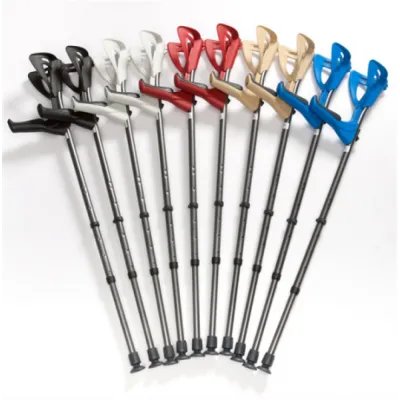
Prices are valid at publication and may change. Please refer to the product page for the latest price.
Material choice directly impacts both the weight of the crutches and their long-term durability. Aluminum frames offer robust, cost-effective support, while carbon fiber provides an ultra-lightweight alternative that reduces upper-body fatigue during extended use. Finally, never overlook the rubber tips, which serve as your primary traction point on slick or uneven surfaces. Prioritizing these criteria ensures your mobility aid supports your independence safely and comfortably.
Step 1: Measuring and Sizing for a Proper Fit
Achieving an accurate fit is the most critical step when selecting forearm crutches. An improperly sized crutch forces your body into unnatural postures, leading to chronic pain in the wrists, shoulders, and lower back. To establish a baseline, always perform your measurements while wearing your typical daily walking shoes, standing as upright as possible with your shoulders relaxed.

To measure the overall height of the crutch, stand with your arms hanging naturally at your sides. Have a second person measure the distance from the floor to the crease of your wrist. This measurement represents the ideal height for the top of the handgrip. If you must measure alone, stand against a wall and mark the height of your wrist crease with a pencil before measuring from the floor to that mark.
Next, determine the correct cuff placement relative to your elbow. The cuff should wrap securely around your forearm, positioned approximately 1 to 1.5 inches (2.5 to 4 cm) below the bend of your elbow. If the cuff is placed too high, it will pinch your skin and restrict your elbow’s range of motion when you bend your arm. If it is placed too low, it will fail to provide adequate lateral support, causing the crutch to wobble and increasing the strain on your wrist.
Finally, verify the handgrip height to ensure optimal elbow flexion. When you grasp the handgrips with the crutch tips resting flat on the floor, your elbows should bend at an angle of roughly 15 to 30 degrees. This slight bend is crucial; it allows your arm muscles to act as natural shock absorbers while ensuring you can fully extend your elbows to lift your body weight during movement. If your elbow is completely straight or bent too sharply, you will experience rapid muscle fatigue and joint pain.
Step 2: Selecting Adjustable Features and Cuff Styles
Once you have established your measurements, you must evaluate the adjustable features and cuff styles that best match your physical capabilities and daily environment. Forearm crutches offer various mechanisms to customize their height and fit, each with distinct trade-offs in stability and ease of use.
Adjustment mechanisms generally fall into two categories: push-button systems and telescopic twist-locks. Push-button mechanisms feature spring-loaded buttons that click into pre-drilled holes along the shaft. These are highly secure and easy to adjust, though they limit you to fixed increments. Telescopic twist-locks allow for infinite micro-adjustments, enabling you to fine-tune the height to the exact millimeter. However, twist-locks require regular manual verification to ensure they remain tightly locked and do not slip under your weight.
Cuff designs are divided into open (half-circle) and closed (full-circle or hinged) styles. Open cuffs are highly popular because they allow you to slip your arms out instantly. In the event of a fall, an open cuff releases your arm, reducing the risk of wrist fractures. However, if you release your grip to open a door or answer a phone, the crutch will fall to the ground. Closed cuffs encircle your forearm completely, keeping the crutches suspended from your arms when you release your grip. This is highly convenient for daily tasks, but it requires more coordination to slip out of quickly during an unexpected loss of balance.
Handgrip shapes and padding also play a vital role in long-term comfort. Anatomical or contoured handgrips are molded to fit the natural shape of your palm, distributing your body weight across a larger surface area to prevent nerve compression. Traditional cylindrical grips are simpler but can cause pressure points. In warm, humid climates, sweat can cause your hands to slip on smooth plastic grips. Look for textured rubber or slip-resistant composite grips, or consider adding aftermarket gel pads to absorb moisture and reduce friction.
Before using any adjustable crutch, establish a strict habit of verifying all locking mechanisms. Ensure that spring buttons are fully engaged and protruding through their adjustment holes, and tighten any integrated silencer rings or collar locks to eliminate wobbling and rattling.
Step 3: Comparing Materials, Weight, and Traction
The materials used to construct your crutches determine their weight, durability, and suitability for different environments. Balancing these factors helps you avoid unnecessary physical strain while ensuring your equipment can withstand daily wear and tear.
Aluminum is the most common material used in forearm crutches. It is highly durable, impact-resistant, and cost-effective, making it an excellent choice for standard daily use. However, aluminum crutches are heavier than their high-tech counterparts, which can lead to shoulder and arm fatigue over long distances. Carbon fiber crutches are exceptionally lightweight and offer natural shock-absorbing properties, significantly reducing the physical effort required to swing the crutches forward. The primary trade-off is cost, as carbon fiber models are typically more expensive and can be sensitive to deep structural scratches if dropped on rough concrete.
Regardless of the material you choose, never assume its strength based on appearance alone. Always locate and check the manufacturer’s weight capacity label. Ensure the specified limit comfortably accommodates your body weight plus any additional weight from backpacks, heavy clothing, or daily gear. Using a crutch below your weight requirement can lead to sudden structural failure.
The rubber tip, or ferrule, at the bottom of the crutch is your sole contact point with the ground, making it critical for traction and safety. Look for high-quality, wide-base rubber tips that feature flexible, articulating joints. These joints allow the rubber pad to remain flat on the ground even when the crutch shaft is angled during your stride. In wet environments, look for tips with deep tread patterns designed to channel water away, preventing hydroplaning on smooth indoor tiles or wet outdoor pavements.
Safety Checks and When to Seek Professional Guidance
While self-fitting is common, your body will provide clear physical feedback if your forearm crutches are set up incorrectly. Pay close attention to early warning signs of an improper fit. Persistent numbness or tingling in your fingers, sharp wrist pain, shoulder hiking (raising your shoulder toward your ear to move), or lower back stiffness are clear indicators that your crutches require adjustment.
Perform a quick structural safety check before every use. Inspect the entire length of the shafts for dents, bends, or hairline cracks. Verify that the rubber tips are securely attached and free of debris. Check that all adjustment buttons are fully locked into place. If you detect any structural damage, replace the affected parts or the entire crutch immediately; never attempt to repair a cracked or bent shaft with tape or temporary adhesives.
Most importantly, understand the limits of self-fitting. Equipment cannot replace professional training, clinical judgment, or physical rehabilitation. If you experience persistent pain, struggle with balance, or have complex neurological or orthopedic conditions, stop using the crutches and consult a qualified physical therapist or healthcare provider. They can provide personalized gait training, ensure your crutches are perfectly calibrated to your physical limits, and help you avoid long-term joint damage.
Frequently Asked Questions (FAQ)
Can I use forearm crutches for long-term daily mobility?
Yes, forearm crutches are highly suitable for long-term daily mobility and are often preferred over standard underarm crutches for chronic conditions. By distributing your body weight across your forearms and hands rather than your armpits, they eliminate the risk of axillary nerve damage. However, because long-term use places repetitive stress on your wrists and shoulders, it is highly recommended to undergo professional gait training with a physical therapist to learn efficient movement patterns and prevent joint strain.
How do I know when to replace the rubber tips?
Inspect your rubber tips weekly for signs of wear. You must replace them immediately if the tread pattern on the bottom has worn smooth, if you notice uneven wear on one side of the pad, or if the rubber begins to split or crack. Additionally, many high-quality tips feature an internal metal washer to prevent the crutch shaft from punching through the rubber; if you can see or feel this metal core, the tip is worn out and must be replaced to prevent sudden slips. Replacement tips are widely available and typically cost under S$15 per pair.
Community discussion
Share your experience or ask a question. Comments are reviewed before publication.