
Selecting the right knee support requires balancing active mobility with targeted joint stabilization. Bauerfeind’s GenuTrain series is engineered around this balance, using medical-grade compression knit rather than rigid immobilization to promote active recovery. The ideal model for your needs depends directly on the severity of your knee condition, your current activity level, and the specific structural support your joint requires.
To find the perfect match, you must evaluate whether your knee requires general compression for swelling, targeted tracking for the kneecap, lateral reinforcement for ligament laxity, or maximum mechanical stabilization for post-injury recovery. Matching these physical requirements to your daily routines and sports activities ensures optimal joint protection without unnecessarily restricting your natural movement.
Quick Answer: Which Bauerfeind Model Fits Your Knee Condition?
Bauerfeind’s GenuTrain series offers tiered support levels designed to address specific clinical indications and physical demands. Choosing the correct model requires assessing your primary symptoms and identifying the level of mechanical stabilization your joint demands.
Products mentioned in this guide
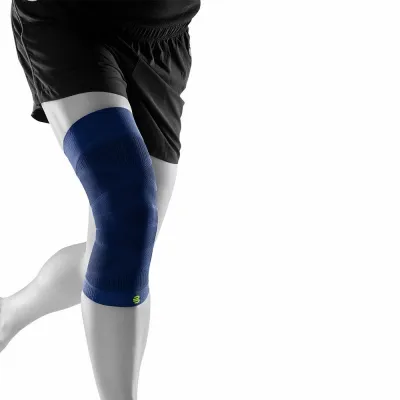
Prices are valid at publication and may change. Please refer to the product page for the latest price.
To simplify your selection, use this conditional decision framework:
- Choose GenuTrain if you require mild compression, active recovery, and enhanced joint awareness (proprioception). This base model is ideal for managing mild swelling, minor joint irritation, or serving as a preventive measure during low-to-moderate impact sports.
- Choose GenuTrain A3 if you experience localized pain around the kneecap, patellar tracking issues, runner's knee, or early-stage knee osteoarthritis. This model features a specialized silicone insert designed to provide targeted massage and relieve tension at key muscle attachments.
- Choose GenuTrain S if you require active lateral stability. This model is designed for mild to moderate ligament instability (such as minor ACL or MCL strains), meniscus issues, or for individuals returning to sports after a minor sprain who need physical guidance without complete joint restriction.
- Choose GenuTrain Plus if you need maximum stabilization and joint guidance. It is designed for managing more severe ligament instability, advanced joint degeneration, or supporting the knee during the later stages of conservative post-operative rehabilitation.
Please note that this guide serves as a practical product selection tool and does not constitute or replace professional medical diagnosis. A knee guard is a supportive aid, not a cure. If you are experiencing acute pain, severe trauma, sudden swelling, or are recovering from recent knee surgery, you must consult a qualified healthcare professional, physiotherapist, or orthopedic specialist before choosing or wearing any brace.
Comparing the Core Bauerfeind GenuTrain Models
To understand why these models target different conditions, it is essential to examine their physical construction, structural features, and how they interact with the joint during movement.

GenuTrain (Active Compression and Mild Support)
The standard GenuTrain is the foundational model of the series. Its construction centers around a highly elastic, breathable 3D air-active knit that conforms precisely to the anatomy of the leg. Embedded within this knit is the Omega pad, an anatomically shaped silicone insert that surrounds the kneecap. This pad features integrated Hoffa pads—silicone nubs that exert targeted pressure on the infrapatellar fat pad—and meniscus wings that provide localized massage to the joint space during movement.
When you move, the combination of the compression knit and the silicone pad produces a continuous, intermittent compression massage. This action stimulates the surrounding musculature, improves local blood circulation, and helps reduce mild swelling and joint effusion. The primary use case for this model is everyday wear, mild joint irritation, and preventive support during low-to-moderate impact activities. It provides substantial proprioceptive feedback—enhancing your body’s natural awareness of joint positioning—without restricting your natural range of motion.
GenuTrain A3 (Targeted Pain Relief and Patella Tracking)
The GenuTrain A3 is specifically engineered to address complex patellar issues and degenerative joint pain. Unlike the uniform compression of the base model, the A3 features a distinct, star-shaped silicone pad with multiple friction points. This pad is designed to target the typical pain zones associated with osteoarthritis and kneecap misalignment.
Additionally, the knit fabric of the A3 incorporates specialized, friction-reducing zones and an integrated corrective guide that gently prevents the patella from drifting outward. This targeted guidance is crucial for individuals dealing with patellofemoral pain syndrome, runner’s knee, or early-stage osteoarthritis. By stimulating the vastus medialis muscle (the inner quadriceps), the brace helps restore proper muscle balance around the knee, offering targeted pain relief during movement rather than relying on passive joint restriction.
GenuTrain S (Lateral Stability and Moderate Support)
When joint laxity or ligament weakness requires physical stabilization beyond compression alone, the GenuTrain S introduces mechanical support. This model incorporates flexible, anatomically contoured lateral splints (side stays) embedded in pockets on both sides of the brace. These side stays are connected to a system of inelastic, adjustable Velcro straps that wrap around the thigh and lower leg.
The primary function of the GenuTrain S is to provide moderate medial and lateral stability, protecting the knee from unwanted side-to-side shearing forces. It is highly effective for athletes returning to multi-directional sports (such as tennis, basketball, or football) after mild ligament sprains, as well as individuals managing mild meniscus irritation. Because the side stays are jointed and flexible, they guide the knee through its natural flexion and extension path while restricting harmful lateral movements, giving the wearer increased confidence and mechanical reassurance.
GenuTrain Plus (Maximum Stabilization and Post-Injury)
The GenuTrain Plus represents the highest level of stabilization in the standard GenuTrain product family, designed for situations where joint integrity is compromised. This model features a heavily reinforced structure, combining rigid lateral joint splints with a comprehensive, multi-point adjustable strap system. These components work in unison to limit extreme, high-risk ranges of motion and provide maximum physical guidance to the joint.
This model is specifically designed for individuals managing severe ligament instability (such as chronic ACL, PCL, or MCL deficiencies), advanced joint degeneration (severe osteoarthritis), or those undergoing conservative rehabilitation after major knee trauma. The GenuTrain Plus provides a high degree of external stabilization, which naturally restricts natural joint kinematics more than the lighter models. Consequently, it should ideally be used under the direct guidance of a physiotherapist or orthopedic specialist to ensure it aligns with your specific rehabilitation protocol.
Matching Your Activity Level to the Right Support Level
Selecting a knee guard is not just about diagnosing your injury; it is also about matching the brace’s mechanical properties to the physical demands of your daily life and athletic pursuits. Different activities subject the knee joint to varying forces, angles, and environmental stressors.
To help you determine which support level aligns with your lifestyle, consider the following activity categories:
- Low-Impact and Daily Living: For activities such as walking, light cycling, office work, or standing for extended periods, your primary requirements are all-day comfort, breathability, and mild compression. The standard GenuTrain or GenuTrain A3 is ideal here. These models fit easily under trousers, manage moisture effectively, and provide the gentle compression needed to prevent swelling during long periods of inactivity or light movement.
- High-Impact and Multi-Directional Sports: Sports that involve rapid acceleration, sudden stops, pivoting, and lateral cutting—such as running, basketball, badminton, or soccer—place intense rotational and lateral stress on the knee. For these activities, maintaining joint alignment is critical. The GenuTrain S is highly recommended for these scenarios. Its lateral side stays prevent joint shearing during sudden pivots, while the adjustable straps ensure the brace remains securely anchored even during heavy sweating and explosive movements.
- Rehabilitation and Heavy Load-Bearing: If you are navigating post-injury physical therapy, recovering from ligament damage, or engaging in heavy load-bearing activities like hiking with a weighted backpack over uneven terrain, your joint requires maximum mechanical guidance. The GenuTrain Plus is built for these demanding conditions. It provides the rigid external structure needed to absorb heavy vertical and lateral loads, reducing the physical strain on compromised ligaments and cartilage.
When choosing a brace, it is important to understand the fundamental trade-off between mechanical support and natural mobility. A highly supportive brace like the GenuTrain Plus or GenuTrain S uses rigid or semi-rigid components to restrict harmful movements. However, this mechanical restriction can slightly alter your natural joint kinematics, which might affect peak athletic performance if your knee does not actually require that level of stabilization. Conversely, wearing a standard GenuTrain for a severe ligament tear will not provide sufficient mechanical protection. Always select the lowest level of support that safely manages your instability to maintain optimal muscle activation.
In warm, humid climates like Singapore, sweat accumulation can lead to skin irritation and material slippage. Bauerfeind’s micro-fiber knit is designed to wick moisture away from the skin, but heavy athletic use still requires regular maintenance. Ensure you review the manufacturer’s care guidelines: frequent, gentle washing is necessary to prevent salt buildup from sweat, which can degrade the elastic fibers over time. Depending on the complexity and model, these medical-grade braces typically range from S$130 to over S$280 in the Singapore market, making proper maintenance essential to protect your investment.
Sizing, Fit, and Safety Boundaries
No matter how advanced a knee guard’s technology is, it cannot perform its therapeutic function if it does not fit correctly. A medical-grade compression brace relies on precise pressure gradients that can only be achieved through accurate anatomical sizing.
Measuring for Fit
To find your correct size, do not rely on your clothing size or general height and weight. You must take precise anatomical measurements using a flexible measuring tape. For most Bauerfeind knee guards, you will need to measure two key circumferences with your knee bent at a slight angle (approximately 30 degrees):
- Thigh Circumference: Measure the circumference of your thigh exactly 14 centimeters above the center of your knee joint.
- Calf Circumference: Measure the circumference of your calf exactly 12 centimeters below the center of your knee joint.
Once you have these measurements, compare them strictly to the official manufacturer’s size chart for the specific model you are purchasing. If your measurements fall between two sizes, it is generally recommended to consult the manufacturer’s fitting guidelines or seek professional assistance at an authorized retailer, as the correct choice may depend on whether you are experiencing active swelling.
Signs of Improper Fit
An improperly fitted knee guard can compromise your recovery or even cause secondary issues. Monitor your leg for the following observable red flags:
- The brace slides down or rolls over at the top during basic movement.
- The knit bunches or pinches painfully in the sensitive area behind the knee (popliteal fossa).
- You experience numbness, tingling, coldness, or discoloration in your lower leg or foot, indicating restricted blood flow.
- The brace leaves deep, painful, or red indentations on your skin after removal.
Safety and Maintenance Boundaries
To protect your health and preserve the lifespan of your investment, adhere to these safety and maintenance protocols:
- Immediate Removal: A knee guard should provide supportive pressure, never acute pain. If you experience sharp pain, throbbing, or signs of restricted circulation, remove the brace immediately.
- Washing Instructions: To maintain the elasticity of the knit and the structural integrity of the silicone pads, hand wash the brace or machine wash it on a gentle cycle in a mesh laundry bag. Use a mild, liquid detergent without fabric softeners, as softeners can clog the breathable fibers.
- Drying: Always air dry the brace flat or hang it up away from direct heat sources, radiators, or direct sunlight. Never tumble dry the brace, as high heat will damage the elastic knit and loosen the adhesive holding the silicone pads and side stays in place.
- Stop Condition: If your knee pain worsens, new swelling develops, or you experience a feeling of joint instability despite wearing the brace, stop using the product immediately and consult a physiotherapist, sports physician, or orthopedic specialist.
Frequently Asked Questions (FAQ)
Can I wear a Bauerfeind knee guard all day?
While the breathable micro-fiber knit of a Bauerfeind knee guard is engineered for comfortable, extended wear during active hours, you should not wear it continuously for 24 hours. It is generally recommended to remove the brace during prolonged periods of rest, such as when sleeping, sitting completely still for hours, or during long-haul travel when you are inactive. Removing the brace allows your skin to breathe, prevents localized pressure points, and ensures normal blood circulation. Always follow the specific wear-time instructions provided by your healthcare professional or the product’s official medical labeling.
How do I know if my Bauerfeind knee brace needs replacing?
Over time, the materials in any medical-grade compression brace will naturally degrade. You should inspect your knee guard regularly for signs of wear, including a noticeable loss of elastic tension (the brace feels loose or slides down frequently), fraying or tearing of the knit fabric, or the silicone pad shifting out of its pocket. Additionally, if the inner silicone elements lose their grip and cause skin irritation, the brace’s therapeutic efficacy is compromised. Depending on your frequency of use, activity level, and washing habits, a brace typically maintains its medical-grade compression for approximately six months to a year of regular use. Refer to the manufacturer’s guidelines to evaluate its ongoing durability.
Community discussion
Share your experience or ask a question. Comments are reviewed before publication.