
To choose the right cricket bat, you must balance your physical height with the bat’s length to maintain a proper batting stance, while matching the bat’s weight to your physical strength and skill level to ensure optimal swing speed and control. A bat that is too long or heavy will compromise your technique, slow your reaction times, and increase your risk of injury, while one that is too small or light will limit your power and reach. By aligning these physical dimensions with your playing style and experience, you can select an instrument that feels like an extension of your body on the pitch.
In Singapore’s warm and humid climate, cricket bats require careful selection and maintenance. The high humidity can cause natural willow to absorb moisture over time, which slightly increases the dynamic weight of the blade. Therefore, choosing a bat with the correct initial dry weight, a comfortable pick-up, and the right profile is essential for maintaining your performance on both natural turf and local synthetic wickets.
Understanding Cricket Bat Sizes and Weight Categories
Standard cricket bats are measured from the top of the handle grip down to the bottom of the toe. For adult players, the overall length typically ranges from 83.8 centimeters (33 inches) to 87.6 centimeters (34.5 inches). Junior bats are scaled down proportionally, categorized by numbered sizes from 1 up to 6, followed by Harrow, which serves as the final stepping stone before adult sizes.
Products mentioned in this guide
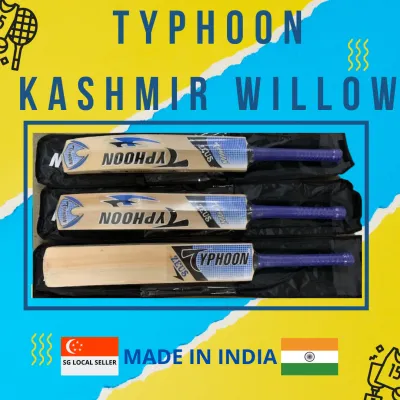
Prices are valid at publication and may change. Please refer to the product page for the latest price.
Manufacturers generally categorize adult bat weights into three broad bands: light, medium, and heavy. In the retail market, these weights are usually expressed in imperial units (pounds and ounces) or metric grams. A light bat typically weighs between 2 pounds 7 ounces and 2 pounds 9 ounces (approximately 1.10 to 1.16 kilograms). Medium bats range from 2 pounds 10 ounces to 2 pounds 12 ounces (1.19 to 1.25 kilograms), while heavy bats exceed 2 pounds 13 ounces (1.28 kilograms or more).
The choice of wood species also plays a significant role in both weight and cost. English willow (Salix alba caerulea) is the traditional premium material, prized for its lightweight, fibrous structure and high resilience. This wood offers excellent shock absorption and a pronounced sweet spot, though it requires regular oiling and knocking-in. In Singapore’s retail market, high-quality English willow bats typically range from S$200 to over S$800. Conversely, Kashmir willow is a denser, heavier wood grown in India. It is highly durable and significantly more affordable—typically priced between S$50 and S$150—making it a common choice for beginners, recreational play, or practice sessions with synthetic balls, though its heavier pick-up can be a trade-off.
While raw weight is a critical metric, the distribution of wood across the blade determines how heavy the bat actually feels during a swing. This distribution is known as the blade profile. A bat with a “low swell” or low sweet spot has more wood concentrated near the toe, making it ideal for low-bouncing wickets and front-foot driving. A “mid-to-high swell” concentrates the wood higher up the blade, which is suited for back-foot play, pulling, and clearing the boundary.
The physical sensation of lifting and swinging the bat is known as the pick-up. A well-crafted bat with a high sweet spot and a concave spine can have a remarkably light pick-up, meaning a 2-pound 10-ounce bat might feel as agile as a 2-pound 8-ounce bat. When browsing options in specialty sports stores, comparing the physical weight on the scale with the subjective pick-up during a mock swing is essential.
Adult sizes are primarily divided into Short Handle (SH) and Long Handle (LH) configurations. Short Handle is the standard choice for the vast majority of adult players, typically those between 1.68 meters and 1.88 meters tall. Long Handle bats feature a slightly longer grip to accommodate taller players or those who prefer a wider hand spacing, though the blade length usually remains the same as a Short Handle model.
Matching Bat Length to Your Height and Build
Selecting the correct bat length is the foundation of a sound batting technique. If your bat is too long, the toe of the blade will scrape against the pitch during your backlift, disrupting your timing and causing you to play shots late. Conversely, a bat that is too short forces you to hunch over in your stance, which limits your peripheral vision, compromises your balance, and strains your lower back during long innings.

To establish a starting point, you should refer to standard sizing guides, keeping in mind that exact specifications can vary slightly between manufacturers. Generally, junior sizes correspond to specific height brackets:
- Size 1: Suitable for players around 1.20 meters tall.
- Size 3: Designed for heights between 1.30 and 1.37 meters.
- Size 5: Ideal for heights ranging from 1.42 to 1.50 meters.
- Harrow: Tailored for teenagers standing between 1.63 and 1.68 meters.
- Short Handle (SH): The standard adult size for players from 1.68 to 1.88 meters.
Because height charts are only reference points, you should always perform a physical alignment check. Stand upright in your natural, relaxed batting stance with your sports shoes on. Place the bat vertically next to your lead leg, with the toe resting flat on the ground. The top of the handle should align comfortably with your wrist crease, or sit between your upper thigh and hip bone. If the handle extends up to your belly button, the bat is too long; if it sits below your mid-thigh, it is too short.
Individual physical proportions must also be factored into your final choice. Players with long arms relative to their height often find that a slightly shorter bat allows them to keep their hands closer to their body, facilitating better control during defensive strokes. On the other hand, players with shorter arms or longer torsos may prefer a slightly longer blade to ensure they can reach the pitch of the ball without overextending.
When testing length, also consider your batting stance style. If you prefer a low, crouched stance, a slightly shorter handle or blade might allow you to keep your hands low and fast. If you stand tall in a classical upright stance, a standard Short Handle bat provides the necessary upright leverage. Ensure that when you tap the bat on the crease, your hands have full clearance past your front pad without catching on your trousers or safety equipment.
When purchasing a bat, always check the manufacturer’s specific size chart and instructions. If you are playing on Singapore’s synthetic or concrete pitches, which tend to have a more consistent bounce than natural turf, having a perfectly sized bat ensures you can confidently commit to either front-foot or back-foot strokes without adjusting your natural posture.
Selecting the Right Weight for Your Skill Level and Strength
The relationship between bat weight, swing speed, and power generation is governed by basic physics, but human biomechanics adds a layer of complexity. A heavier bat has more mass, which theoretically transfers more kinetic energy to the ball upon impact. However, this power is only realized if you can swing the bat at high speed; a slow swing with a heavy bat will result in less distance than a rapid swing with a lighter bat.
For beginners and junior players, prioritizing a light bat is non-negotiable. At this stage of development, the primary goal is to master the mechanics of fundamental strokes, such as the forward defensive, cover drive, and pull shot. A light bat allows novice players to control the blade with precision, build correct muscle memory, and avoid developing bad habits like “casting” the hands away from the body to compensate for a heavy toe. Furthermore, lighter equipment minimizes the risk of wrist fatigue and shoulder strain.
As players transition to the intermediate level, they can begin exploring medium-weight bats. Intermediate cricketers have typically developed the core stability and forearm strength needed to handle a slightly heavier blade without sacrificing swing mechanics. A medium-weight bat provides a stable platform to absorb the impact of faster bowling, allowing for a more controlled defensive block while still offering enough mass to clear the infield when playing attacking shots.
Advanced players, who possess refined timing and excellent physical conditioning, have the luxury of choosing their weight based on personal preference and role. An opening batter who relies on technical placement, late cuts, and quick deflections will often prefer a lighter to medium bat for maximum control and rapid hand speed. Conversely, a middle-order power hitter who looks to clear the boundary may opt for a heavier bat with a thick profile to maximize raw power, provided they can maintain their swing speed.
Your physical conditioning is the ultimate arbiter of the weight you can handle. Swinging a cricket bat engages a chain of muscles starting from your legs and core, moving through your shoulders, and terminating in your forearms and wrists. If your forearm strength is not fully developed, a heavy bat will force you to rely too heavily on your shoulders, leading to a looping, slow swing path. For players recovering from joint injuries or those with lighter builds, starting with a lightweight bat allows you to focus on forearm snap and wrist roll, which are the true drivers of placement and touch play.
Your local playing environment in Singapore should also influence your weight decision. High humidity levels can cause English willow bats to absorb ambient moisture over time, which can add up to an ounce (around 28 grams) of weight to the blade. If you are already playing at the limit of your strength, this moisture absorption can tip the bat into the “too heavy” category. Selecting a bat that is slightly lighter than your maximum comfortable weight is a smart safeguard against the tropical climate.
When transporting your bat to local nets or matches, using a padded bat cover or a dedicated cricket bag is highly recommended. In Singapore, sudden tropical downpours and high ambient humidity can expose the raw wood to excessive moisture, which warps the grain and alters the weight. A padded bag protects the willow from physical dents and acts as a barrier against atmospheric changes, preserving the bat’s carefully chosen balance.
Step-by-Step Guide to Testing Your Bat Before Buying
Before committing to a purchase, you should physically test the cricket bat to ensure it aligns with your biomechanics. Follow this systematic testing sequence in a spacious area, preferably at a local sports retailer where you can compare multiple models side-by-side.
Step 1: The Grip and Hold Test Extend your dominant hand (the top hand on the grip—your left hand if you are a right-handed batter, or your right hand if you are left-handed) and hold the bat straight out in front of you, parallel to the ground. Attempt to hold this position steadily for 10 to 15 seconds. If your wrist begins to tremble, your forearm burns, or the toe of the bat immediately dips toward the floor, the bat is too heavy for your current forearm and wrist strength.
Step 2: The Shadow Batting Test Adopt your batting stance and perform a series of controlled shadow swings. Execute a mix of shots, including a forward defensive block, a classic cover drive, and a horizontal-bat pull shot. Pay close attention to the end of your swing path; the bat should decelerate smoothly under your control rather than pulling your body off-balance or forcing your hands to drop. If you feel a lag in your swing or struggle to change the path of the blade mid-swing, try a lighter model.
Step 3: Evaluate the Pick-up and Balance Close your eyes and lift two or three different bats of similar weights one after the other. Focus entirely on how the weight is distributed. A bat with a thick middle but a tapered toe and a balanced handle will often feel significantly lighter during a mock swing than a lighter bat with a thick, heavy toe. Always prioritize a bat that feels light and maneuverable during the lift over one that simply boasts a lower number on the scale.
Step 4: Verify Specifications and Condition Examine the manufacturer’s label to confirm the exact size and weight grade. Inspect the willow carefully for any natural defects, such as deep knots or irregular grain lines that could compromise durability. Check the handle to ensure the rubber grip is tightly bound and that there is no audible creaking or movement where the handle meets the shoulder of the blade, which could indicate a faulty cane joint.
Warning and Stop Conditions If at any point during these physical tests you experience sharp pain, pinching, or sudden fatigue in your wrists, elbows, shoulders, or lower back, stop immediately. Do not attempt to “push through” the discomfort. These symptoms indicate that the bat’s weight or length is placing excessive mechanical stress on your joints. Put the bat down and select a lighter or shorter model, or consult a qualified cricket coach or sports professional to assess your batting posture.
Frequently Asked Questions (FAQ)
Can I use a heavier bat to hit the ball further?
While a heavier bat has more physical mass to transfer energy to the ball, it only results in longer hits if you can maintain a high swing speed. If a bat is too heavy for your physical strength, your swing speed will decrease, your timing will suffer, and you will struggle to connect with the ball cleanly. For most amateur and intermediate players, a lighter bat swung with high speed and precise timing will consistently hit the ball further and more reliably than a heavy bat that is difficult to control.
How do I know if my current cricket bat is too heavy?
You can identify a bat that is too heavy by observing your performance on the pitch and how your body feels after playing. Common signs include consistently arriving late on fast deliveries, mistiming your shots, or hitting the ball in the air off the toe of the bat because you cannot lift the blade in time. Physically, if you experience rapid fatigue in your forearms, soreness in your wrists, or persistent tension in your shoulders after a short batting session, your equipment is likely too heavy for your current conditioning.
Community discussion
Share your experience or ask a question. Comments are reviewed before publication.