
To get the most out of your workouts, selecting the correct exercise ball size is not just a matter of comfort; it is a fundamental requirement for proper biomechanics. An exercise ball, also known as a stability ball, serves as an unstable surface that forces your deep stabilizer muscles to engage. When the ball matches your height, your body can maintain its natural alignment, allowing you to perform movements with optimal form.
If your ball is too large, you will constantly struggle to maintain balance, shifting focus away from targeted muscle engagement. This excessive strain often leads to overcompensating with your lower back or hip flexors, increasing the risk of muscle fatigue. Additionally, a ball that is too tall forces your joints into awkward angles, making it nearly impossible to execute core exercises like pikes or rollouts with proper technique.
Conversely, using a ball that is too small compromises your range of motion. When sitting on an undersized ball, your knees are forced higher than your hips, which places excessive pressure on your lumbar spine. This poor alignment restricts your ability to engage your lower abdominal muscles effectively, reducing the overall utility of your workout session.
Products mentioned in this guide
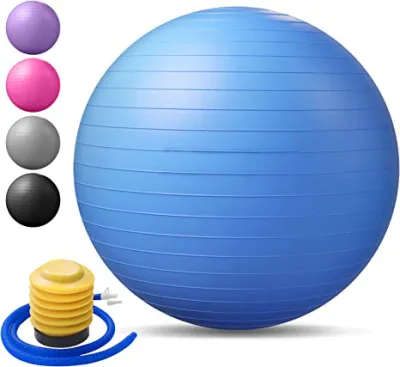
![🇸🇬 [READY STOCK] Anti-Burst and Slip Swiss Ball Yoga Ball Fitness Ball Birthing Ball with Quick Pump](https://img.lazcdn.com/g/p/7185f59d3c18814d079973d3aa24ae62.jpg_400x400q80.jpg_.webp)
![[SG Seller]Exercise Ball Weight Loss Bola Yoga Fitness Yoga Ball Anti-Burst Yoga Ball Thickened Stability Balance Ball Birthing Ball Portable Yoga](https://img.lazcdn.com/g/p/73f4eb1fc956e5309c7ccca840c40047.jpg_400x400q80.jpg_.webp)
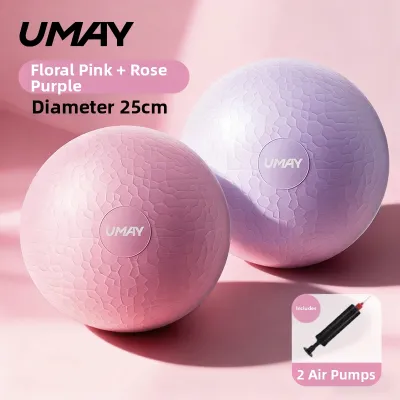
Prices are valid at publication and may change. Please refer to the product page for the latest price.
Ultimately, an exercise ball is a highly effective stability tool, but its performance relies entirely on your ability to maintain a neutral spine. By matching the ball’s diameter to your height, you establish a secure foundation that supports safe movement patterns. This simple alignment check ensures that every stretch, lift, or core contraction delivers maximum fitness benefits.
Exercise Ball Size Chart Based on Height
When choosing an exercise ball, the primary decision-making factor is the ball’s inflated diameter in relation to your physical height. Sizing standards are widely consistent across the fitness industry, mapping specific height ranges to standard ball diameters. These standard sizes typically increase in increments of 10 centimeters, starting from 45 cm and going up to 85 cm.
To help you quickly identify the correct baseline size, use the following comprehensive sizing chart. This guide matches your height in both metric and imperial measurements to the recommended fully inflated ball diameter.
| User Height (Metric) | User Height (Imperial) | Recommended Ball Size (Diameter) |
|---|---|---|
| Under 152 cm | Under 5'0" | 45 cm |
| 152 cm to 165 cm | 5'0" to 5'5" | 55 cm |
| 165 cm to 180 cm | 5'5" to 5'11" | 65 cm |
| 180 cm to 190 cm | 5'11" to 6'3" | 75 cm |
| Over 190 cm | Over 6'3" | 85 cm |
These measurements refer specifically to the fully inflated diameter of the ball, not its flat, deflated packaging dimensions. When you purchase a ball labeled “65 cm,” it is designed to measure exactly 65 cm from top to bottom when inflated to its optimal pressure. Attempting to judge the size of the ball before it is fully inflated will lead to incorrect assumptions about its fit.
While this chart serves as an excellent starting point, individual body proportions can influence your final choice. For instance, if you have a particularly long torso or exceptionally long legs relative to your overall height, you may need to adjust your selection. A person with longer legs will often require a slightly larger ball to maintain proper joint angles, whereas someone with a longer torso and shorter legs might find a smaller size more manageable.
Adjusting Size for Your Specific Workout Goals
While the standard height chart provides an excellent baseline, your primary fitness activities and daily habits may require you to deviate slightly from these recommendations. Different exercises and functional uses place unique demands on your body’s positioning, meaning a size that works perfectly for core training might not be ideal for desk ergonomics.

Using as a Desk Chair If you plan to use an exercise ball as an active sitting chair at your desk, ergonomics must take priority over standard fitness sizing. For comfortable and safe desk work, your hips should be positioned slightly higher than your knees to promote a natural forward pelvic tilt. This subtle tilt helps maintain the natural curve of your lumbar spine, reducing the slouching that leads to chronic lower back strain.
Because standard office desks typically stand at a fixed height of about 70 to 75 cm, a standard-sized ball may leave you sitting too low, forcing you to reach upward and strain your shoulders. In this scenario, it is highly recommended to size up by one level—for example, choosing a 65 cm ball instead of a 55 cm ball. This extra height, combined with adjusting the inflation pressure, allows you to align your forearms parallel to your desk surface while keeping your feet firmly planted on the floor.
Core Training and Pilates For focused core training, stability exercises, and Pilates routines, sticking closely to the standard height chart is almost always the best approach. Exercises such as pikes, rollouts, and hamstring curls rely on precise leverage and a specific level of instability to challenge your deep abdominal and stabilizing muscles. If the ball is too large, you will lose the necessary leverage, making it difficult to control the movement and increasing the risk of straining your back.
Conversely, a ball that is too small limits your range of motion during core exercises, reducing the overall effectiveness of the workout. When the ball is sized correctly according to your height, it provides the perfect balance of support and challenge. This optimal sizing allows you to move smoothly through your full range of motion while maintaining strict control over your body’s alignment.
Yoga and Stretching For yoga, mobility work, and general body stretching, your choice of ball size can vary depending on the specific stretches you want to target. If your primary goal is to perform deep backbends, chest openers, or spinal decompressions, a slightly larger ball can offer a broader, more supportive surface area. This extra volume cradles your spine more comfortably, allowing you to relax into passive stretches without feeling like you might roll off the sides.
However, if you are focusing on targeted joint mobilization, balance poses, or lower-body physical therapy exercises, a smaller ball may be more beneficial. A smaller diameter keeps your center of gravity closer to the ground, offering a more stable and approachable platform for balance work. This lower profile is particularly helpful for beginners or individuals recovering from injuries who need to build confidence and strength gradually.
Safety and Weight Limits Regardless of the size you choose, safety must always be your top priority when selecting and using an exercise ball. It is a common misconception that larger balls automatically possess higher weight capacities or superior burst resistance. In reality, weight limits and material durability are determined entirely by the manufacturer’s construction quality and material thickness, not the ball’s physical dimensions.
Before purchasing or using any ball, you must explicitly check the manufacturer’s label or product packaging for its static and dynamic weight limits, as well as its anti-burst rating. High-quality balls are typically constructed from thick, slip-resistant PVC that is designed to deflate slowly and safely if punctured, rather than popping suddenly. Always adhere to the specified weight limits and care instructions to ensure a safe workout environment.
How to Properly Inflate and Test Your Exercise Ball
Acquiring the correct size exercise ball is only the first step; you must also inflate and test it properly to ensure it functions as intended. Under-inflation is one of the most common issues users face, often leading to a ball that feels soft, unstable, and significantly smaller than its rated diameter. Following a systematic inflation process and verifying the fit with a physical test will guarantee your ball provides the perfect balance of support and challenge.
Step-by-Step Inflation Guide
To achieve the correct physical size without damage, follow a careful, two-stage inflation process. A new exercise ball is cold, stiff, and tightly folded from shipping. Forcing it to its maximum diameter immediately can overstretch the material, weaken the seams, or cause minor tears that compromise structural integrity.
Begin by inflating the ball to approximately 80% of its target diameter using a hand or foot pump. Insert the temporary plug and let the ball rest undisturbed for 24 hours. This resting period allows the PVC or rubber material to acclimate to your room’s temperature and stretch safely to its natural shape.
After 24 hours, remove the plug and continue inflating the ball to its full, specified diameter. To measure this accurately, use a flexible tape measure to check the circumference around the widest part, or mark the target height on a wall and inflate until the ball touches the mark. Once fully inflated, insert the permanent plug securely; the ball should feel firm but still have about 2 to 3 centimeters of depression when pressed.
The 90-Degree Rule Test
Once fully inflated, perform a physical verification test to confirm the size matches your body. The most reliable method is the 90-degree rule test, which ensures your joints are aligned in a biomechanically neutral position to minimize strain and maximize stability.
Sit comfortably in the center of the ball with your feet flat on the floor, shoulder-width apart. Sit tall with a neutral spine and relaxed shoulders, then check the angle of your hips, knees, and ankles. Ideally, your thighs should be parallel to the floor, creating a clean 90-degree angle at both your knees and your hips.
If your knees are higher than your hips, the ball is under-inflated or too small. This position forces your pelvis to tilt backward, rounding your lower back and placing unnecessary pressure on your lumbar discs. To correct this, add more air without exceeding the maximum rated diameter, or upgrade to a larger size. Conversely, if your hips are excessively high and your feet barely touch the floor, the ball is over-inflated or too large, which reduces your stability and increases the risk of rolling off.
Common Sizing Mistakes and Troubleshooting
Even with a clear guide, simple mistakes in selecting, inflating, and maintaining an exercise ball can compromise your safety and workout quality. Because these tools rely on air pressure and flexible materials, they require regular attention to remain safe and effective over time. Recognizing common pitfalls and learning how to troubleshoot them will help you prolong the lifespan of your equipment.
Assuming a Deflated Ball is the Wrong Size A brand-new, deflated exercise ball looks incredibly small and wrinkled out of the packaging, often leading users to assume they received the wrong size. It is vital to remember that the PVC material requires time and gradual pressure to expand fully. Following the two-stage inflation process allows the polymer chains to stretch safely; do not be discouraged if the ball looks undersized during the first inflation.
Over-Inflation Risks Attempting to over-inflate a smaller ball to fit a taller user stretches the PVC material beyond its safe design limits, compromising its burst-resistance and increasing the risk of sudden failure. Over-inflation also creates a hard, rigid surface that rolls unpredictably and offers very little traction against the floor. If you need more height, always purchase the correct larger size rather than trying to force a smaller ball to perform beyond its specifications.
Environmental Factors Environmental conditions play a significant role in how your exercise ball behaves, particularly in tropical climates like Singapore. Because air expands when heated and contracts when cooled, temperature fluctuations between warm, humid outdoor air and cool, air-conditioned interiors will directly affect the ball’s firmness. To maintain a consistent size, store and use your ball in a temperature-controlled environment, and be prepared to make minor adjustments to the inflation pressure as needed.
Maintenance and Replacement Perform a quick inspection of your ball’s condition and firmness on a weekly basis, as all PVC balls naturally lose a small amount of air over time. Inspect the surface for signs of wear, such as deep scratches, scuffs, discoloration, or small punctures. If you notice any visible damage, or if the ball fails to hold its shape, stop using it immediately and replace it; a quality replacement is a small investment that protects you from the risk of a sudden fall.
Frequently Asked Questions (FAQ)
What if my height falls exactly between two size ranges?
If your physical height falls directly on the boundary between two size ranges, your choice should depend on your primary fitness goals and body proportions. For general fitness, core training, or if you have relatively short legs, selecting the smaller size and inflating it to its maximum capacity will provide a firmer, more responsive surface. This setup is excellent for dynamic movements that require quick stabilization and precise control.
However, if you plan to use the ball primarily as an ergonomic desk chair, or if you have longer legs, choosing the larger size is generally the better option. You can slightly under-inflate the larger ball to achieve the correct 90-degree seating angle without making the surface too hard. This under-inflation also creates a slightly wider, flatter contact patch with the floor, which increases stability and makes it easier to maintain your balance during long sitting sessions.
Does the color or material of the exercise ball affect its size or durability?
The color of an exercise ball is purely cosmetic and has no bearing on its size, strength, or performance. You can choose any color that matches your personal style or home gym decor without worrying about structural differences. However, the material composition of the ball is of critical importance when it comes to durability, weight capacity, and safety.
High-quality exercise balls are manufactured from professional-grade, heavy-duty PVC that features advanced anti-burst technology. This specific material construction ensures that if the ball is punctured by a sharp object, it will deflate slowly and controlled rather than popping like a balloon, protecting you from sudden injury. Always verify these material specifications, weight limits, and anti-burst ratings on the product packaging or manufacturer’s label rather than making assumptions based on visual appearance or color alone.
Community discussion
Share your experience or ask a question. Comments are reviewed before publication.