
Choosing the right medicine ball weight is a balancing act between movement speed, control, and your current physical capacity. Unlike traditional weights designed solely for resistance, a medicine ball is often thrown, caught, or swung dynamically. To select the correct weight, you must match the ball to your specific training goals: lighter loads are essential for explosive, high-velocity power movements, while moderate to heavier loads are better suited for slow, controlled strength and core exercises.
Understanding Medicine Ball Types and Weight Distribution
The physical construction of a medicine ball significantly influences how heavy it feels and how safely you can handle it. Medicine balls generally fall into three material categories: rubber, leather (or synthetic leather), and soft-shell vinyl. Rubber balls often feature a textured surface for enhanced grip, which is particularly beneficial in warm, humid climates like Singapore where sweat can quickly compromise your hold. These balls typically bounce, making them ideal for solo wall rebounds or floor-bounce exercises. However, their high rebound capacity requires quick reflexes and stable wrist alignment to catch safely.
Leather and synthetic leather options offer a classic, firm grip with minimal bounce. They are excellent for partner drills and rotational throws against solid walls, as they absorb impact without erratic rebounds. Soft-shell balls, often filled with sand, steel shot, or dense fibers, are designed to absorb impact completely. These are commonly referred to as slam balls. Because they do not bounce, they force you to bend and lift them from the floor for every repetition, adding a metabolic challenge to your workout. In compact living spaces, such as Singapore’s HDB apartments, a non-bounce soft-shell ball or slam ball is often preferred over a high-bounce rubber ball to prevent floor damage and minimize noise transmission to neighbors.
Products mentioned in this guide
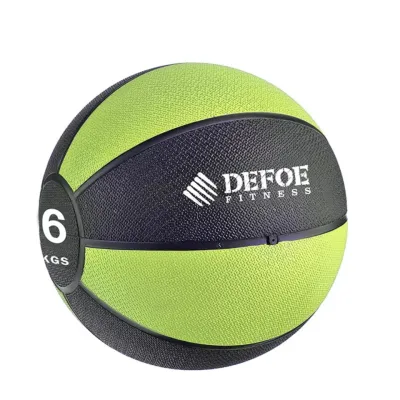
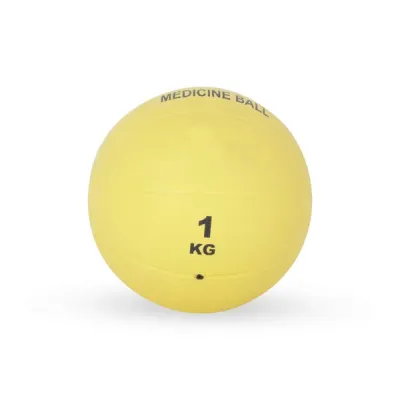
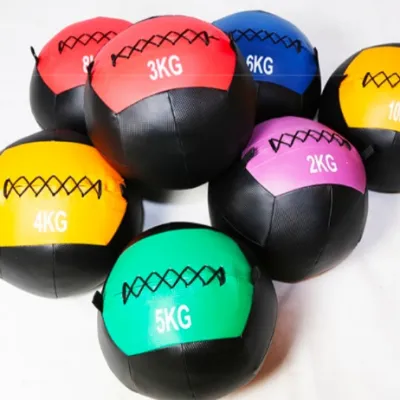
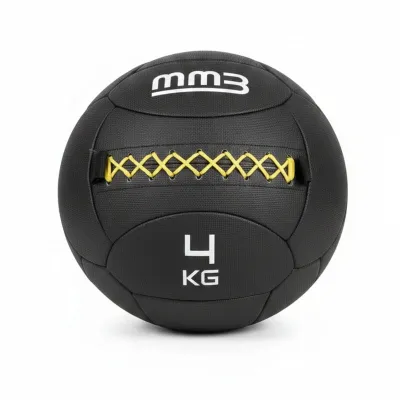
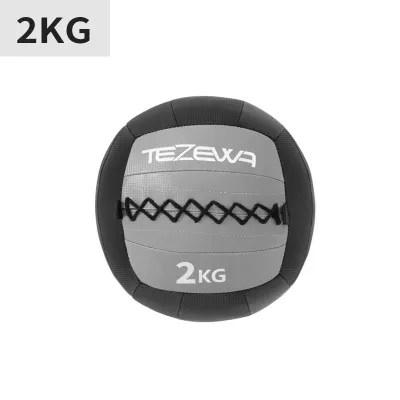
Prices are valid at publication and may change. Please refer to the product page for the latest price.
Beyond material, the physical size of the ball alters its usability. A larger diameter shifts the center of mass further away from your body’s midline. This increased leverage demand means a 5kg soft-shell ball with a wide diameter can feel substantially heavier and more awkward during a squat or throw than a compact 5kg rubber ball. Always check the manufacturer’s labels and product specifications to verify the ball’s construction, fill material, and intended use. Using a standard stitched medicine ball for high-impact slams can rupture the seams, while slamming a hard rubber ball can result in a dangerous rebound.
Assessing Your Strength Baseline and Movement Capacity
Before selecting a medicine ball, you must evaluate your current physical conditioning to establish a safe starting threshold. Begin by assessing your core stability, shoulder mobility, and grip endurance. For overhead movements, verify that you can raise both arms fully overhead without arching your lower back or shrugging your shoulders toward your ears. If your shoulder mobility is restricted, starting with a heavy ball overhead increases the risk of joint strain.

You can use familiar gym equipment as a relative reference point to estimate your starting weight. If you can comfortably perform a shoulder press with a pair of 4kg dumbbells, a 4kg medicine ball is a reasonable starting point for controlled, two-handed overhead movements. If you routinely use an 8kg kettlebell for goblet squats, you can safely select an 8kg medicine ball for lower-body strength exercises. However, for explosive or rotational movements, you should scale this weight down by at least half to account for the added acceleration and deceleration forces.
Your training history, joint health, and injury recovery status must also guide your selection. If you are returning to exercise after a wrist, shoulder, or lower back injury, prioritize movement quality over external resistance. A lighter ball allows you to rebuild neuromuscular coordination and joint stability without overloading healing tissues.
Matching the Load to Exercise Speed and Biomechanics
The biomechanical demands of your workout dictate the ideal weight of your medicine ball. Training for explosive power requires high-velocity movements, such as rotational wall throws, overhead slams, and chest passes. For these exercises, select a lighter load—typically between 2kg and 5kg for most fitness levels. If the ball is too heavy, your movement speed drops, the exercise becomes a slow strength movement, and you lose the targeted power-development benefits. Keeping the load light ensures you can accelerate the ball rapidly while maintaining joint integrity.
Conversely, slow and controlled exercises can accommodate moderate to heavier loads. Movements like Russian twists, standing core rotations, dead bugs, and weighted squats are designed to build muscular endurance and structural strength. For these patterns, a heavier ball (ranging from 6kg to 10kg or more, depending on your baseline) provides the necessary resistance to challenge your muscles. The slower tempo allows you to focus on core bracing and spinal alignment under load.
This distinction highlights the fundamental biomechanical trade-off between external resistance and movement speed. According to the force-velocity relationship, as load increases, maximum movement velocity decreases. To develop athletic power, you must prioritize velocity over mass. To develop raw strength or hypertrophy, you must prioritize mass over velocity. Attempting to force a heavy ball through a high-velocity movement pattern often leads to compensatory mechanics, such as rounding the lower back or snapping the elbows.
Practical Testing Methods to Verify Your Selection
To ensure your selected medicine ball is safe and effective, perform a practical testing protocol before committing to a full training session. The most reliable method is the “form-break” test. Select your target weight and perform five to eight continuous repetitions of your planned exercise at the intended speed. Observe your technique closely or use a mirror. If you notice your posture collapsing, your shoulders shrugging, your wrists bending backward, or your knees caving inward, the ball is too heavy. You should immediately scale down to a lighter weight.
Next, evaluate your grip comfort and hand fatigue. Hold the ball in front of your chest and perform a few rapid chest presses or short tosses. Your hands should feel secure, and your wrists should remain in a neutral, straight alignment. If you feel excessive strain in your forearms or if the ball slips easily, the material or the diameter may not be suitable for your hand size, regardless of the weight.
Establish clear stop conditions during your testing. Stop immediately if you experience sharp joint pain, sudden instability, or an inability to safely decelerate the ball during catches or slams. Equipment cannot replace physical preparation; if you cannot control the deceleration phase of a throw, the risk of muscle strain or joint hyperextension increases significantly.
Progression Criteria for Increasing Medicine Ball Weight
As your strength, coordination, and movement efficiency improve, you will eventually need to progress to a heavier medicine ball. Look for objective signs that your current weight is no longer challenging. If you can complete all planned sets and repetitions with flawless form, feel minimal fatigue, and maintain maximum velocity from the first rep to the last, it is time to increase the load.
When progressing, manage weight jumps conservatively. An increase of just 1kg or 2kg can feel substantial due to the dynamic nature of medicine ball exercises. Be prepared for changes in ball diameter as you move up in weight. A larger ball will alter your leverage and grip requirements, which may temporarily make the exercise feel more awkward. Allow your body a few sessions to adapt to the new dimensions before increasing your training volume or speed.
During this transition, prioritize movement quality and deceleration control. Before attempting explosive throws with a heavier ball, practice catching and absorbing the weight in a controlled manner. Ensuring your joints and core can safely decelerate the increased mass is the most critical step in preventing injury during progression.
Frequently Asked Questions (FAQ)
Can I use the same medicine ball weight for all exercises?
No, using a single medicine ball weight for every exercise is rarely effective because different movement patterns involve vastly different muscle groups and leverage points. Long-lever movements, such as rotational throws where the ball is held far from your body’s center of mass, require a lighter ball to protect your shoulders and lower back. Short-lever movements, such as close-grip core crunches or squats, allow you to safely handle a much heavier load. To build a versatile home gym setup, consider acquiring at least two balls: a lighter one for explosive, rotational work, and a heavier one for strength and core conditioning.
What should I do if the medicine ball feels too heavy mid-workout?
If a medicine ball begins to feel too heavy during a workout, prioritize safety by immediately reducing the intensity. Do not attempt to force the remaining repetitions, as fatigue compromises your form and increases the risk of injury. Safely decelerate and ground the ball by squatting down to place it on the floor, rather than dropping it from waist height or bending over at the waist. You can modify the exercise by reducing the range of motion, slowing down the tempo, or switching to a lighter ball. If no lighter alternative is available, perform the movement using only your body weight to maintain the training flow safely.
Do different medicine ball materials affect how heavy they feel?
Yes, the material and physical dimensions of a medicine ball directly influence your perception of its weight. A ball with a smooth rubber surface requires more grip strength to hold, which can cause rapid forearm fatigue and make the ball feel heavier than it actually is. Conversely, a textured leather or soft-shell ball provides better friction, reducing the grip effort required. Additionally, a larger diameter shifts the weight further from your body, increasing the leverage demand on your shoulders and core. This is why a large, soft-shell wall ball can feel more challenging to control than a compact rubber ball of the identical weight.
Community discussion
Share your experience or ask a question. Comments are reviewed before publication.