
Selecting the correct outboard fuel tank capacity is a balancing act between securing enough range for your excursion and keeping your watercraft light, stable, and safe. Carrying too much fuel adds unnecessary weight that degrades performance, while carrying too little risks stranding you in open water. The ideal capacity depends on your motor’s horsepower, your watercraft’s weight limits, and your planned journey duration.
For motorized kayaks and small outboards (2 to 5 horsepower), a 6-liter to 12-liter portable tank is usually sufficient. For small aluminum boats, dinghies, or skiffs running larger outboards (9.9 to 25 horsepower), a 12-liter to 24-liter tank provides the necessary range without overloading the transom. To make an accurate choice, you must evaluate how your specific engine consumes fuel and how that weight impacts your watercraft’s handling.
Understanding Your Outboard Motor's Fuel Consumption
To establish a reliable baseline for your fuel needs, you must first understand how your outboard motor consumes fuel under different operating conditions. Relying on guesswork can lead to dangerous shortages or carrying excessive, stability-compromising weight.
Products mentioned in this guide
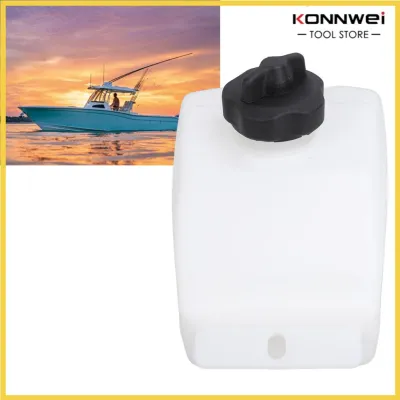
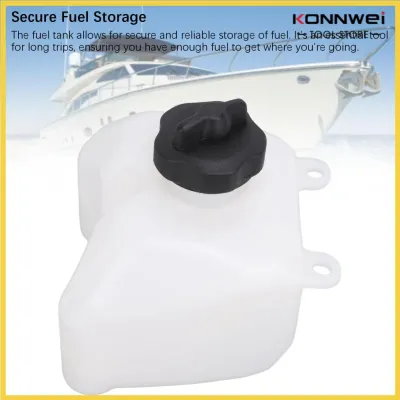
Prices are valid at publication and may change. Please refer to the product page for the latest price.
Fuel consumption varies dramatically depending on throttle position. Wide-open throttle (WOT) represents the maximum fuel burn rate of your engine, which occurs when the motor is running at its absolute limit. Cruising speed, typically achieved at 70% to 80% of maximum RPM, is far more efficient. At cruising speed, an outboard motor often consumes up to 30% to 50% less fuel per hour than it does at WOT. For capacity planning, cruising consumption is the most practical and realistic metric to use.
To find your motor’s specific fuel consumption rate, consult the manufacturer’s manual or check the engine specification plate. Marine engines are rated in Liters Per Hour (LPH) or Gallons Per Hour (GPH). As a general rule of thumb, modern four-stroke outboards burn approximately 0.35 to 0.4 liters of fuel per hour for every horsepower produced at WOT. A 10 hp outboard, for example, will consume roughly 3.5 to 4 liters per hour at full throttle, whereas it may only burn 2 to 2.5 liters per hour at cruising speed.
It is important to remember that these manufacturer ratings are established under ideal test conditions. In the real world, actual fuel burn is highly variable. Added passenger weight, heavy gear, choppy water, strong head winds, and high tidal currents all force the engine to work harder, increasing fuel consumption. Always treat manufacturer specifications as a starting baseline and adjust your capacity calculations upward to account for local marine conditions.
Matching Tank Capacity to Your Watercraft
Different types of watercraft have distinct physical limitations, weight capacities, and hull designs. A fuel tank capacity that is perfect for a small utility boat could easily capsize a motorized kayak. You must match the tank’s physical size and weight to the specific design of your vessel.

Small Boats (Dinghies, Skiffs, and Aluminum Boats)
Small boats, such as aluminum utility boats (jon boats), rigid inflatable boats (RIBs), and fiberglass skiffs, generally feature flat decks, bench seats, or dedicated storage lockers. These layout elements make them well-suited for mid-to-large portable outboard fuel tanks ranging from 12 liters to 24 liters.
While these boats can physically accommodate larger tanks, weight distribution remains a critical factor. A full 24-liter petrol tank weighs approximately 22 kilograms. If you place this heavy tank entirely at the stern alongside a heavy outboard motor and a starting battery, you risk creating an extreme stern-heavy trim. This causes the bow to rise excessively (squatting), increases fuel consumption, and makes it difficult for the boat to get on plane. Whenever possible, position the fuel tank mid-ship or forward to maintain optimal hull balance.
Additionally, portable tanks must be secured firmly to the deck or inside a locker. Choppy coastal waters can cause an unsecured tank to slide, which can damage fuel lines, disconnect fittings, or shift the boat’s center of gravity suddenly. Use heavy-duty tie-down straps or mounting brackets to keep the tank locked in place during transit.
Motorized Kayaks and Canoes
Motorized kayaks and canoes operate under strict space, deck layout, and weight limitations. Because these watercraft have narrow beams and low freeboard, they are highly sensitive to changes in their center of gravity. For these vessels, smaller, low-profile portable tanks of 6 liters to 12 liters are highly recommended.
Every kilogram added to a kayak reduces its buoyancy and stability. A 12-liter tank filled with fuel weighs roughly 11 kilograms, which can significantly lower the kayak’s freeboard if placed incorrectly. Positioning a heavy tank high on a kayak’s tank well or rear deck raises the center of gravity, making the kayak feel tippy and increasing the risk of a roll. Keep the tank as low as possible and centered along the watercraft’s centerline.
Because kayaks sit very low in the water, they are constantly exposed to spray and wash. It is vital to choose a fuel tank with a splash-resistant, tightly sealing vent system to prevent water from contaminating the fuel. Secure the tank using heavy-duty bungee systems or webbing straps attached to robust deck pad eyes, ensuring it cannot slide or tip even if the kayak encounters a sudden wake.
Calculating Range and Trip Duration
To ensure you never run out of fuel on the water, you must translate your engine’s consumption rate and your trip itinerary into a minimum required tank capacity. This calculation must always include a dedicated safety margin.
For safe fuel management, boaters worldwide rely on the “Rule of Thirds.” This rule dictates that you allocate:
- One-third of your fuel for the outbound journey
- One-third of your fuel for the return journey
- One-third of your fuel kept in reserve for emergencies, unexpected weather, or navigational detours
To calculate your required tank size, use this straightforward formula:
Required Tank Capacity = (Estimated Hours of Motoring × Cruising LPH) × 1.5
Multiplying your planned cruising consumption by 1.5 mathematically builds the necessary 33% safety reserve directly into your capacity planning. Let us look at how this formula applies to two common boating scenarios:
- Scenario A: A half-day coastal fishing trip. You are operating a 3.6-meter aluminum boat powered by a 9.9 hp outboard motor. The motor consumes approximately 3 liters per hour at cruising speed. You plan to spend a total of 2 hours actively motoring between different fishing spots. Using the formula: (2 hours × 3 LPH) × 1.5 = 9 liters. In this scenario, a standard 12-liter portable tank is the ideal choice, providing ample fuel and a comfortable safety margin.
- Scenario B: A short island-hopping excursion. You are paddling a motorized kayak equipped with a small 2.5 hp outboard motor that burns roughly 1 liter per hour at cruising speed. You plan to motor for 4 hours total throughout the day. Using the formula: (4 hours × 1 LPH) × 1.5 = 6 liters. A compact 6-liter tank fits the space perfectly while fully satisfying the Rule of Thirds.
Managing Space, Weight, and Safety on Board
Selecting the right capacity is only the first step; you must also ensure the tank physically fits and operates safely within your watercraft’s environment. Marine fuel systems require careful handling to prevent fire hazards and equipment damage.
Before purchasing any outboard fuel tank, measure the exact footprint of your designated storage area or deck space. Do not just measure the base of the tank; you must account for the height of the fuel cap, the manual vent screw, and the quick-connect fuel line fitting. Ensure there is at least 10 centimeters of clearance above the tank to prevent the fuel hose and primer bulb from bending sharply, which can restrict fuel flow and starve the engine.
If you plan to store your fuel tank inside an enclosed compartment or locker, ventilation is a critical safety requirement. Petrol vapors are heavier than air and will naturally pool in low, unventilated spaces. A single spark from a battery terminal, bilge pump, or electrical switch can ignite these trapped vapors. Ensure the compartment has active or passive venting to allow fumes to escape safely into the open air.
+-----------------------------------------------------------------+
|                   PORTABLE FUEL TANK CHECKLIST                  |
+-----------------------------------------------------------------+
| [ ] Check clearance above tank for fuel line and primer bulb    |
| [ ] Ensure storage compartment has passive or active venting    |
| [ ] Confirm tank is constructed from UV-resistant HDPE          |
| [ ] Verify fuel line and gaskets are ethanol-compatible         |
| [ ] Secure tank with marine-grade webbing straps to prevent slide|
+-----------------------------------------------------------------+
Portable marine fuel tanks must be constructed from high-density polyethylene (HDPE) infused with UV inhibitors. The intense tropical sun can rapidly degrade standard plastics, making them brittle and prone to cracking. Additionally, ensure all tank components, gaskets, and fuel lines are fully compatible with ethanol-blended fuels. Even if you primarily run non-ethanol petrol, ethanol-compatible components offer superior resistance to chemical breakdown, preventing fuel leaks and line degradation over time.
Finally, always secure your tank to the deck. Use non-slip rubber mats underneath the tank to absorb vibrations and prevent sliding. Secure the tank using marine-grade webbing straps with corrosion-resistant plastic or stainless steel buckles. Never rely on the fuel line itself to hold a tank in place.
Common Fuel Tank Sizing Mistakes
Avoiding common pitfalls during the selection process will save you money and keep you safe on the water. Many boaters make mistakes by focusing solely on fuel volume without considering the practical consequences.
- Oversizing: It is tempting to buy the largest tank that will physically fit on your deck to maximize your range. However, carrying a 24-liter tank on a small kayak or a tiny 2-meter dinghy is highly dangerous. The excess weight degrades the watercraft's performance, lowers the transom close to the waterline, and significantly increases the risk of capsizing in rough water.
- Undersizing: Conversely, choosing an undersized tank to save deck space or minimize weight leads to severe range anxiety. If you choose a tank that is too small, you may find yourself running out of fuel while fighting strong tidal currents or head winds, leaving you stranded in busy shipping lanes.
- Ignoring Fittings: Outboard manufacturers do not use universal fuel connectors. Brands like Yamaha, Mercury, Suzuki, and Tohatsu all utilize proprietary quick-connect fittings. Before purchasing a portable tank, verify that the tank's outlet threads match your engine's specific fuel line connector and hose diameter. Using mismatched or poorly fitted connectors can cause air leaks, fuel starvation, or dangerous fuel sprays under pressure.
Frequently Asked Questions (FAQ)
Can I use a standard automotive gas can for my outboard motor?
No, you should never use a standard automotive gas can as a primary fuel tank for an outboard motor. Automotive cans are designed solely for transport and pouring; they lack the specialized two-way venting valves required to handle the pressure changes of a marine fuel system. Furthermore, automotive cans do not feature the secure, leak-proof quick-connect fittings needed to hook up a marine fuel line, and they lack the internal baffling and UV-stabilization required to withstand constant movement and sun exposure on open water.
Do I need a fuel water separator for a small portable tank?
Yes, installing a compact, inline fuel-water separator is highly recommended, even for small portable tanks. In humid tropical environments, rapid temperature changes between day and night cause moisture to condense on the exposed inner walls of partially empty fuel tanks. Over time, this water settles to the bottom of the tank and can enter your engine, causing sputtering, fuel injector damage, or complete engine failure. A small inline separator filters out this water before it can reach your carburetor or fuel injection system.
Community discussion
Share your experience or ask a question. Comments are reviewed before publication.