
Choosing the right resistance level for your yoga stretch band is the key to unlocking deeper flexibility while protecting your joints from strain. Unlike heavy strength-training equipment, a yoga stretch band is designed to assist your alignment, deepen your range of motion, and provide gentle traction. Selecting the ideal tension depends on your current flexibility, your specific physical goals, and the muscle groups you plan to target.
Starting with the wrong resistance can lead to two common issues: a band that is too stiff will force your body into poor alignment, while a band that is too loose will fail to provide the support needed to hold challenging poses. By understanding how to evaluate your body’s baseline and read product specifications, you can select a band that safely enhances your practice.
Assess Your Baseline Flexibility and Stretching Goals
Before purchasing or using a yoga stretch band, it is essential to conduct a quick self-assessment of your current mobility. Sit on the floor with your legs extended straight in front of you and attempt to reach toward your toes. If you cannot reach past your shins without rounding your lower back, or if your hamstrings feel tight immediately, your baseline flexibility is limited. Similarly, test your overhead shoulder mobility by raising both arms straight up; if your shoulders pinch or your chest arches excessively, you have tight upper-body joints.
Products mentioned in this guide


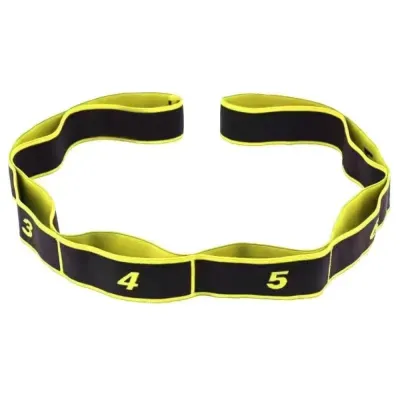
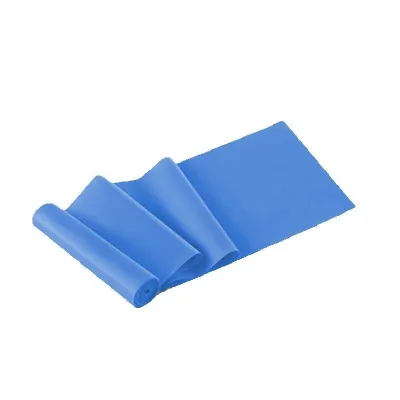


![[RECEIVE IN 3 DAYS] Looped Resistance Exercise Yoga Bands](https://img.lazcdn.com/g/p/478c71011ff76f1dc2636e7c42012a8d.jpg_400x400q80.jpg_.webp)
Prices are valid at publication and may change. Please refer to the product page for the latest price.
Your specific stretching goals will also dictate the level of resistance you need. If you are using the band for physical rehabilitation or gentle daily stretching to relieve stiffness from sitting at a desk, you require very light tension. In these scenarios, the band acts primarily as a limb extension, helping you reach your feet or bind your hands without straining.
Conversely, if your goal is deep flexibility training—such as preparing for advanced yoga poses like the king pigeon or splits—you will benefit from a medium-resistance band. This level of tension provides enough structural support to help you hold deep stretches for extended periods. Always identify your primary target areas first, as smaller, delicate joints like the shoulders require a much lighter touch than large, powerful muscle groups like the hips and hamstrings.
Read Band Specifications and Identify Resistance Levels
When shopping for a yoga stretch band, you cannot rely on color-coding alone. There is no universal standard for band colors; a red band from one manufacturer might represent light tension, while a red band from another brand could be rated as extra heavy. To avoid confusion, always check the product tags, packaging, or the manufacturer’s official guide for specific tension ratings, which are often listed in kilograms or pounds of resistance.

You can also use visual and tactile cues to evaluate a band’s resistance level. Examine the thickness and width of the band: thicker and wider bands naturally offer higher resistance and are more difficult to stretch. The material composition also plays a major role in how the band behaves under tension.
Latex and TPE Bands These bands are highly elastic and provide a smooth, progressive stretch. They are excellent for precise, incremental tension adjustments, but they can sometimes roll up or pinch the skin if they are too thin.
Fabric and Cotton-Latex Blends These bands are thicker, wider, and much sturdier. They offer a high level of resistance and do not roll up during use, making them ideal for lower-body stretches. However, they have less elasticity, which means they reach their maximum stretch limit much faster than pure latex options.
Match Tension to Your Experience and Target Muscle Groups
Matching the band’s tension to your experience level is crucial for maintaining proper form. If you are a beginner or are dealing with severe muscle tightness, always default to a light resistance band. Light bands allow you to focus on your breathing and alignment without forcing your muscles to fight against excessive tension, which can trigger a protective contraction rather than a deep stretch.
As you plan your routine, remember that different muscle groups require different levels of resistance. Large muscle groups, such as the hamstrings, glutes, and quadriceps, are incredibly strong and require a medium to heavy band to feel a meaningful stretch. For example, when performing a lying hamstring stretch, a sturdier band helps support the weight of your leg comfortably.
For smaller, more delicate joints like the shoulders, rotator cuffs, and wrists, heavy resistance can easily lead to joint impingement or muscle strain. These areas should only be stretched using light bands. To accommodate these varying anatomical needs, consider investing in a multi-band set. Having a range of light, medium, and heavy bands allows you to seamlessly adjust your resistance as you move through different poses and progressively build flexibility over time.
Test Your Band Safely and Recognize Warning Signs
To ensure your safety, always test a new yoga stretch band before incorporating it into a full workout. Begin by inspecting the band for any visible signs of wear, such as micro-tears, cracks, or discoloration, which can cause the band to snap under tension. Once inspected, secure the band firmly around a stable anchor point, such as the arch of your foot or a heavy, non-slip piece of furniture.
Apply tension gradually and in a controlled manner. Never pull the band with sudden, jerky movements. As you stretch, pay close attention to your body’s physical feedback to determine if the resistance is appropriate.
Signs the Resistance is Too Heavy
- Your posture collapses, or you have to round your back to hold the pose.
- You find yourself holding your breath or breathing shallowly.
- You experience sharp, localized pain in your joints rather than a dull, pleasant stretch in the muscle belly.
Signs the Resistance is Too Light
- The band goes completely slack during the movement.
- You reach the maximum physical stretch of the band without feeling any engagement in the target muscle.
If you experience any of the warning signs of excessive resistance, or if you feel the band starting to slip, initiate an immediate stop. Slowly and carefully release the tension to return to your starting position; never let go of a fully stretched band suddenly, as this can cause painful snapping and potential injury.
Frequently Asked Questions (FAQ)
Can I use the same resistance level for all yoga poses?
No, using a single resistance level for every pose is not recommended because your body’s muscle groups vary significantly in strength and mobility. Large lower-body muscles like your hamstrings can safely handle much higher tension than the delicate joints in your shoulders and upper back. To maintain safe and effective tension throughout your routine, you can adjust your grip length on a single band to increase or decrease resistance, or simply switch to a different band when transitioning between upper-body and lower-body poses.
How do I know when it is time to move to a heavier resistance band?
You will know it is time to progress to a heavier band when your current band no longer provides a noticeable stretch or support, even when pulled to its comfortable limit. If you can easily maintain perfect alignment and joint stability throughout a pose without feeling any muscle engagement, your body has adapted to that level of resistance. Before upgrading, always ensure that your form is flawless and that you can hold the stretch comfortably with deep, steady breathing.
Community discussion
Share your experience or ask a question. Comments are reviewed before publication.