
To choose the right ROCKBROS electric pump, you must first identify your primary inflation task. Different models are engineered with distinct performance trade-offs: road cycling requires high-pressure capabilities, mountain and gravel biking require high-volume air delivery, and household or multi-sport applications demand versatility and multiple nozzle adapters. No single electric pump is perfectly optimized for every scenario, so selecting the correct device depends on your most frequent inflation needs.
Before purchasing any model, always inspect the sidewalls of your bicycle tires, sports equipment manuals, or inflatable labels to verify the required pressure limits. Operating an electric pump outside its intended pressure or volume range can lead to motor strain, battery depletion, or damage to your equipment.
Key Specifications to Check Before Buying a ROCKBROS Electric Pump
Understanding the core technical specifications of portable electric pumps allows you to evaluate different models effectively and verify manufacturer claims against your actual needs.
Products mentioned in this guide
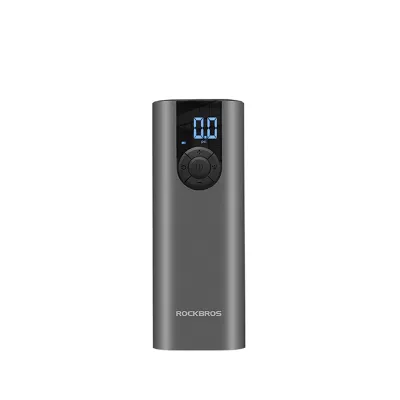
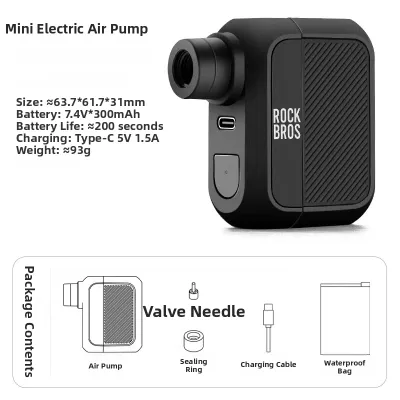
![[SG SELLER] ROCKBROS Foot Pump Bicycle Pump High Pressure Portable Basketball Bicycle Electric Bicycle Motorcycle Car Air Pump Road Bike Folding Bike](https://img.lazcdn.com/g/p/031056b8547fb93e4a8b03ba21866574.png_400x400q80.png_.webp)
![[Ready Stocks in SG!] ROCKBROS Foot Pump High Pressure Portable Basketball Bicycle Pump Electric Bicycle Motorcycle Car Air Pump Daily Inflator Bike](https://img.lazcdn.com/g/p/7c008e466259c136ffaad2f8643b0736.png_400x400q80.png_.webp)
Prices are valid at publication and may change. Please refer to the product page for the latest price.
Maximum Pressure (PSI/Bar)
The maximum pressure rating of an electric pump determines its mechanical limits. Road bike tires often require pressures between 80 and 110 PSI (Pounds per Square Inch). To achieve this, the pump’s internal motor must drive a small-diameter piston with sufficient force to overcome the backpressure from the tire. If a pump is rated for a maximum of 100 PSI, running it at its upper limit causes the motor to draw maximum current, generating substantial heat. For safety and longevity, choose a model with a maximum pressure rating that exceeds your typical operating pressure by at least 15% to 20%. This prevents the pump from running at its thermal and mechanical limits, reducing the risk of premature motor failure.
Airflow Volume and Speed
Airflow rate, typically measured in liters per minute (L/min), dictates how quickly a pump can fill a given space. While a road tire has low volume but high pressure, a mountain bike or gravel tire has a large volume but lower pressure (often 20 to 40 PSI). A pump with a high maximum pressure but a very low airflow rate will take several minutes to inflate a wide mountain bike tire, which can drain the battery and cause the unit to overheat. Conversely, a pump designed for high-volume air delivery can fill large tires rapidly but may struggle to reach the high pressures required for narrow road tires.
Battery Capacity and Power Source
Portable electric pumps rely on internal lithium-ion batteries. When evaluating battery specifications, look at both the capacity (measured in milliampere-hours, or mAh) and the operating voltage. Higher-voltage systems (such as 7.4V or 11.1V) generally provide more torque and faster inflation speeds than basic 3.7V systems. For trail riders, battery capacity translates directly to how many tires can be inflated on a single charge. For home or casual users, the convenience of USB-C recharging is a key consideration, allowing the pump to be powered up via standard wall adapters, car chargers, or external power banks.
Valve Compatibility and Adapters
Bicycles utilize different valve standards, primarily Presta and Schrader. Presta valves are narrow and threaded, common on high-performance road, gravel, and mountain bikes. Schrader valves are wider and identical to those found on automotive tires, common on utility and entry-level bikes. Ensure the pump you select features a dual-purpose chuck or includes robust, screw-on adapters that seal tightly without leaking. For multi-sport household use, verify that the package includes a ball needle and wide plastic nozzles for inflatable recreation equipment.
Auto-Shutoff and Accuracy
Over-inflating a tire or sports ball can cause structural damage or sudden blowouts. Modern electric pumps feature digital pressure sensors that allow users to pre-program a target pressure. Once this limit is reached, the pump automatically shuts off the motor. When selecting a pump, verify the accuracy tolerance of the digital display. High-quality sensors typically offer accuracy within +/- 1 to 1.5 PSI. Reading user feedback can help confirm whether a specific model maintains its calibration over extended periods of use.
Choosing a ROCKBROS Pump for Road Cycling (High Pressure, Low Volume)
Road cycling demands high pressure and low volume. Road tires are narrow, containing a relatively small volume of air that must be compressed to high pressures (typically 80 to 100+ PSI) to minimize rolling resistance and protect against pinch flats. To meet these demands, a road-specific electric pump must feature a highly efficient motor and a small-diameter piston capable of generating high force.

When browsing ROCKBROS models for road use, prioritize pressure stability and digital accuracy. Because high-pressure tires are highly sensitive to small pressure changes, a precise digital gauge is essential. Look for models that allow adjustments in small increments, such as 0.5 PSI, to fine-tune your setup.
The connection mechanism is also critical. Presta valves have delicate brass cores that can easily bend or break under lateral force. Avoid pumps that mount rigidly and heavily onto the valve stem. Instead, look for models that utilize a short, flexible hose or a secure, straight-push locking chuck. A built-in bleed valve or a quick-release mechanism is highly beneficial, as it allows you to detach the pump cleanly without losing several PSI of air pressure in the process.
Keep in mind the inherent trade-offs of road-optimized pumps. To maintain a compact, lightweight form factor that fits easily into a jersey pocket or saddlebag, these pumps utilize smaller batteries and pistons. While they are highly efficient at inflating low-volume road tires, they will struggle significantly if used on high-volume gravel or mountain bike tires, resulting in slow inflation times, rapid battery drain, and potential thermal shutdown.
Choosing a ROCKBROS Pump for Mountain Biking and Gravel (High Volume, Durability)
Off-road riding presents a different set of challenges. Mountain bike tires (typically 2.0 to 2.6 inches wide) and gravel tires (35mm to 50mm wide) operate at much lower pressures (usually 15 to 45 PSI) but contain a massive volume of air compared to road tires. The primary requirement here is moving a large volume of air quickly.
For these tires, prioritize ROCKBROS models with higher airflow rates. A higher airflow rate is not just a matter of convenience; it is also crucial for riders who use tubeless tire setups. Seating a tubeless tire bead onto a rim requires a sudden, rapid rush of air to push the tire casing outward into the rim hooks. While a portable electric pump cannot match the instantaneous blast of a dedicated workshop compressor or a pressurized tubeless canister, a model with a higher airflow rate significantly improves your chances of successfully seating a tubeless tire on the trail.
Battery capacity is another critical factor. Because of the volume of air required, inflating a single wide mountain bike tire can consume as much battery energy as inflating multiple road tires. Look for models with robust battery capacities (typically 2000 mAh or higher) to ensure you have enough power for multiple top-ups or to assist other riders in your group during a trailside emergency.
Durability and carrying convenience are paramount on the trail. Off-road pumps are subjected to dust, mud, vibrations, and occasional drops. Verify that the pump features protective dust covers for the charging port and valve interfaces. Look for ruggedized construction, such as an aluminum-alloy housing or a protective silicone sleeve, and ensure the form factor fits securely inside a hydration pack, frame bag, or jersey pocket.
While electric pumps are highly convenient, they are electronic devices with batteries that can drain in cold weather or fail due to moisture or physical damage. Never rely solely on an electric pump when riding in remote backcountry areas. Always carry a compact manual hand pump or a CO2 inflator as a reliable, non-electronic backup.
Choosing a ROCKBROS Pump for General Household and Multi-Sport Use
If your primary goal is inflating casual commuter bicycles, sports balls, pool floats, and other household inflatables, your main priorities are versatility, ease of use, and convenient storage rather than ultra-lightweight trail portability.
Versatility is key because household items require vastly different pressure ranges. For example, a standard soccer ball or basketball requires only 8 to 12 PSI, while a commuter bicycle tire might require 40 to 60 PSI. A household pump must be able to handle these low-to-medium pressures safely. Ensure the pump features a highly sensitive low-pressure sensor and auto-shutoff to prevent over-inflating and damaging delicate items like sports balls or inflatable toys.
Check the included accessory kit carefully. A dedicated household or multi-sport pump should come with a complete set of adapters, including a metal needle for sports balls and wide plastic nozzles for pool floats or air mattresses. Having an integrated storage compartment on the pump body to hold these small accessories is highly beneficial, preventing them from getting lost in a garage shelf or drawer.
Form factor and storage options differ for household users. Since you do not need to carry the pump in a jersey pocket, you can opt for slightly larger, more ergonomic models. A larger body allows the manufacturer to include a larger motor, a bigger cooling fan, and a higher-capacity battery (often 4000 mAh or more). These models are easier to hold steady on a flat surface and can run for longer periods without needing a cool-down break.
Digital displays and preset memory modes are highly convenient for household settings where multiple family members might use the device. Look for models that feature dedicated preset modes (such as bicycle, ball, or car icons) with pre-programmed safe pressure limits. This allows any user to select the correct item and inflate it safely without needing to memorize specific PSI requirements.
Quick Comparison: Spec Requirements by Inflation Task
This comparison table outlines the primary requirements and features to prioritize based on your specific use case.
| Use Case | Primary Requirement | Key Feature to Prioritize | Ideal Form Factor |
|---|---|---|---|
| Road Cycling | High Pressure (80-110+ PSI) | Precision digital gauge & secure Presta connection | Ultra-compact, lightweight pocket-sized |
| Mountain & Gravel | High Air Volume (15-45 PSI) | High airflow rate & robust battery capacity | Rugged, dust-resistant trail-ready |
| Household & Multi-Sport | Versatility & Low-Pressure Safety | Multi-nozzle accessory kit & preset memory modes | Ergonomic, larger desktop or garage style |
Frequently Asked Questions (FAQ)
How do I maintain the battery of my electric bike pump during long storage?
To maximize the lifespan of the lithium-ion battery in your electric pump, store the device in a cool, dry place. In Singapore’s warm, humid climate, avoid storing the pump in unventilated outdoor sheds, metal toolboxes, or car trunks parked in direct sunlight, as high ambient temperatures accelerate battery degradation. Store the pump at approximately 50% to 70% charge rather than fully depleted or fully charged. Periodically check and top up the charge every three to six months to prevent the battery from falling into a deep discharge state, which can permanently reduce its capacity.
Can an electric pump completely replace a manual floor pump for home maintenance?
While electric pumps offer great convenience, precision auto-shutoff, and portability, they do not completely replace a high-quality manual floor pump for home workshop use. Manual floor pumps move a much larger volume of air per stroke, making them faster for seating tubeless tires or inflating large tires from scratch. They do not rely on battery life, have no electronic components that can fail, and feature large, highly durable mechanical pressure gauges that do not require calibration. An electric pump is an excellent tool for quick top-ups, precise pressure adjustments, and portable use, while a manual floor pump remains the reliable backbone of home bicycle maintenance.
Community discussion
Share your experience or ask a question. Comments are reviewed before publication.