
The ideal wall ball weight depends on your ability to maintain a deep, upright squat and a high, consistent throw without losing your balance or collapsing your chest. For most fitness enthusiasts, starting with a lighter weight allows you to master the complex, full-body mechanics before progressing to standard training weights. Choosing a weight that is too heavy prematurely can compromise your form, strain your lower back, and reduce the cardiovascular intensity of your workouts.
To train effectively, you must understand how power transfers through your kinetic chain. A wall ball is not simply a shoulder press or a squat; it is a continuous flow of energy starting from your feet, driving through your hips, and releasing through your arms. If any link in this chain is weak, using an excessively heavy ball will quickly expose and worsen those movement flaws.
In Singapore’s warm and humid climate, training environments can also influence your performance. Whether you are working out in a local functional fitness box or setting up a personal workout space in a high-ceilinged HDB flat, factors like grip texture and sweat resistance become highly relevant to your safety. Selecting a weight that you can confidently control even when fatigued is key to preventing slips and maintaining a steady training rhythm.
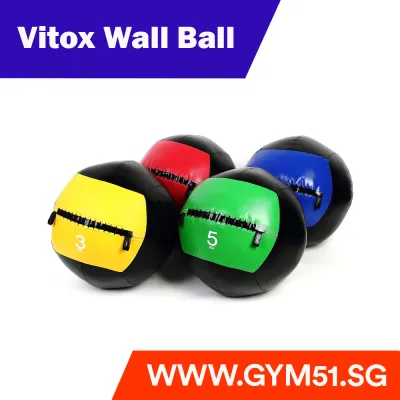
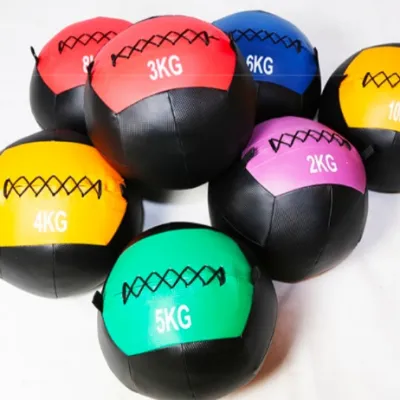
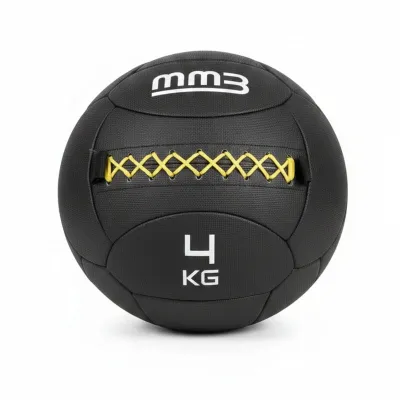
Products mentioned in this guide
![[READY STOCKS] 10KG Medicine Ball / Slam Ball / Fitness Ball / Exercise Ball / Wall Ball / Gym Ball / Power Ball (Multiple Colours + FREE 3 Months Warranty)](https://img.lazcdn.com/g/p/0ad6227f4ec9a2e6de12c040a6a12eab.png_400x400q80.png_.webp)
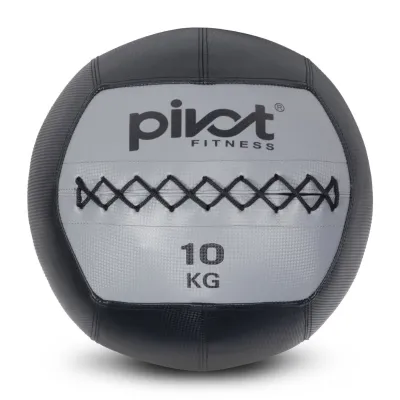
Prices are valid at publication and may change. Please refer to the product page for the latest price.
Assess Your Baseline: How to Gauge Your Current Strength
Before purchasing a wall ball or selecting one from the gym rack, you must evaluate your movement mechanics. This initial assessment ensures your joints can handle the dynamic forces of catching and throwing a weighted object repeatedly.
Begin by performing a series of bodyweight air squats in front of a mirror. Observe whether your hips can sink below parallel while keeping your heels firmly planted on the floor. If your knees cave inward or your chest drops forward excessively, adding a dynamic load will only worsen these patterns.
Next, test your movement with a light goblet squat using a dumbbell or kettlebell. This helps simulate the front-loaded nature of holding a wall ball. Pay close attention to your upper back; if you feel your shoulders rounding or your lower back arching excessively to keep the weight up, your core stability needs development before you attempt high-velocity throws.
Finally, perform an overhead reach test. Stand with your back against a wall and raise both arms overhead, attempting to touch the wall with the backs of your hands without arching your lower back. If your ribs flare out or you cannot reach the wall, your shoulder mobility may limit your ability to catch and throw safely, suggesting you should start with a lighter, more manageable weight.
Match Your Level to a Starting Weight Range
Selecting a starting weight requires balancing your current strength with the high-repetition nature of functional workouts. It is helpful to use clear, manageable weight ranges based on your movement assessment to guide your purchase.

For beginners, a reference range of 4kg to 6kg is highly recommended. This range allows you to focus entirely on mastering squat depth, absorbing the impact of the catch, and refining your throwing trajectory. At this stage, the goal is motor pattern development rather than metabolic fatigue.
Intermediate lifters who already possess established squat strength and core stability can typically transition to a range of 6kg to 9kg. This weight is heavy enough to increase your metabolic demand and build muscular endurance, yet light enough to maintain safe mechanics over multiple sets.
Advanced athletes who have developed explosive power and high-intensity conditioning may opt for weights of 9kg or more. These heavier options are reserved for those who can execute dozens of unbroken reps without any breakdown in posture or throwing height.
It is important to note that standard competitive benchmarks, such as the 14-pound (approx. 6kg) and 20-pound (approx. 9kg) weights often prescribed in functional fitness competitions, are sport-specific targets. They are not mandatory starting points for general fitness, and forcing yourself to use them too early can hinder your progress.
The "Feel" Check: How to Validate Your Choice on Day One
Once you have selected a candidate weight, you must validate your choice through a practical “feel” check during your first warm-up set. Perform five to ten continuous repetitions to observe how your body responds to the dynamic load.
First, pay attention to your throw height and trajectory. The ball should reach your target height—typically 9 feet for women and 10 feet for men—without requiring you to lean excessively backward. If you find yourself arching your spine to launch the ball, the weight is too heavy, and you should scale down immediately.
Second, evaluate how you absorb the ball during the catch phase. As the ball descends, you should catch it at chest level and smoothly transition into a squat, using your hips and legs to absorb the impact. If the ball crashes into your chest, forces your shoulders forward, or causes your wrists to bend backward uncomfortably, the load is compromising your safety.
Establish strict stop conditions for your training session. If you experience lower back discomfort, sharp wrist strain, or notice your knees caving inward during the squat, halt the set immediately. Do not attempt to push through pain; instead, swap the ball for a lighter option or focus on bodyweight mechanics.
Progression Strategy: When and How to Move Up in Weight
Progressing to a heavier wall ball should be a systematic process based on observable performance markers rather than calendar dates. Rushing the progression can lead to chronic shoulder or lower back strain.
Look for clear progression signals during your workouts. You are ready to consider a heavier weight when you can complete your target repetitions with consistent form, maintain a steady throw height on every single rep, and experience rapid heart rate recovery between sets. If you are still struggling to hit the target on your final reps, stay at your current weight.
Before adding physical load, apply a progression hierarchy that prioritizes volume and density. First, try increasing your total repetitions per set, or decrease your rest intervals between sets. Mastering a lighter ball at a higher intensity builds a more resilient cardiovascular foundation than jumping prematurely to a heavier weight.
When you do decide to increase the load, make small, safe weight jumps of 1kg to 2kg. Always verify this new weight using the day-one “feel” check before committing to a high-volume workout, ensuring your mechanics remain sound under the heavier load.
Frequently Asked Questions (FAQ)
Does the wall ball size change with the weight?
Yes, depending on the manufacturer, heavier wall balls can sometimes have a larger physical diameter. A larger ball alters your grip width and release point, which can increase the demand on your forearms and chest. When purchasing, check the product specifications to ensure the diameter is comfortable for your hand size and allows for a secure, balanced grip.
Should I use a different weight for upper body versus lower body focus?
It is generally advisable to avoid changing the weight to isolate specific muscle groups, as the wall ball is designed as a unified, full-body compound movement. Using an excessively heavy ball to target your shoulders can disrupt your kinetic chain, leading to poor squat mechanics and potential injury. Keep the weight within a range that allows a seamless transfer of power from your hips through your arms.
Community discussion
Share your experience or ask a question. Comments are reviewed before publication.