
Choosing your first tennis machine can transform your practice sessions, but beginners often fall into the trap of buying overly complex models. To get the most value, you should prioritize basic portability, adjustable feed rates, and reliable battery life over high-end programmable drills or extreme spin settings. A solid entry-level machine allows you to build muscle memory through consistent, predictable feeds, which is exactly what a developing player needs. By focusing on these core mechanics, you can avoid overpaying for advanced features that might actually hinder your foundational progress.
Assess Your Readiness and Practice Goals
Before investing in a tennis machine, it is essential to evaluate whether your current skill level aligns with machine practice. If you can already execute basic groundstrokes with some consistency and sustain a short, slow-paced rally with a partner, you are likely ready to benefit from a machine. If you are still struggling to make contact with the ball consistently, working with a coach to establish basic swing paths should remain your primary focus. A machine is an excellent tool for reinforcing good habits, but it can also lock in poor mechanics if you use it before understanding the fundamentals.
Your primary practice goals at this stage should center on repetition, footwork, and stroke consistency. A tennis machine excels at delivering the exact same ball to the exact same spot, allowing you to isolate specific movements, such as your backhand preparation or split-step timing. This predictable environment lets you focus entirely on your body mechanics without the distraction of adapting to an opponent’s unpredictable shots.
Products mentioned in this guide
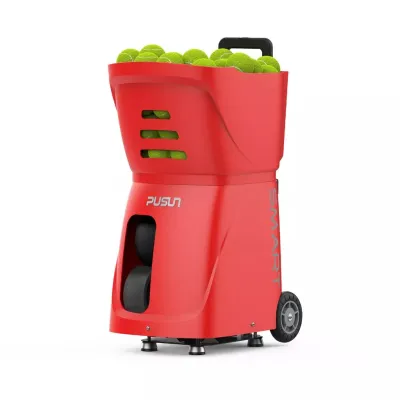
![SG [In Stock]PUSUN PT-Smart Tennis Ball Machine - 100% Genuine Automatic Launcher with 3-Year Warranty & Lifelong Maintenance Portable for Tennis Training & Games](https://img.lazcdn.com/g/p/2ec99476661dd32c9412c8f267272116.jpg_400x400q80.jpg_.webp)
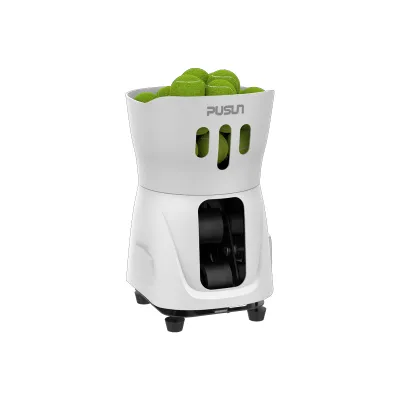
![SG[Ready Stock]PT-smart Pri Tennis Serve Machine + Professional Training Equipment to Enhance Your Game](https://img.lazcdn.com/g/p/ca077eadf61238b68e45b4ca304c67c4.jpg_400x400q80.jpg_.webp)
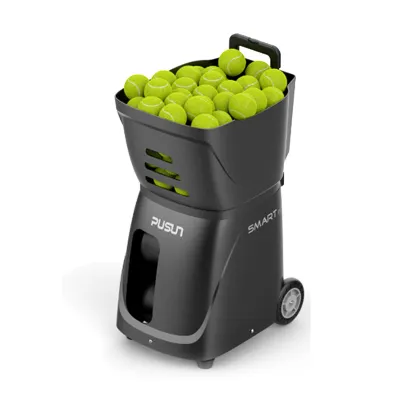
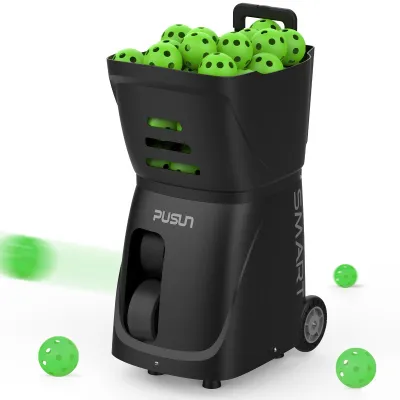
Prices are valid at publication and may change. Please refer to the product page for the latest price.
Finally, establish a realistic budget boundary that reflects your actual commitment level and local playing conditions. In Singapore, where court bookings through platforms like ActiveSG or condominium booking systems are highly competitive and usually limited to one or two hours, you must consider how often you will realistically get the machine onto a court. Factor in the cost of court fees and transport alongside the purchase price of the machine, which typically ranges from S$800 to S$2,000 for reliable entry-level models, to ensure your investment makes financial sense over the long term.
Essential Features to Prioritize for Foundational Practice
When evaluating entry-level tennis machines, ball capacity and feeding intervals are critical specifications that directly impact your practice flow. A machine with a capacity of 70 to 120 balls is generally ideal for beginners, providing a substantial hitting session before you need to stop and collect balls. The feeding interval—the time between each ball release—should be adjustable, ideally ranging from two to ten seconds. A longer interval gives you ample time to recover your court position, reset your stance, and prepare for the next shot, preventing you from feeling rushed or fatigued too quickly.

Adjustable ball speed and elevation ranges are equally vital for matching your current pace and allowing room for future progression. As a beginner, you will want to start with lower speeds, typically around 20 to 40 kilometers per hour, to focus on clean contact and proper follow-through. The ability to adjust the elevation manually or electronically allows you to switch between low groundstrokes, mid-court sitters, and high lobs, ensuring you can practice a variety of basic strokes as your confidence grows.
Portability is a make-or-break factor, especially if you do not live directly adjacent to a tennis court. Look for a machine with a compact, lightweight design, an ergonomic transport handle, and large, sturdy wheels that can handle uneven surfaces like grass, gravel, or court transitions. If you rely on public transport, private hire cars, or have limited storage space in a typical Singapore apartment, a machine that folds down easily or has a removable ball hopper will save you significant physical strain and logistical frustration.
Lastly, pay close attention to the power source and expected battery runtime. Most portable machines run on rechargeable batteries, which should ideally offer at least two to three hours of continuous operation on a single charge. This ensures the machine will comfortably last through a standard two-hour court booking, even when running at higher feed rates. If you have easy access to court-side power outlets, a hybrid machine that supports both AC and DC power can offer additional flexibility, though battery-powered models remain the most practical choice for most public courts.
Premium Upgrades Beginners Can Safely Skip
Many premium tennis machines come equipped with multi-line horizontal and vertical oscillation, which sweeps the ball from side to side or varies the depth automatically. While this is excellent for advanced cardio workouts and match simulation, it is often counterproductive for beginners. When you are still working to stabilize your stance, contact point, and footwork, you need the ball to land in the exact same spot repeatedly. Paying extra for complex oscillation patterns will only complicate your practice before you have mastered the basics.
Advanced spin controls that generate heavy topspin or backspin are another expensive feature you can safely bypass. While learning to handle spin is part of tennis progression, your initial focus must be on mastering flat, clean ball contact and a consistent swing path. Machines that use dual-motor systems to create extreme spin profiles add significant cost and mechanical complexity, which is unnecessary when a basic flat feed is what your development requires.
Smartphone app connectivity and highly customizable, programmable drill sequences are modern conveniences that often inflate the retail price without adding real value to a beginner’s routine. While it might seem appealing to program a custom six-ball sequence from your phone, the reality is that manual adjustments on the machine’s control panel are usually faster and less distracting. Keeping your practice simple allows you to focus on your physical movement rather than troubleshooting wireless connections on the court.
Similarly, dedicated physical remote controls and smart target sensors are luxury add-ons rather than necessities. While a remote control allows you to pause the feed from across the net, many modern entry-level machines feature a built-in start delay that gives you plenty of time to walk to your side of the court before the first ball is fired. Skipping these high-tech extras can save you hundreds of dollars while keeping your equipment straightforward and reliable.
Final Verification Checklist Before Purchasing
Before finalizing your purchase, perform a thorough physical and logistical check to ensure the machine fits your lifestyle. Measure your vehicle’s trunk space or the storage areas in your home and compare them directly against the folded dimensions of the machine. You must also verify the total weight of the unit; a machine that is too heavy to lift comfortably into a car boot or carry up a flight of stairs will quickly end up gathering dust in a closet.
Next, check the machine’s compatibility with the specific type of tennis balls you plan to use. Some machines are highly sensitive to ball wear, dampness, or pressure levels, which can lead to frequent jamming or inconsistent feeding speeds. Ensuring the feeding mechanism is designed to handle standard training balls will save you hours of on-court frustration.
Given Singapore’s hot and highly humid climate, electronic and mechanical components are subject to accelerated wear, making warranty terms and local service availability crucial. Verify whether the manufacturer or local distributor offers a reliable warranty and has a physical service center in Singapore. Shipping a heavy machine overseas for repairs can be prohibitively expensive and time-consuming, so local support is a major asset.
Finally, review the retailer’s return policy and test the machine’s minimum settings as soon as it arrives. Ensure that the lowest speed setting is gentle enough for comfortable beginner practice and that the feed interval can be set slow enough to allow for proper recovery. Confirming these details early protects your investment and guarantees a machine that truly supports your learning journey.
Frequently Asked Questions (FAQ)
Can I use regular pressurized tennis balls in a beginner machine?
While you can use regular pressurized tennis balls, they are not recommended for long-term machine practice. Pressurized balls lose their bounce and internal pressure rapidly when repeatedly compressed by a machine’s feeding rollers, leading to highly inconsistent feeds and erratic trajectories. Additionally, the high humidity in Singapore can cause the felt on standard balls to absorb moisture quickly, increasing their weight and causing the machine to jam. Using specialized pressureless tennis balls is highly recommended, as they maintain a consistent bounce over time, feature durable felt, and ensure smooth, reliable feeding.
How often should a beginner use a tennis machine?
A beginner should ideally use a tennis machine once or twice a week, balancing it carefully with live hitting sessions. While a machine is unmatched for building muscle memory and refining stroke mechanics, relying on it exclusively can lead to a robotic playing style. Unlike a machine, a human opponent never hits the ball with perfect predictability, meaning you must learn to read ball trajectories, adapt to varying spins, and develop court awareness. To maintain a well-rounded game, aim for a balanced routine where machine practice is used to drill specific techniques, which you then immediately apply in live rallies, coaching sessions, or friendly matches.
Community discussion
Share your experience or ask a question. Comments are reviewed before publication.