
Long-distance running requires a meticulous approach to fueling and hydration. When you are out on the trails or roads for hours, stopping to rummage through a pack for a gel or a water bottle disrupts your rhythm, wastes time, and saps mental energy. The Salomon ADV Skin 12 running vest is engineered specifically to solve this problem by keeping your most critical supplies within arm’s reach while you maintain your stride.
To get the most out of this high-performance vest, you must organize your gear systematically. Strategic packing ensures that your soft flasks remain stable, your energy gels are accessible in seconds, and your physical balance is preserved over technical terrain. By mastering the layout of your vest, you can focus entirely on your pace and form rather than fighting your gear.
Mapping the ADV Skin 12 Compartments for Efficient Packing
Before loading your gear, it is essential to establish a clear mental map of the vest’s storage zones. The Salomon ADV Skin 12 is designed with a front-heavy accessibility philosophy, meaning that high-frequency items sit on your chest and sides, while low-frequency, emergency, or bulky gear is relegated to the rear. This layout allows you to run continuously without needing to remove the vest to access hydration or nutrition.
Products mentioned in this guide
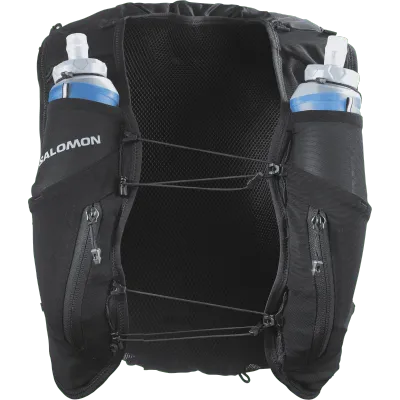
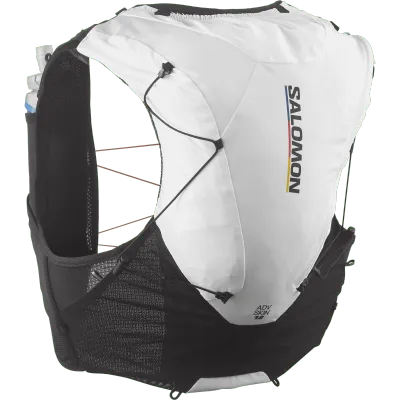
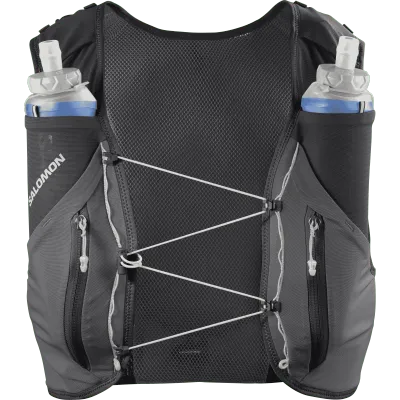
Prices are valid at publication and may change. Please refer to the product page for the latest price.
The front of the vest features two deep, dedicated chest pockets designed specifically to house soft flasks. Directly overlapping and surrounding these flask sleeves are several stretch-mesh utility pockets and small zippered compartments on the shoulders. Under the arms and wrapping around the lower back is a large, double-access kangaroo pocket that can be reached from either side while running. Finally, the main rear compartment offers a larger volume for gear that you only need when stopped.
Before packing, always check the manufacturer’s care label and the physical dimensions of your specific vest size to confirm the maximum compatible soft flask volume. While the vest is optimized for standard 500ml soft flasks, variations in flask shapes, cap designs, or aftermarket filters can affect how they sit against your rib cage. Ensuring a correct physical fit prevents the pockets from overstretching and keeps the vest wrapping snugly around your torso.
Positioning Soft Flasks for Balance and Quick Hydration
Properly loading and securing your soft flasks is the foundation of a bounce-free run. To prepare your flasks, fill them to your desired level, then gently squeeze the body of the flask until the liquid reaches the brim to expel any trapped air before screwing the cap on tight. Removing this excess air eliminates the annoying sloshing sound and prevents the flasks from folding or collapsing awkwardly inside the pockets as you drink.

Weight distribution across your chest is critical for maintaining your running posture and preventing shoulder strain. Always try to carry equal volumes of liquid on both the left and right sides of your vest. If you prefer to carry plain water in one flask and an electrolyte or carbohydrate mix in the other, make a conscious effort to drink from both alternately. Running with one completely full flask and one empty flask creates an asymmetrical load that can cause the vest to shift, rub, or chafe against your neck and shoulders.
Accessing your hydration on the move should require minimal physical effort. With the ADV Skin 12, you do not need to slide the flasks out of their pockets to drink; simply bend your head down slightly, squeeze the body of the flask, and sip from the bite valve. When you do need to remove a flask to refill it at an aid station, sliding a soft, empty flask back into a tight mesh pocket can be challenging. To make this easier, blow a small amount of air into the empty flask to give it structure before sliding it downward, or use the small fabric loops at the bottom of the pockets to help pull the flask into place.
If you prefer using soft flasks equipped with extended drinking tubes or straws, proper routing is essential to prevent distractions. Thread the tubes through the elastic loops located on the shoulder straps of the vest. This keeps the bite valves positioned close to your mouth, preventing them from bouncing against your face, swinging wildly, or catching on low-hanging tree branches along the trail.
Organizing Energy Gels for Rapid Access on the Move
Maintaining a consistent fueling schedule during long runs requires quick access to your nutrition. A chaotic pocket layout leads to missed feeds and dropped wrappers, which can ruin your performance. By dividing your nutrition into immediate-use and bulk-storage zones, you can establish a highly efficient fueling routine.
Reserve the small shoulder strap pockets and the upper elastic collar slots for the nutrition you need in the immediate future—typically one or two energy gels or a small sleeve of salt capsules for the next 30 to 45 minutes. Stashing these items high on your chest ensures you can grab them instantly without having to look down or break your running form. This is especially helpful during high-intensity efforts or technical descents where taking your eyes off the trail is dangerous.
Store your remaining bulk nutrition supply in the lower front stretch pockets or the side mesh compartments. When packing these pockets, orient your energy gels vertically with the tear-tabs pointing upward and outward. This layout makes it easy to grab a single gel by its top tab and pull it clean from the pocket. It also prevents the sharp, crimped plastic edges of the gel packaging from rubbing against your skin or wearing holes in thin, lightweight running shirts.
As your run progresses, implement a systematic rotation method to keep your fueling seamless. During walking breaks, flat service road sections, or while waiting at trail crossings, transfer gels from your lower bulk pockets up into the empty shoulder strap pockets. This keeps your immediate-use zone constantly replenished, ensuring that you never have to fumble around in deeper pockets when you are fatigued or climbing steep hills.
Your packing strategy should also adapt to local climate conditions. In hot and humid environments, such as Singapore’s tropical climate, high body heat combined with intense humidity can cause energy gels stored directly against your torso to become warm and unpleasantly runny. If you are sensitive to warm nutrition, store your gels in the outer mesh layers of the vest rather than the inner pockets, or place them in the rear compartment separated from your back by a light windbreaker to keep them slightly cooler.
Combining Hydration, Nutrition, and Gear for Long-Distance Comfort
Optimizing the fit of your Salomon ADV Skin 12 over long distances requires a smart layering strategy that balances water, food, and mandatory safety gear. The golden rule of packing any running vest is to place the heaviest, densest items low and as close to your spine or torso as possible. This centers the weight over your hips and reduces the leverage the pack has on your shoulders, which dramatically cuts down on bounce and friction.
Your soft flasks naturally occupy the front-center position, while any heavy gear should go at the bottom of the main rear compartment. Reserve the rest of the rear compartment for lightweight, highly compressible items that you do not need to access frequently, such as an ultra-light rain shell, an emergency space blanket, a basic first-aid kit, or a spare headlamp. Packing these soft, compressible items in the back also acts as a comfortable buffer between your spine and any harder objects.
As you consume your water and nutrition throughout a long run, the overall volume of your vest will shrink, which can cause the fabric to loosen and bounce. To counteract this, utilize the Quick Link sternum strap system on the front of the vest. Tension these elastic cords gradually as your flasks empty to pull the front panels closer together, keeping the vest snug against your rib cage. You can also adjust the side elastic bungees on the fly to compress the rear compartment, preventing your remaining gear from shifting.
Make micro-adjustments to these tension cords depending on the terrain. When you are climbing steeply and breathing heavily, loosen the front sternum straps slightly to allow your chest to expand fully. Once you crest the hill and begin a fast, bouncy descent, pull the cords tight again to lock the vest down and eliminate any vertical movement that could cause chafing.
Packing Combinations to Avoid: Preventing Punctures and Chafing
To ensure a smooth run, you must avoid several common packing mistakes that can damage your equipment, ruin your nutrition, or cause physical pain. A systematic approach to separating incompatible items will save you from mid-run disasters.
- Sharp Objects vs. Soft Flasks: Never pack house keys, car keys, multi-tools, or trail poles with exposed tips in the same pockets as your soft flasks. The constant vibration and friction of running can cause sharp edges to wear through the soft polyurethane material of the flasks, resulting in slow leaks that drain your hydration.
- Sticky Nutrition vs. Electronics: Keep your energy gels, chew packets, and salt tablets strictly separated from your smartphone, GPS tracker, or car key fobs. A punctured gel packet in a shared pocket creates a sticky residue that can ruin charging ports, jam buttons, and damage sensitive electronics. Always use a small, lightweight zip-lock bag to store empty gel wrappers and trash.
- Overstuffing the Chest: Avoid the temptation to cram too many gels, bars, or bulky items into the front chest pockets alongside your full soft flasks. Overstuffing these pockets creates a rigid, bulky wall across your chest that restricts your breathing, limits lung expansion, and causes the vest straps to rub aggressively against your inner arms and ribs.
- Loose Items in the Main Cabin: Do not throw small, loose items like individual salt pills, coins, or loose keys directly into the large rear compartment. They will bounce around noisily, migrate to the bottom where they can cause pinpoint pressure pain against your back, and be incredibly difficult to locate when your hands are cold or sweaty. Always secure these small items inside the vest's dedicated internal zippered pocket or a small organizer pouch.
Frequently Asked Questions (FAQ)
Can I use the rear compartment for a hydration bladder instead of front soft flasks?
Yes, the Salomon ADV Skin 12 features an internal rear sleeve and routing loops designed to support a 1.5-liter hydration bladder. Using a rear bladder allows you to carry a larger total volume of water, which is highly beneficial for long self-supported runs in hot climates. However, a rear bladder makes it much harder to monitor your fluid consumption rate on the fly and requires you to remove the vest completely to refill it, unlike the easily accessible front soft flasks.
How do I prevent energy gels from falling out of the side mesh pockets?
To keep your energy gels secure, pack them tightly together so that mutual friction holds them in place inside the pockets. Ensure you do not overstretch the elastic mesh with overly bulky items, as this reduces the fabric’s natural tension and recovery. For technical or highly bouncy trails, utilize the secure zippered pockets on the front or sides of the vest to store your high-value nutrition items, ensuring they cannot bounce out over rough terrain.
Community discussion
Share your experience or ask a question. Comments are reviewed before publication.