
To use an exercise ladder to improve football footwork, you must focus on deliberate, high-repetition movement patterns that train fast-twitch muscle fibers, neuromuscular coordination, and balance, then immediately bridge these isolated patterns into ball-handling and reactive game scenarios. Implementing an exercise ladder into your training routine helps close the gap between raw physical speed and the sharp, controlled movements required on the pitch. By refining your footwork mechanics, you can execute quicker direction changes, maintain better balance under pressure, and increase your overall agility during a match.
How Exercise Ladder Drills Translate to the Pitch
When you perform high-speed, coordinated movements on an exercise ladder, you train your nervous system to recruit motor units more rapidly. This fast-twitch muscle activation reduces the ground contact time of your boots, allowing you to transition from a standstill to a sprint or change direction with minimal lag. The repetitive, precise nature of these drills enhances your proprioception—your body’s awareness of its position in space—which directly translates to better balance during high-speed maneuvers.
On the pitch, these physical adaptations are crucial for both attacking and defending scenarios. For attacking players, split-second changes of direction allow you to execute body feints, step-overs, and sudden accelerations that leave defenders off-balance and create space for a shot or pass. Defensively, maintaining a low center of gravity and executing rapid lateral steps are vital for jockeying. If an opposing winger attempts to cut inside, your ability to quickly reposition your feet determines whether you can block the cross or get bypassed.
Products mentioned in this guide
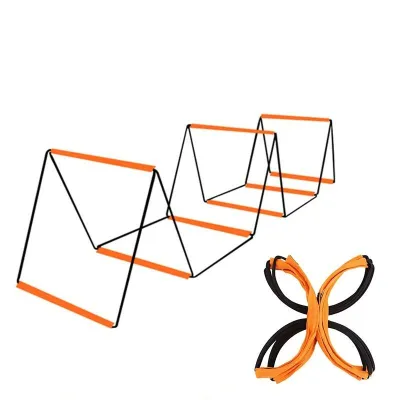
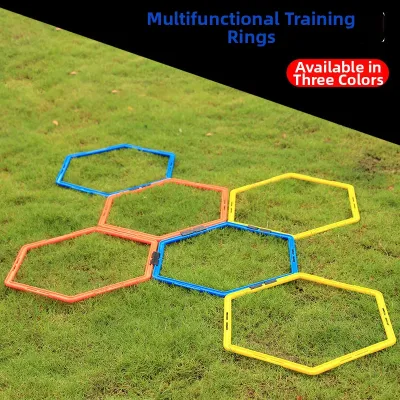
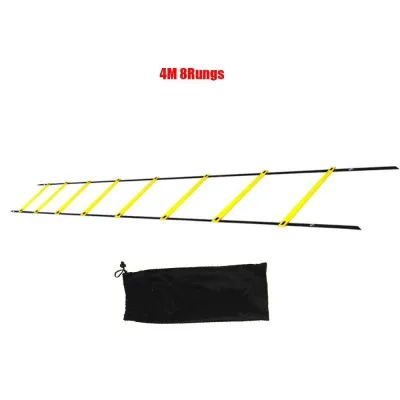
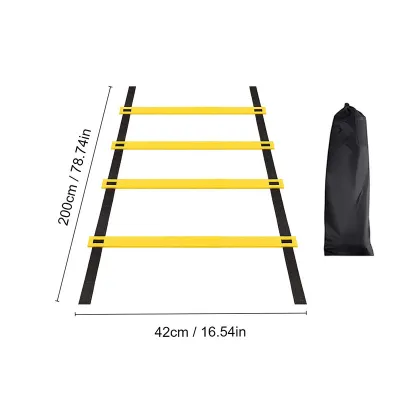
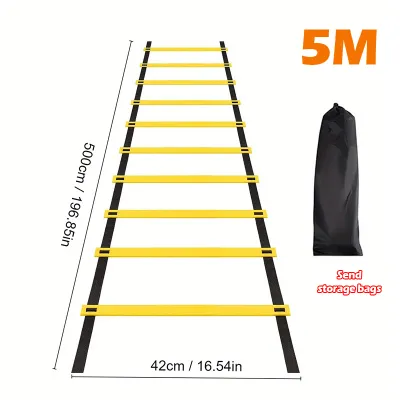
![[SG] Nylon Strap Agility Ladder Speed Training Football Fitness Flexibility Plyometric Workout Equipment](https://img.lazcdn.com/g/p/f631eecb7b6fe53488efffcb083d2930.jpg_400x400q80.jpg_.webp)
Prices are valid at publication and may change. Please refer to the product page for the latest price.
However, it is important to set realistic expectations for your training. An exercise ladder is a closed-loop training tool; it teaches movement mechanics, foot-eye coordination, and rhythm in a controlled environment. It is not a magic solution that will instantly transform your game on its own. To truly transfer these benefits to a live match, ladder drills must be paired with active ball work, cognitive reaction drills, and tactical positioning exercises.
Preparing Your Exercise Ladder Setup and Warming Up Safely
Singapore’s tropical climate brings high humidity and frequent, heavy afternoon downpours. Whether you are training on an outdoor concrete court, an HDB void deck, or an artificial turf futsal pitch, you must verify that the surface is completely dry. Wet concrete or damp turf significantly reduces the grip of your shoes, increasing the risk of slips, ankle rolls, or knee strains. Always select a flat, non-slip surface that is clear of debris, loose gravel, or puddles before laying down your equipment.

Once you have selected a safe surface, lay your exercise ladder completely flat. Any twists in the nylon straps or raised rungs can easily catch the studs of your football boots or the soles of your trainers, leading to a hard fall. If you are training outdoors on grass, secure the ends of the ladder using ground pegs or stakes to keep it taut. On hard courts or concrete, you can use small training cones or light weights to keep the straps aligned and prevent the ladder from shifting during high-intensity drills.
High-intensity footwork requires prepared joints and activated muscles to prevent injury and maximize performance. Spend 5 to 10 minutes performing a dynamic warm-up rather than static stretching. Incorporate light jogging, high knees, butt kicks, lateral lunges, and ankle mobility circles. This routine increases blood flow to the calves, hamstrings, and quadriceps, lubricating your joints and preparing your nervous system for explosive, rapid movements.
Core Exercise Ladder Drills for Football Footwork
To get the most out of these drills, prioritize form over speed. Start by walking through the patterns to build muscle memory, then gradually increase the tempo. Always maintain an athletic stance: knees slightly bent, hips pushed back, and weight distributed on the balls of your feet. Keep your upper body stable and your core engaged throughout each exercise.
The Icky Shuffle: Building Coordination and Quick Feet
The Icky Shuffle is a classic three-step pattern that builds lateral coordination and rapid weight transfer. To execute it, start on the left side of the exercise ladder, facing forward. Step into the first square with your right foot, follow immediately with your left foot so both feet are inside, and then step your right foot out to the right side of the ladder. As you do this, progress forward: step your left foot into the second square, follow with your right foot, and step your left foot out to the left side. The rhythm is a consistent “in-in-out, in-in-out” cadence.
Maintaining proper posture is critical. Keep your hips low and your center of gravity centered. If your hips sway too far to the left or right when stepping outside the ladder, you lose the balance required for an explosive push-off. Keep your upper body slightly forward and your core engaged to stabilize your spine, ensuring your feet move rapidly while your torso remains stable.
Do not let your arms hang loosely at your sides. Your arms act as counterweights that drive your legs. Coordinate your arm swing with your footwork: as your right foot steps, your left arm should swing forward, mimicking a natural running stride. This synchronized movement ensures that your upper and lower body work in harmony, maximizing your agility and speed.
In-In-Out-Out: Mastering Lateral Movement and Hip Mobility
This lateral drill is excellent for improving side-to-side agility and hip mobility. Stand at the bottom of the exercise ladder, facing sideways (perpendicular to the ladder). Step your leading foot into the first square, follow with your trailing foot so both are inside. Next, step your leading foot out of the square on the opposite side, followed by your trailing foot. Move laterally down the ladder using this “in-in-out-out” sequence. Once you reach the end, repeat the drill in the opposite direction to train both sides equally.
Focus on quick hip rotation and maintaining a low, athletic stance throughout the movement. Your hips should remain square to the side, avoiding unnecessary twisting of the torso. This low stance keeps your muscles pre-loaded, allowing you to transition from lateral movement to a forward sprint instantly.
This drill directly mimics defensive jockeying and lateral tracking. In a match, when a winger attempts to dribble past you, you must match their lateral movements without crossing your legs or losing your balance. Mastering the lateral shuffle ensures you can shift your weight smoothly and maintain a defensive barrier.
Single-Leg Hops: Developing Balance and Explosive Power
Single-leg hops are designed to build unilateral strength, ankle stability, and explosive power. Stand at the start of the exercise ladder on one leg. Hop forward, landing cleanly inside the first square on the same foot, and continue hopping through each square to the end. Perform the drill on your left leg, then switch to your right leg on the return. Focus on landing softly, absorbing the impact through your ankle, knee, and hip joints rather than landing with a stiff leg.
Pay close attention to your joint alignment. When landing, your knee should track directly over your second toe, and your ankle should remain stable without rolling inward or outward. If you notice your knee collapsing inward (valgus alignment), slow down and focus on stabilizing your hip and gluteal muscles. This alignment check is vital for preventing common knee injuries, such as ACL strains.
Football is a game played primarily on one leg; whether you are planting your foot to strike a ball, leaping for a header, or pushing off to sprint, your power and stability depend on unilateral control. Single-leg hops train the stabilizer muscles around your joints, ensuring you have the structural integrity to support explosive, single-leg movements on the pitch.
Bridging the Gap: Adding the Ball and Game Scenarios
While isolated ladder drills are excellent for building coordination, they do not fully replicate the demands of a football match. To bridge this gap, you must integrate the ball into your training. Place a football approximately one to two meters from the exit of your exercise ladder. As soon as you complete the final footwork pattern, immediately transition into an explosive sprint to the ball, take a sharp first touch, and execute a turn or a quick pass against a wall or to a teammate.
To elevate your training further, introduce cognitive load to simulate the unpredictable nature of a real match. Have a coach, teammate, or training partner stand at the end of the ladder. As you exit, they can provide visual cues (such as holding up a colored cone or pointing left or right) or audio cues (calling out a specific direction or number). You must instantly react to these cues, shifting your body and directing the ball according to the instruction. This trains your brain to scan the environment and make split-second decisions while executing complex footwork.
Progression should be gradual but deliberate. Begin by mastering the footwork patterns at a slow, controlled pace, focusing entirely on clean execution and proper posture. Once the movement patterns become second nature, gradually increase your speed. The ultimate goal is to perform the ladder drills at maximum game intensity, transitioning seamlessly into explosive ball control without any hesitation.
Common Footwork Mistakes and How to Fix Them
One of the most common mistakes players make is looking down at their feet while navigating the ladder. While this is natural when learning a new pattern, relying on visual feedback prevents you from scanning the pitch. In a match, looking down means you cannot see open teammates, opposing defenders, or space to exploit. To fix this, once you have learned a pattern, consciously lift your chin and focus your eyes on a point ahead of you. You can also have a partner stand in front of you and hold up different numbers of fingers that you must call out while completing the drill.
Another frequent error is prioritizing speed over proper technique. Rushing through the ladder often leads to messy footwork, clipping the rungs, and tripping. An exercise ladder is a tool for precision; messy repetitions only reinforce poor movement mechanics. If you find yourself catching the rungs or losing your rhythm, reduce your speed to 50% or 60%. Focus on clean, deliberate foot placements, and only increase the tempo when you can complete the entire ladder flawlessly three times in a row.
Landing with flat feet is a critical mistake that slows down your response time and increases the impact on your joints. When your heels strike the ground, you lose the spring-like action of your calves and Achilles tendons, making your movements sluggish. Always perform these drills on the balls of your feet, keeping your heels slightly elevated. This position keeps your muscles pre-tensioned and ready to react, allowing for rapid, explosive changes of direction.
Frequently Asked Questions (FAQ)
How often should I do agility ladder drills for football?
To see consistent improvements in your footwork, aim to perform agility ladder drills 2 to 3 times per week. Each session should be relatively short, lasting about 10 to 15 minutes, as the primary focus is high-quality neuromuscular training rather than cardiovascular endurance. It is highly recommended to perform these drills immediately after your dynamic warm-up, while your nervous system is fresh and free from fatigue. Doing them at the end of a grueling training session when your muscles are tired can lead to sloppy form and an increased risk of injury.
Can I use an exercise ladder on natural grass pitches?
Yes, you can use an exercise ladder on natural grass pitches, but you must take extra precautions to ensure safety. Natural grass can be uneven, and wet grass can be highly slippery, especially after a typical Singapore rain shower. To prevent the ladder from shifting or bunching up during high-intensity drills, secure both ends using ground pegs or stakes. Ensure that all the rungs lie completely flat against the turf; any raised sections or gaps between the ladder and the ground can catch the studs of your football boots, presenting a significant tripping hazard.
Community discussion
Share your experience or ask a question. Comments are reviewed before publication.