
If you are searching for a “Babolat Ezone,” it is helpful to clarify a common brand mix-up before diving into specifications: the Ezone is actually a signature racket line manufactured by Yonex, while Babolat is a completely separate brand famous for its own user-friendly lines like the Pure Drive and Boost series. Both brands are industry giants, and both offer exceptional entry-level options. If you are looking at the Ezone series as a potential entry point into tennis, understanding how its specific design features align with your current skill level is the most reliable way to make a smart investment.
Choosing your first tennis racket is a balancing act between finding immediate playability and leaving room for technical growth. A racket that is too heavy or demanding can stall your progress and lead to physical fatigue, while one that is too light or flexible might fail to provide the stability you need as your swing develops. By evaluating the core design elements of the Ezone lineup, you can determine whether this popular series matches your physical needs and learning curve.
What Beginners Should Look for in a Tennis Racket
When you are first learning to consistently connect with the ball, your racket needs to act as a supportive partner rather than a demanding taskmaster. The primary characteristic a beginner needs is forgiveness. In tennis terms, this means a large sweet spot—the central area of the string bed that produces a clean, predictable bounce. A larger sweet spot ensures that even when you misjudge the distance and strike the ball closer to the frame, the ball still clears the net.
Products mentioned in this guide
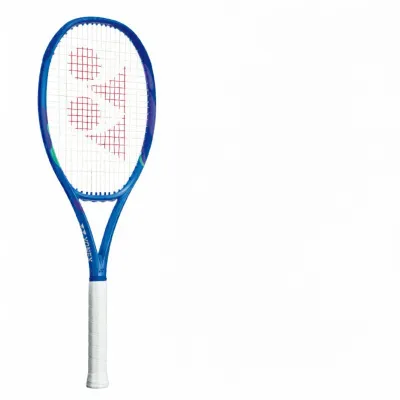
Prices are valid at publication and may change. Please refer to the product page for the latest price.
Power assistance is another critical factor for those new to the sport. Beginners typically swing with shorter, slower strokes as they focus on timing and footwork. A racket designed with a stiffer frame helps transfer energy back into the ball with minimal effort, allowing you to achieve depth past the service line without needing a flawless, high-speed swing. This built-in power lets you focus on your form rather than muscle strength.
Finally, arm comfort and vibration dampening are essential for preventing early fatigue and injury. When a ball strikes a racket, shock waves travel down the shaft into your hand, wrist, and elbow. Rackets that incorporate advanced dampening materials in the handle help absorb these vibrations. This protection is especially important for beginners, whose developing muscles and occasional off-center hits make them more susceptible to joint strain.
How to Check if the Ezone Fits Your Beginner Needs
To determine if an Ezone racket is appropriate for your current level, you must look closely at the technical specifications printed on the inside of the racket throat. The first specification to check is the head size. For beginners, a head size of 100 square inches is the absolute minimum, though 102 or 105 square inches is highly recommended. A larger head size directly translates to a more forgiving string bed and a larger sweet spot.

Next, examine the unstrung weight of the frame. Adult beginners should generally look for a racket that weighs between 270 and 285 grams unstrung. Anything over 290 grams will quickly feel heavy during a long practice session, leading to late swings and dropped wrists. The balance point is also crucial; a slightly head-heavy or evenly balanced racket helps generate swing momentum, whereas a highly head-light racket requires more developed forearm strength to plow through the ball.
In terms of playability, the Ezone series is widely recognized for its user-friendly power and plush feel. The frame shape is designed to offer a wider sweet spot at the top of the racket head, which is where developing players frequently make contact. This design provides a predictable launch angle, helping you understand how your swing path affects the ball’s trajectory without fighting against an overly stiff or dead string bed.
Signs the Ezone Might Be Too Advanced for You
Even a highly regarded racket line can hinder your progress if you choose a version designed for advanced players. One of the clearest signs that a racket is too advanced is physical discomfort. If you experience persistent soreness in your wrist, forearm, or elbow after a short hitting session, the frame may be too heavy or too stiff for your current physical conditioning. Tennis should not cause joint pain, and ignoring these warning signs can lead to chronic issues.
Another common indicator is a persistent struggle with depth control. If you find that your shots are consistently flying long past the baseline, even when you attempt to slow down your swing, you may be using a version with too much inherent power or a string setup that is too loose. Conversely, if your shots constantly fall short or dump into the net because you are afraid to swing fully, the racket’s weight may be forcing you into a defensive, tentative stroke.
Maneuverability issues are also easy to spot during rapid play. If the racket feels sluggish when you try to position it for a quick volley at the net, or if you find yourself consistently striking the ball behind your body during baseline rallies, the swingweight is likely too high. A beginner’s racket should feel like an extension of your arm, allowing you to react quickly and prepare your swing early.
How to Pick the Right Ezone Version for a Beginner
If you decide to move forward with the Ezone line, you must navigate the different versions available, as they cater to vastly different player profiles. The standard model, often labeled simply as the Ezone 100, weighs 300 grams unstrung. While highly popular, this version is generally too heavy for a true beginner and is better suited for intermediate players. Instead, look for models designated with “L” (Lite), “Feel,” or “Game” on the frame.
The Ezone 100L typically weighs around 285 grams, making it an excellent transitional frame that offers room to grow as your swing speed increases. For those who prefer an even lighter feel to protect their joints, the Ezone Feel or Ezone Game models drop the weight down to the 250 to 270-gram range while often offering a slightly larger head size of 102 square inches. These lighter variations allow you to practice proper swing mechanics without straining your shoulder.
Selecting the correct grip size is just as important as choosing the right frame weight. In warm, humid climates, a grip that is too small will twist in your hand, while a grip that is too large will prevent you from snapping your wrist naturally. You can check your grip size by holding the racket in a continental grip; you should be able to fit the index finger of your opposite hand comfortably in the space between your ring finger and the palm of your hand.
How to Test the Racket Before You Buy
Before committing to a purchase that can easily cost upwards of S$250 to S$350, it is highly recommended to test the racket on a court. Many local specialty tennis shops and clubs offer demo programs that allow you to borrow a racket for a small fee, which is often deductible from the final purchase price. Spending an hour hitting real balls will tell you more about how the racket handles than any specification sheet can.
When demoing, pay close attention to the strings installed in the test frame. Beginners should avoid stiff polyester strings, which are designed for advanced players who generate their own spin and power. Instead, ask the shop to string the demo with a comfortable multifilament or a basic synthetic gut at a moderate tension, such as 50 to 53 pounds. This setup provides a realistic representation of how the racket will perform for a developing player.
During your on-court test, do not just focus on hitting your hardest shots. Spend time hitting slow, controlled rallies from the service line to assess how easy it is to maneuver the frame. Practice hitting volleys at the net to check for stability against faster incoming balls, and hit a dozen serves to ensure the weight does not put undue strain on your shoulder. If you can play comfortably for an hour without fatigue, you have likely found a match.
Frequently Asked Questions (FAQ)
Do Beginners Need the Latest Ezone Model?
No, beginners do not need to purchase the absolute latest generation of the Ezone series. Racket manufacturers update their lines every two to three years, but the technological differences between consecutive generations are usually incremental and rarely noticeable to someone still mastering basic swing paths.
Opting for a previous-generation model can save you a significant amount of money. You can redirect these savings toward high-quality coaching, court rental fees, or a proper pair of tennis-specific shoes, all of which will have a much greater impact on your development than a slightly newer racket model.
How Does the Ezone Compare to Other Beginner Rackets?
The Ezone series is generally classified as a power-and-comfort line, making it highly comparable to the Babolat Pure Drive or the Wilson Ultra. These rackets feature thicker, stiffer frames that help push the ball deep with minimal effort.
If you find that you naturally swing very fast and struggle to keep the ball inside the court, you might prefer a control-oriented frame, which typically features a thinner, more flexible beam. However, for the vast majority of beginners who need help with depth and off-center forgiveness, the power-focused design of a lightweight Ezone or its direct competitors is usually the most rewarding starting point.
Community discussion
Share your experience or ask a question. Comments are reviewed before publication.