
Choosing your first tennis racket directly impacts how quickly you develop clean technique and avoid early frustration on the court. The Wilson Blade 100 V8 is a highly regarded frame, but whether it suits a beginner depends on your physical conditioning, athletic background, and development goals. Rather than offering a simple yes or no, evaluating this racket requires looking at how its control-oriented design matches your current swing mechanics. By diagnosing your personal needs and verifying the racket’s physical specifications, you can determine if this frame will support your growth or if a more forgiving alternative is a wiser starting point.
Decoding the Wilson Blade 100 V8 Design Profile
To understand how this racket behaves, you must first look at its core design blueprint. When inspecting a racket in a local pro shop or browsing online, always check the printed specifications located on the inside of the racket throat. This area lists the foundational metrics of the frame, including its static weight, balance point, and head size.
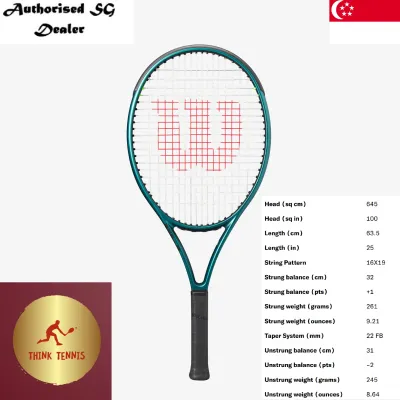
The “100” in the model name denotes a 100-square-inch head size, which falls into the Midplus category. For a beginner, this head size represents a balanced middle ground. It offers a slightly larger hitting area than precision-focused player frames, yet it does not provide the massive, ultra-forgiving sweet spot found in oversized recreational rackets.
Products mentioned in this guide
Prices are valid at publication and may change. Please refer to the product page for the latest price.
Unlike rackets engineered specifically to amplify power, the Blade family is designed with a focus on control, feel, and direct feedback. The frame is built to flex in a way that keeps the ball on the strings a fraction of a second longer, giving you a precise sense of where the ball is going. However, this means the racket expects the player to supply the swing speed and energy required to push the ball deep. A flexible frame absorbs more energy from the ball, which helps with placement but requires you to have a complete, technically sound swing to generate depth.
Self-Diagnosis: Matching Your Skill Level to the Racket
Before committing to a control-oriented frame, you must conduct an honest self-assessment of your physical abilities and technique. The first factor to evaluate is your natural swing speed and power generation. If you are a naturally athletic beginner who can easily generate rapid racket head speed through a full, fluid swing, you may appreciate a frame that helps keep your powerful shots inside the lines. Conversely, if your swing is short, tentative, or slow, a control-oriented frame may leave your shots landing short, forcing you to muscle the ball and compromise your form.

Next, consider your stroke consistency. Beginners who are still struggling to make clean contact with the center of the string bed will find that off-center hits on a control frame feel stiff and lack depth. If your primary goal is simply to keep the ball in play during casual rallies, you might find a more forgiving frame less punishing. However, if you have already established a basic, repeatable stroke and want clear, tactile feedback to help you adjust your directional control, the feedback from this frame can be highly educational.
Finally, pay close attention to physical load and injury prevention. A racket’s static weight and swing weight place direct physical demands on your wrist, forearm, and shoulder. In Singapore’s humid climate, physical fatigue can set in rapidly during extended outdoor practice sessions. Wielding a frame that is too heavy for your current conditioning can lead to late contact, poor mechanics, and eventual joint strain. Ensure your wrist and arm strength can comfortably support the racket’s weight through a full session without causing muscle tightness or discomfort.
Essential Specifications to Verify Before Purchasing
If you decide that a control-oriented 100-square-inch frame fits your development path, you must verify the exact specifications of the model you intend to purchase. Racket lines often feature multiple sub-models that look identical but perform very differently.
First, verify the static weight of the specific frame. While the standard version of this model carries a moderate weight suitable for intermediate players, manufacturers often produce lighter variations, sometimes designated as “L” or “Team” models. A lighter variant reduces the physical burden on a beginner’s arm, making it easier to maneuver the racket while learning the fundamentals of the swing path.
Second, check the string pattern density printed on the frame, which is commonly configured as a 16×19 pattern. This open string pattern provides a balance of spin potential and power transfer. The spacing allows the strings to deflect and snap back, helping developing players generate natural topspin to pull the ball down into the court.
Third, select the correct grip size to protect your hand and wrist. Grip sizes typically range from size 1 (4 1/8 inches) to size 4 (4 1/2 inches), with sizes 2 (4 1/4) and 3 (4 3/8) being the most common for adult players. To check your size, hold the racket in an Eastern forehand grip; there should be enough space to fit the index finger of your opposite hand between your ring finger and palm. Choosing a grip that is too small forces you to squeeze the handle too tightly, while a grip that is too large limits wrist snap and maneuverability.
When to Look for Alternative Beginner Rackets
There are clear indicators that a beginner should bypass this specific model in favor of a more accommodating starter racket. If you find yourself consistently hitting the net, struggling to clear the service line, or feeling like the racket is a heavy club in your hand, you likely need a frame designed for power assistance. Power-oriented rackets are typically lighter, feature a stiffer frame construction, and have a head-heavy balance that helps push the ball deep with minimal physical effort.
Additionally, if off-center hits are causing frequent vibrations and killing your confidence, transitioning to an oversized racket with a head size between 105 and 110 square inches is highly recommended. These larger frames expand the sweet spot significantly, ensuring that even imperfect contact results in a playable shot, which keeps your practice sessions engaging and productive.
To avoid making an expensive mistake, establish a practical testing route before buying. Many local tennis shops, clubs, or coaches offer demo programs that allow you to rent or borrow rackets for a small fee. Spend at least one or two sessions hitting with the racket on court. During your demo session, focus on hitting a variety of shots: try baseline groundstrokes to test depth, volleys at the net to test maneuverability, and serves to test the physical load on your shoulder. No amount of technical reading can replace the immediate feedback of how a frame feels in your hand.
Frequently Asked Questions (FAQ)
Should a beginner string the Wilson Blade 100 V8 with polyester or multifilament strings?
Beginners should generally avoid full setups of polyester strings. While polyester is favored by advanced players for its durability and spin generation, it is a very stiff material that requires high swing speeds to activate. For a beginner, a stiff string in a control-oriented frame can lead to arm discomfort and joint strain. Instead, prioritize multifilament (nylon) strings, which offer excellent comfort, elasticity, and easy power. A multifilament string cushions the impact of off-center hits and helps propel the ball with less effort. Always check the manufacturer’s recommended tension range printed on the inside of the racket throat, and consider starting near the middle of that range to balance control and comfort.
How long can a beginner use this racket before needing an upgrade?
If your physical strength and swing mechanics align with this racket, it can easily serve you for several years as you transition from a beginner to an intermediate player. Because it is built with high-quality materials and a control-oriented profile, it will not hold back your development as your strokes become faster and more precise. You will only need to consider an upgrade when you hit a specific technical plateau. Signs of outgrowing the frame include needing a heavier static weight to plow through heavy incoming balls, or requiring a different balance point to suit a highly specialized net or baseline playstyle. Upgrades should always be driven by these observable performance needs rather than an arbitrary timeline.

Community discussion
Share your experience or ask a question. Comments are reviewed before publication.