
The Yonex EZONE 100 is a highly popular tennis racket, but whether it is suitable for a complete beginner depends heavily on your physical strength, athletic background, and swing mechanics. While it offers an excellent blend of power, comfort, and stability that can support a player’s transition into intermediate play, its standard weight and frame stiffness require a baseline level of physical preparation. For many true beginners, starting with this specific model can be a double-edged sword: it provides a generous sweet spot and easy depth, but it can also mask technical flaws or lead to early fatigue if your muscles are not yet conditioned for the sport.
Assessing Your Physical Strength and Swing Speed
Before committing to a premium racket like the Yonex EZONE 100, you must evaluate your physical conditioning and how your body moves on the court. Tennis rackets in the standard weight class typically sit around 300 grams unstrung. While this might sound light on paper, swinging this weight repeatedly over an hour-long session requires significant endurance in your forearm, wrist, and shoulder. If you are new to racket sports or do not regularly engage in upper-body strength training, a 300-gram frame can quickly feel heavy, leading to dropped racket heads and late contact points.
Your swing speed also plays a critical role in determining if this racket profile matches your current ability. Beginners often start with short, compact swings as they focus on making clean contact with the ball. If your swing is slow and tentative, you will rely heavily on the racket’s frame to generate depth and pace. The EZONE 100 is designed as a modern power racket, meaning its stiff beam helps propel the ball forward with minimal effort. However, if you naturally swing fast but lack control, this inherent power might cause your shots to fly consistently past the baseline.
Products mentioned in this guide
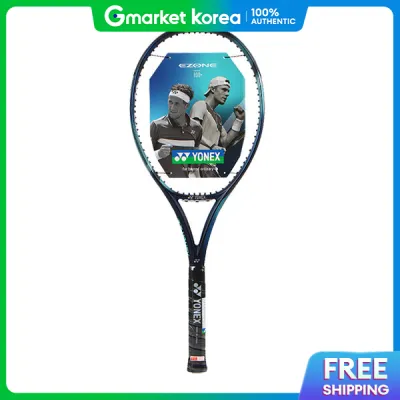
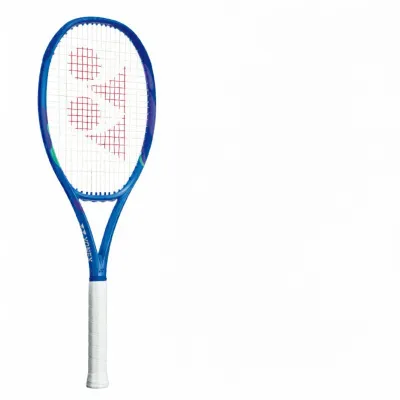
Prices are valid at publication and may change. Please refer to the product page for the latest price.
Finally, consider your planned practice frequency and duration. Playing once a week for 45 minutes places very different demands on your body compared to training three times a week for two hours. Fatigue is the primary driver of poor form and subsequent injury. If you find your arm aching or your grip slipping after just 20 minutes of rallying, a standard-weight frame may be too demanding for your current endurance levels, suggesting you need to build baseline strength before adopting this setup.
In tropical climates where high humidity can accelerate physical exhaustion, managing racket weight becomes even more critical. Sweaty hands and rapid dehydration can make a 300-gram racket feel significantly heavier after the first few games on an outdoor hard court. If you find yourself struggling to maintain a firm grip or if your swing path begins to break down halfway through a session, your body is telling you that the physical load is currently too high.
How the Yonex EZONE 100 Design Impacts Beginner Play
The physical design of the Yonex EZONE 100 offers several features that can either assist or challenge a beginner. Its 100-square-inch head size is widely considered the industry sweet spot for players of all levels. This head size provides a generous hitting area, which is crucial when you are still developing your hand-eye coordination and timing. The unique isometric head shape characteristic of Yonex rackets is designed to expand the sweet spot further, particularly toward the top of the frame, offering more forgiveness on off-center hits and reducing the jarring sensation of a mishit.

Weight distribution is another critical factor in how a racket behaves during a stroke. The standard EZONE 100 features a head-light balance, meaning more of the overall weight is concentrated in the handle rather than the head. This design choice is intended to make the racket feel more maneuverable, allowing you to swing the frame through the air quickly. However, because the overall unstrung weight is 300 grams, it still provides enough mass to remain stable when contacting fast-moving balls. For a beginner, this balance helps you practice proper swing paths without the racket twisting violently in your hand upon impact.
Comfort is a major consideration for new players whose muscles and joints are not yet accustomed to the repetitive shock of hitting a tennis ball. The EZONE 100 incorporates specialized vibration dampening mesh within the handle to absorb harsh vibrations before they travel up your arm. While this technology helps smooth out the feel of your shots, it is important to remember that no technology can completely eliminate the impact of poor technique. The racket provides a relatively plush feel for a stiff frame, but beginners must still focus on hitting the ball cleanly to protect their joints.
The frame’s beam thickness also contributes to its overall performance profile. A thicker beam generally translates to more power and stability, as the frame deforms less upon impact with the ball. The EZONE 100 utilizes a variable beam thickness that balances power in the hoop with flexibility in the shaft. For a beginner, this means the racket does a lot of the heavy lifting when it comes to depth, allowing you to focus on your footwork and positioning rather than forcing you to muscle the ball over the net.
Warning Signs the EZONE 100 Is Not the Right Fit
It is essential to monitor how your body and your game respond to the racket during your first few weeks on the court. The most critical warning sign to watch for is physical discomfort. If you experience persistent pain in your elbow, wrist, or shoulder during or after play, the racket may be too stiff or too heavy for your current physical development. Ignoring early signs of joint strain can lead to chronic conditions like tennis elbow, which will force you off the court entirely.
Beyond physical pain, pay close attention to your technical execution during rallies. If you find yourself consistently hitting the ball behind your body rather than in front of it, the racket’s weight may be slowing down your preparation. Sluggish reaction times, especially when trying to react to quick volleys at the net or defending fast-paced groundstrokes, indicate that you are struggling to maneuver the frame efficiently. When a racket is too heavy, players often compensate by using their wrists to flick the ball, which ruins control and increases the risk of injury.
You can perform a simple check during your next practice session to assess maneuverability. Try to perform quick, short shadow swings at the net, transitioning rapidly from a forehand volley position to a backhand volley position. If the racket feels sluggish, or if you feel a heavy drag that makes it difficult to accelerate the frame quickly, the overall swingweight is likely too high for your current strength. A racket should feel like an extension of your arm, not a heavy tool you have to drag through the air.
Another subtle warning sign is the trajectory of your shots. If your balls are consistently landing short in the service box despite you swinging with significant effort, you may not be generating enough racket head speed to access the frame’s built-in power. Conversely, if your shots are constantly sailing long because you cannot control the racket’s launch angle, the frame’s inherent stiffness and power may be overwhelming your current ability to apply topspin.
Adjusting Your Setup or Exploring Alternative Rackets
If you already own the EZONE 100 and feel it is slightly too demanding, you do not necessarily need to buy a new racket immediately. You can make several highly effective adjustments to your setup to improve playability. First, look at your strings. Many intermediate and advanced players string this racket with stiff polyester strings for maximum spin and control. For a beginner, however, polyester is highly discouraged as it increases the overall stiffness of the bed. Instead, opt for a soft multifilament or synthetic gut string strung at a lower tension, such as 48 to 52 pounds. This adjustment increases the racket’s pocketing effect, softens the impact, and provides easier depth.
Another critical adjustment is your grip setup. If your grip is too small, you will naturally squeeze the handle too tightly to prevent the racket from twisting, which quickly fatigues your forearm and wrist. Adding a high-quality overgrip can slightly increase the handle size, improve sweat absorption, and provide a more secure, cushioned feel. Conversely, if the grip is too large, you will struggle to wrap your fingers around it securely, leading to a loss of control. Ensure you can fit the index finger of your non-hitting hand in the gap between your ring finger and palm when holding the racket.
If these adjustments do not resolve your discomfort or technical struggles, it is time to transition to a different racket category. If the standard 300-gram weight is the primary issue, look for lighter variations within the same family, such as the EZONE 100L (typically around 285 grams) or the EZONE 100SL (around 270 grams). These lighter models retain the forgiving head shape and power profile of the standard version but are significantly easier to swing, allowing you to develop proper technique without straining your muscles. Alternatively, if you struggle with clean contact, an oversized racket head of 105 square inches or larger will provide the maximum possible forgiveness.
Ultimately, the goal is to find a setup that allows you to play comfortably and consistently. If you are unsure about which adjustments to make, visiting a local pro shop or consulting a certified tennis coach can provide personalized guidance. They can observe your swing mechanics in real-time and recommend specific string setups or alternative frames that align with your current physical capabilities and long-term playing goals.
Frequently Asked Questions (FAQ)
Is the Yonex EZONE 100 too stiff for a beginner's arm?
The EZONE 100 features a relatively stiff frame design to maximize power and stability, which can sometimes feel harsh on a beginner’s arm if paired with the wrong strings. To prevent discomfort, avoid stiff polyester strings and instead choose a soft multifilament string. You should also check the manufacturer’s stiffness rating (often measured as RA) and consult a professional stringer to select a tension that prioritizes shock absorption and comfort.
Should a beginner start with the standard EZONE 100 or a lighter variant?
Most beginners will benefit more from starting with a lighter variant, such as the EZONE 100L (285g) or EZONE 100SL (270g), rather than the standard 300g model. The standard version is best suited for beginners with an athletic background, excellent natural strength, or those transitioning quickly to intermediate play. If you have a smaller build, are new to sports, or have a slower swing speed, the lighter variants will allow you to focus on learning proper stroke mechanics without premature fatigue.

Community discussion
Share your experience or ask a question. Comments are reviewed before publication.