
Choosing your first serious tennis racket is a pivotal moment in your development as a player. The Yonex EZONE 100 is widely recognized in the tennis community as a highly versatile frame, but determining whether it matches your specific beginner skill level requires a careful look at your physical capabilities, swing style, and long-term athletic goals. While it offers an appealing blend of power and forgiveness, it is not a one-size-fits-all solution for every player stepping onto the court for the first time.
To make an informed decision, you must evaluate how the racket’s physical specifications align with your current technique. Rather than relying on general popularity, assessing your personal strength, swing speed, and budget will help you determine if this frame will support your learning trajectory or hinder your progress.
Quick Assessment: Is the Yonex EZONE 100 for You?
The Yonex EZONE 100 is generally best suited for beginners who possess a moderate level of natural athleticism, decent baseline physical strength, and an ambition to transition quickly into intermediate play. If you are someone who can consistently swing a standard-weight racket without early fatigue, this frame provides an excellent platform. Its 100-square-inch head size offers a generous hitting area that helps clean up slightly off-center hits, making your early practice sessions much more rewarding.
Products mentioned in this guide
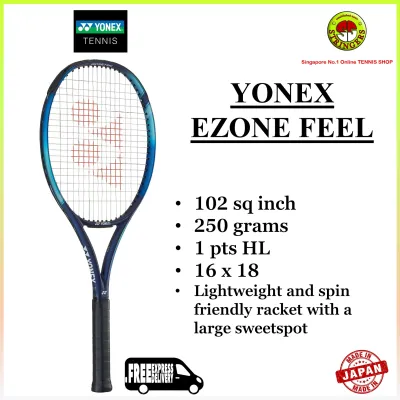
Prices are valid at publication and may change. Please refer to the product page for the latest price.
However, this racket presents distinct trade-offs that you must consider before purchasing. The primary benefit of the EZONE 100 is its ability to generate easy depth and power, which is highly advantageous when you are still developing full swing mechanics. The trade-off is a slight reduction in surgical control and maneuverability compared to heavier, smaller-headed player frames. If your natural swing is already very fast and wild, the inherent power of this frame might cause your shots to fly long until you learn to apply consistent topspin.
Ultimately, your final suitability cannot be determined solely on paper. It depends heavily on your individual physical comfort, your unique swing mechanics, and how the racket feels in your hand during active play. A racket that feels perfect for one beginner might feel cumbersome or overly stiff to another, making personal evaluation an indispensable step in your buying journey.
Key Specifications to Check on the Racket Label
When examining a Yonex EZONE 100 in a pro shop or online, the physical specifications printed directly on the racket throat or label serve as your primary guide. Understanding how to read these metrics allows you to compare the frame objectively against other options on the market.

- Head Size (100 sq in / 645 sq cm): This is the standard measurement for modern versatile rackets. A 100-square-inch head size provides a large sweet spot, which offers crucial forgiveness on off-center hits. For a beginner, this means fewer vibrations and more predictable ball launches when your contact is not perfectly centered.
- Unstrung Weight (300g / 10.6 oz): This is a critical metric to verify on the label. An unstrung weight of 300 grams is generally considered the upper limit for a beginner racket. While it provides excellent stability when blocking back fast balls, it requires sufficient wrist and forearm strength to swing repeatedly over a multi-hour session.
- Balance Point (320mm / Head-Light): The balance point indicates how the weight is distributed along the frame. A measurement of 320mm unstrung indicates a head-light balance, meaning more of the weight is concentrated toward the handle. This design choice helps make the 300-gram weight feel more maneuverable and easier to swing through the air.
- Stiffness Rating (RA) and Beam Width: The EZONE series is known for a relatively stiff beam, often rating in the high 60s on the RA scale, combined with a variable beam width (typically 23.8mm / 26.5mm / 22.5mm). A thicker, stiffer beam deforms less upon ball impact, transferring more energy back into the ball for easy power, though it can transmit more shock to your arm if you mishit.
- Grip Size Options: Rackets are available in grip sizes ranging from 1 (4 1/8 inches) to 4 (4 1/2 inches). To check your correct fit, hold the racket in a continental grip; you should be able to slide the index finger of your opposite hand comfortably into the space between your ring finger and your palm. Choosing a grip that is too small or too large can lead to excessive wrist squeezing and eventual strain.
Self-Diagnosis: Matching Your Tennis Skill and Learning Goals
To determine if the EZONE 100 fits your current stage of development, you must perform an honest self-diagnosis of your on-court abilities. Beginners vary widely in their natural hand-eye coordination, athletic history, and swing speeds, all of which influence how a racket behaves in their hands.
First, assess your current swing speed and consistency. If you tend to take short, cautious swings because you are still figuring out the contact point, a forgiving 100-square-inch frame like the EZONE 100 can help push the ball deep into the opponent’s court with minimal effort. Conversely, if you already have a long, fast, and aggressive swing from other racket sports, you may find that the EZONE 100’s inherent power makes it difficult to keep the ball inside the lines until you master spin production.
Second, consider your long-term learning trajectory. If you plan to play occasionally as a social hobby, a lighter, highly recreational frame might be more comfortable and cost-effective. However, if you are taking regular coaching sessions and aim to transition to an intermediate level within a year, investing in a 300-gram frame prevents you from “outgrowing” your equipment. The EZONE 100 is highly capable of growing with you, offering the stability and spin potential required for advanced baseline rallies.
Finally, identify your most common struggles on the court. If you frequently suffer from short balls that land near the service line, or if off-center hits cause your racket to twist painfully in your hand, the EZONE 100’s stable frame and expanded sweet spot can directly address these issues. However, if your primary struggle is simply getting the racket into position on time due to slow reaction speeds, you might actually benefit more from a lighter alternative, such as the EZONE 100L (typically weighing around 285 grams unstrung).
Physical Comfort and Biomechanical Fit
No matter how advanced a racket’s design is, it will not benefit your game if it causes physical discomfort or fatigue. The biomechanical fit between your body and your equipment is the most critical factor in preventing injury and ensuring long-term enjoyment of the sport.
Begin by evaluating your upper body strength. A 300-gram unstrung racket will weigh approximately 315 to 320 grams once strings, an overgrip, and a dampener are added. During a long practice session or a match under the hot sun, this weight can begin to feel significantly heavier. If you notice your wrist dropping, your swing slowing down, or your shoulder aching after thirty minutes of play, the frame’s weight may be exceeding your current physical conditioning.
Furthermore, you must take any existing joint sensitivities into account. Stiffer frames transfer more kinetic energy to the ball, but they also send more high-frequency vibrations down the shaft into your wrist, elbow, and shoulder. If you have a history of tendonitis, tennis elbow, or shoulder joint issues, a highly stiff frame may not be the safest starting point. In such cases, verifying the frame’s comfort through active testing is essential.
To properly assess maneuverability, pay close attention to how the racket behaves during quick reaction drills and net volleys. At the net, you have very little time to prepare; if the racket feels sluggish or difficult to position quickly, the swing weight may be too demanding. If you ever experience sharp, persistent pain during or after play, stop using the racket immediately. Equipment cannot replace proper biomechanics, and continuing to play through pain can lead to chronic injury. Consult a certified tennis coach to analyze your stroke mechanics, or seek advice from a medical professional.
Next Steps: How to Test and Make Your Final Decision
Before committing to a premium purchase—which can often run upwards of S$300 in Singapore—you should always arrange an on-court trial. Buying a racket based solely on online reviews or professional player endorsements is a common mistake that can lead to buyer’s remorse.
To arrange a trial, look for local authorized tennis retailers, pro shops, or tennis clubs that offer a demo program. Many specialized shops in Singapore allow you to rent demo frames for a small fee, which is often fully deductible from the purchase price if you buy from them. Alternatively, you can ask a coach or a friend who plays with the EZONE 100 if you can hit a few balls with their setup.
When you take the racket onto the court for a test session, structure your play to evaluate different aspects of the frame’s performance:
- Baseline Rallies: Hit at least 20 to 30 groundstrokes from the baseline. Focus on how easily you can hit the ball past the service line and whether the racket twists when you hit off-center.
- Net Volleys: Have a partner hit moderate-paced balls directly at you while you stand at the net. Assess how quickly you can maneuver the racket and how stable it feels when blocking fast shots.
- Serves: Hit 10 to 15 serves to evaluate how the weight affects your shoulder and shoulder blade during overhead motions.
During your test, it is highly beneficial to compare the EZONE 100 directly against a lighter alternative, such as a 285-gram frame, or a more control-oriented 98-square-inch frame. This side-by-side comparison establishes a personal baseline, helping you feel exactly how weight and head size variations impact your swing speed and physical comfort. Finally, consult with the pro shop staff regarding string setups; in tropical climates like Singapore, high humidity can cause strings to lose tension faster, making string selection and regular maintenance even more critical to your overall experience.
Frequently Asked Questions (FAQ)
Does the Yonex EZONE 100 come pre-strung, and does string choice matter for beginners?
Most premium performance rackets, including the Yonex EZONE 100, are sold unstrung. This is because advanced and developing players have highly specific preferences regarding string type and tension. For a beginner, string choice and tension are incredibly important.
It is highly recommended to avoid stiff polyester strings initially, as they require high swing speeds to generate depth and can be very harsh on beginner joints. Instead, opt for a soft multifilament or a high-quality synthetic gut string. Having the racket strung at a moderate, beginner-friendly tension—typically between 50 and 53 pounds—will maximize comfort, shock absorption, and easy power while you refine your technique.
Should a complete beginner start with a 100-square-inch head or a larger oversized racket?
For most physically active beginners, starting directly with a 100-square-inch head is highly beneficial because it provides a great balance of forgiveness and room for skill development. It offers enough of a sweet spot to keep early rallies enjoyable while encouraging you to develop clean, modern swing habits that you will not outgrow as you improve.
Oversized rackets, which feature head sizes of 105 square inches or larger, are generally best reserved for players with very slow swing speeds, limited mobility, or older adults who require maximum assistance from the frame to get the ball over the net. If you have reasonable athletic ability and plan to practice regularly, starting with a 100-square-inch frame like the EZONE 100 is usually the preferred path to avoid needing a replacement racket too quickly.
Community discussion
Share your experience or ask a question. Comments are reviewed before publication.