
Choosing a tennis racket is a highly personal decision that directly impacts your development on the court. The Yonex EZONE 100L is widely recognized as a lighter, more maneuverable alternative to the standard EZONE 100, making it an attractive option for players seeking easier swing speeds and reduced physical strain. However, selecting a racket based solely on its popularity or brand reputation can hinder your progress. A lighter frame is not a universal upgrade; its effectiveness depends on your physical strength, swing mechanics, and long-term athletic goals. To determine if this specific model matches your current playing ability, you must evaluate how its physical properties align with your on-court performance and physical feedback.
Verify the Yonex EZONE 100L Core Specifications
Before committing to any tennis racket, you should carefully analyze its baseline physical specifications to understand how they translate to actual play. The “L” designation in the Yonex EZONE 100L signifies a lighter unstrung weight, which typically sits around 280 grams. While this makes the racket exceptionally easy to swing initially, you must consider how this weight changes once strings, an overgrip, and a dampener are added. The strung weight and the resulting swing weight—the measure of how heavy the racket feels when in motion—will be higher, though still significantly lower than standard player-weight frames that hover around 300 grams or more.
Another critical specification is the 100-square-inch head size. This head size offers a generous sweet spot, providing a balanced blend of power and forgiveness on off-center hits. For players who are still developing consistent contact, this larger surface area helps maintain ball depth even when the strike is not perfectly centered. Additionally, you should check the manufacturer’s spec sheet for the balance point and beam width. The EZONE series generally features a slightly head-light balance to preserve maneuverability, while the variable beam width is engineered to offer stiffness in key areas for power generation without sacrificing feel. Verifying these dimensions against your current equipment will give you a clear baseline for comparison.
Products mentioned in this guide
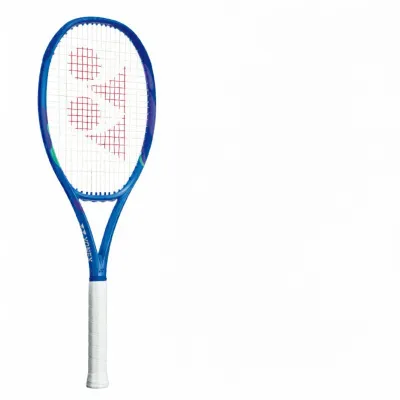
Prices are valid at publication and may change. Please refer to the product page for the latest price.
Self-Diagnosis: Does Your Stroke Match a Lighter Frame?
Your physical stroke mechanics and playing style are the most critical factors in determining whether a lighter frame like the EZONE 100L will benefit your game. Lighter rackets are highly suited for players who have moderate to slow natural swing speeds and require assistance in accelerating the racket head through the contact zone. If you find yourself struggling to complete your swing path or getting late to the ball during fast-paced rallies, the reduced mass of the 100L can help your timing, allowing you to prepare earlier and swing more rapidly.

Your reliance on spin versus flat power also dictates your racket choice. Generating heavy topspin requires rapid upward acceleration of the racket head just before contact. A lighter frame allows your wrist and forearm to brush up the back of the ball with less resistance, which can be highly advantageous for developing spin mechanics. However, if you naturally hit a very flat, driving ball and rely on the racket’s mass to plow through the shot, a lighter frame may feel unstable or fail to deliver the depth you expect.
Furthermore, consider your primary court positioning and physical endurance. In warm, humid climates where outdoor court sessions can quickly lead to physical fatigue, managing a heavy racket over a two-hour session can cause your technique to break down. If you play a style that involves frequent transitions to the net, the EZONE 100L offers rapid maneuverability for quick volleys and reflex shots. Conversely, if you prefer to stay anchored at the baseline, trading heavy groundstrokes with hard-hitting opponents, you may find that a lighter frame requires you to exert more physical effort to return their pace.
Skill Level Alignment: Beginner Ease vs. Intermediate Growth
Aligning a racket with your skill level requires looking at both your current capabilities and your near-future technical progression. For beginners, the primary challenges are developing hand-eye coordination, learning proper swing paths, and avoiding early fatigue. The EZONE 100L excels in this phase by offering a highly forgiving platform. The reduced static weight minimizes the risk of arm fatigue, allowing you to focus on clean contact and footwork during long practice sessions. The larger sweet spot builds confidence, as minor timing errors do not result in immediate, jarring vibrations.
For intermediate players, the evaluation becomes more nuanced. As you face opponents who hit with greater velocity and heavier spin, the racket must be able to absorb and redirect that incoming energy. A lighter frame has less physical mass to resist the force of a heavy incoming ball, which can cause the racket to twist in your hand upon impact. If you are an intermediate player who is starting to participate in competitive league play or high-intensity drills, you must assess whether the 100L still provides the stability you need to control fast-paced shots.
To map your progression, look for specific technical milestones. If you can consistently hit deep into the opponent’s court using a full kinetic chain—utilizing your legs, hips, and torso rather than just your arm—you may find that you are maximizing the potential of a 280-gram racket. When your technique becomes consistent enough that you can generate your own power and control, the lighter weight of the 100L may transition from an asset into a limitation.
On-Court Feedback: Comfort, Stability, and Stop Conditions
The ultimate test of any racket occurs during actual play, where you must pay close attention to the physical and sensory feedback your body receives. Comfort is highly subjective, and a racket that feels comfortable during a five-minute warm-up may cause discomfort after an hour of play. Monitor your joints and muscles closely during and after your sessions. If you experience unusual tightness or strain in your wrist, forearm, or elbow, it may indicate that the racket’s weight distribution is not matching your swing path, or that you are gripping the handle too tightly to compensate for a lack of frame stability.
Pay attention to how the racket behaves when you make contact with the ball outside of the sweet spot. If the frame exhibits significant torsion—twisting or fluttering in your hand—it forces your hand and forearm muscles to contract harder to keep the racket stable. Over time, this repetitive micro-strain can lead to overuse injuries. A stable racket should feel solid upon impact, dampening harsh vibrations before they travel up your arm.
It is vital to establish clear stop conditions for your play sessions. If you experience sharp pain, persistent numbness, or worsening joint discomfort at any point, you must cease play immediately. Do not attempt to play through pain by changing your grip or altering your swing mechanics, as this often exacerbates the issue. Consult a certified tennis coach to analyze your stroke mechanics, or seek advice from a medical professional to address any underlying physical strain before returning to the court.
Progression Triggers: When to Upgrade to a Heavier Racket
Knowing when to transition from a lighter racket to a heavier model is essential for continuous skill development. The most common signal that you have outgrown the EZONE 100L is the “flutter” effect. This occurs when you strike a fast, heavy ball from an opponent, and the racket feels as though it is being pushed backward or twisting, despite your technique being clean and your grip secure. This physical sensation indicates that the incoming ball has more momentum than the racket’s mass can comfortably handle.
Another indicator is power leakage. As your physical strength and swing mechanics improve, you will naturally generate more racket head speed. If you find that your shots are consistently sailing long or lacking control despite executing a proper, controlled swing, it may be because the lighter frame lacks the mass to absorb and redirect your energy efficiently. A heavier racket provides more “plow-through,” allowing you to use the racket’s own mass to drive the ball deep with greater stability and control.
When planning your transition, look for standard 300-gram models, such as the standard EZONE 100, or frames with slightly smaller head sizes if you want to prioritize precision. The transition should be gradual; jumping too quickly to a significantly heavier racket can disrupt your timing and increase the risk of injury. Testing a heavier frame during a practice session will help you determine if your muscles and joints are ready for the increased physical demand.
Frequently Asked Questions (FAQ)
Is the Yonex EZONE 100L a good choice for players managing arm discomfort?
While a lighter racket like the EZONE 100L reduces the static load on your shoulder and arm during your swing, it is not a guaranteed solution for arm discomfort. Because a lighter frame has less mass, it is less efficient at absorbing the impact energy of the ball, which can result in more shock being transferred directly to your wrist and elbow, especially on off-center hits. If you are managing arm issues, you should prioritize developing proper stroke technique, selecting a softer string setup at an appropriate tension, and consulting a medical professional rather than relying solely on a change in racket weight.
How does the 100L differ from the standard EZONE 100 in actual play?
The primary difference between the two models lies in the trade-off between maneuverability and stability. The EZONE 100L is lighter and easier to swing, making it highly maneuverable at the net and easier to accelerate for players with slower swing speeds. In contrast, the standard EZONE 100 weighs more, providing greater stability, better plow-through against heavy incoming balls, and more inherent power for players with established, fast swings. To understand how these differences affect your game, you should test both models side-by-side on the court to feel the variation in swing weight and impact stability.
Should I adjust my string setup to compensate for the lighter weight?
Adjusting your string setup can help you fine-tune the performance of a lighter frame like the EZONE 100L. If you have a slower swing speed and need help generating depth and comfort, opting for a lower string tension or a softer multifilament string can provide a livelier feel. Conversely, if you are an intermediate player who swings faster and needs to control the inherent power of the 100-square-inch head, a slightly higher tension or a hybrid string setup can offer more control. You should consult a professional stringer to customize your setup based on your specific swing mechanics and comfort preferences.
Community discussion
Share your experience or ask a question. Comments are reviewed before publication.