
For a beginner golfer, selecting the right equipment to transport clubs is a fundamental decision that directly impacts physical stamina and overall enjoyment of the game. The choice between a manual push cart and an electric golf trolley primarily depends on your budget, physical fitness level, and the specific environments where you play.
A manual push cart is generally the most practical starting point for beginners. These carts are valued for their mechanical simplicity, lightweight design, and lower upfront cost. They provide an excellent way to walk the course and get a cardiovascular workout without the physical strain of carrying a heavy golf bag on your shoulders.
Conversely, electric trolleys are the superior choice for beginners with pre-existing joint or back concerns, those with a larger budget, or players who regularly tackle 18-hole rounds on hilly layouts under intense tropical heat and high humidity. By eliminating the physical effort required to push your clubs, an electric trolley helps conserve your energy so you can focus entirely on your swing and course strategy.
Products mentioned in this guide
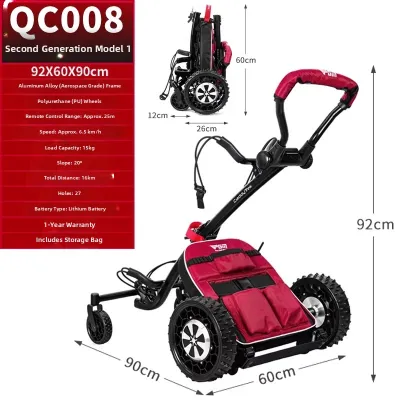
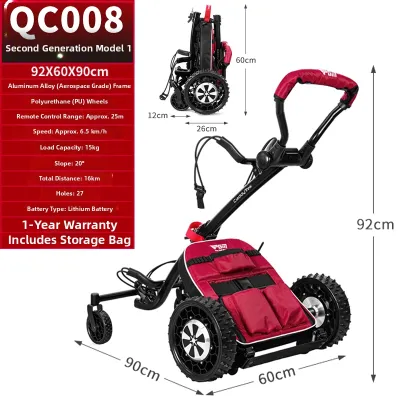
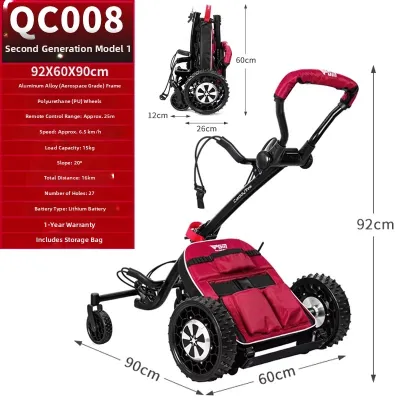
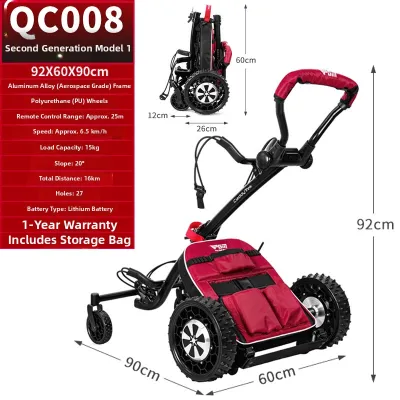
Prices are valid at publication and may change. Please refer to the product page for the latest price.
Ultimately, the right choice is not about picking the most technologically advanced option, but rather about balancing your personal physical needs, your financial comfort zone, and the typical playing conditions of your local courses.
Core Differences Between Manual and Electric Trolleys
Understanding the fundamental design and operational differences between these two categories of golf cart trolleys is essential before making a purchase. While both options serve the primary purpose of transporting your golf bag, they do so through entirely different mechanical frameworks.
Manual push carts—often referred to as push trolleys—are human-powered vehicles that typically feature three or four wheels. They are constructed from lightweight materials such as aluminum or high-grade plastics, making them easy to maneuver and fold down. Because they lack motors, batteries, or complex electronic wiring, they are mechanically straightforward, highly reliable, and require virtually no ongoing maintenance beyond occasional cleaning or wheel lubrication.
Electric golf trolleys are motorized vehicles powered by a rechargeable battery pack, typically utilizing lithium-ion technology. These trolleys feature an electric motor housed near the axle, which drives the wheels forward at adjustable speeds controlled via a handle dial or, in premium models, a handheld remote control. Some high-end electric trolleys even feature automatic follow modes that track the golfer’s movement across the fairway. Because of the motor and battery, these units are substantially heavier and more complex than manual carts.
Despite these differences, both manual and electric models offer significant advantages over carrying a golf bag. They keep your clubs organized, protect your equipment from ground moisture, and prevent the spinal compression and shoulder fatigue associated with carrying a heavy bag for several hours.
How to Compare Them Across 4 Key Dimensions
Physical Effort and Fatigue Management
Walking a golf course provides excellent low-impact exercise, and a manual push cart enhances this benefit. Pushing a lightweight cart helps you burn calories while keeping a natural walking pace. For active beginners who view golf as a fitness routine, this physical effort is often a positive attribute rather than a drawback.

However, the physical demands of pushing a manual cart can accumulate over an 18-hole round. Pushing a 15-kilogram golf bag up steep inclines, through thick rough, or across wet fairways requires substantial physical exertion. As the round progresses, this continuous physical labor can lead to muscle fatigue in your legs, back, and shoulders. This fatigue often manifests as a subtle loss of core stability, increased grip pressure, and diminished swing consistency, which can negatively affect your performance on the final holes.
Electric trolleys address this issue by completely removing the physical labor of moving your clubs. Because the motor does all the heavy lifting, you walk beside or behind the trolley at a leisurely pace, experiencing virtually no upper-body or lower-body strain. This conservation of physical energy is a major advantage for beginners, who are already mentally fatigued from learning the complex mechanics of the golf swing. By preserving your physical stamina, an electric trolley helps you maintain consistent posture, grip pressure, and tempo right through to the 18th green.
Upfront Budget and Ongoing Costs
The financial commitment required for these two types of trolleys represents a significant divergence in entry barriers and long-term costs. For a beginner who is still deciding whether golf will become a lifelong passion, the upfront cost of equipment is a critical factor to weigh carefully.
Manual push carts are highly budget-friendly, making them an attractive entry point. High-quality manual carts generally range from S$150 to S$400, depending on the brand, wheel configuration, and built-in accessories. Beyond this initial purchase, manual carts incur almost no ongoing expenses. The mechanical parts are highly durable, and any necessary repairs—such as replacing a worn wheel bearing or adjusting a manual brake cable—are inexpensive and can often be performed at home with basic tools.
Electric trolleys, by contrast, are premium investments that require a much larger initial financial outlay. Entry-level electric models typically start around S$800, while advanced models featuring lithium batteries, remote controls, GPS integration, or follow-me technology can easily exceed S$2,500. Furthermore, electric trolleys come with ongoing maintenance considerations. The battery pack is a consumable component that will eventually lose its capacity to hold a charge and require replacement, which can cost several hundred dollars. Motor repairs, charger replacements, and electronic troubleshooting also add to the long-term cost of ownership.
Navigating Course Terrain and Tropical Weather
The geographical and climatic conditions of your typical playing environment play a massive role in determining which trolley will provide the best user experience. In tropical regions like Singapore, where high temperatures, extreme humidity, and sudden heavy downpours are common, these environmental factors become even more pronounced.
When playing on hilly courses, a manual cart requires a significant amount of physical effort to push uphill, as well as constant physical control and braking when walking downhill to prevent the cart from running away. On the other hand, electric trolleys excel on undulating terrain. Many electric models are equipped with automatic downhill braking systems (often called electronic braking systems or EBS) that maintain a constant, controlled speed when descending slopes, eliminating the strain of holding back a heavy cart.
The intense tropical heat and humidity can rapidly drain a golfer’s physical energy. Walking 18 holes under the afternoon sun is physically taxing, and pushing a manual cart significantly accelerates dehydration and heat fatigue. An electric trolley acts as a vital energy-saver in these conditions, allowing you to walk comfortably under an umbrella attached to the trolley frame without exerting unnecessary physical force. However, tropical climates also bring heavy rain and wet fairways. While manual carts handle wet grass with ease, electric trolleys require careful attention to water-resistance ratings. It is crucial to verify that the trolley’s battery, motor, and control panel have robust water protection to prevent electrical failure during sudden downpours. Additionally, wet conditions require wheels with excellent traction to prevent slipping on muddy slopes.
Setup, Folding, and Transport
The convenience of getting your equipment from your home to the course and back again is a practical consideration that is easily overlooked but highly impactful on your overall satisfaction. The ease of folding, the weight of the unit, and how it fits into your vehicle are daily usability factors.
Manual push carts are designed with transportability in mind. Most modern manual carts feature highly engineered folding mechanisms that allow the cart to fold down into a compact footprint in just one or two simple steps. Because they do not contain heavy motors or batteries, manual carts typically weigh between 6 and 9 kilograms. This lightweight nature makes them exceptionally easy to lift into and out of a car boot, carry up stairs, or store on a high shelf in your home.
Electric trolleys are inherently heavier and more complex to transport. A standard electric trolley, including its battery, can easily weigh between 12 and 18 kilograms. Lifting this weight into a vehicle trunk requires proper lifting technique and can be a significant physical challenge for older golfers or those recovering from back injuries. To make transport manageable, many electric models require you to remove the battery before folding, adding an extra step to your pre- and post-round routine. Furthermore, folded electric trolleys tend to take up more space in a car boot, which can make it difficult to fit both the trolley and a full-sized golf bag into smaller vehicles.
Quick Spec Comparison Table
To help you visualize the key differences between these two options, the table below provides a direct comparison of their primary characteristics.
| Feature | Manual Push Cart | Electric Trolley |
|---|---|---|
| Primary Power Source | Human power (pushing/pulling) | Rechargeable battery (Lithium or Lead-acid) |
| Relative Weight | Lightweight (typically 6–9 kg) | Heavy (typically 12–18 kg with battery) |
| Setup Time | Fast (usually one-step folding) | Moderate (requires battery connection/setup) |
| Maintenance Level | Low (minimal mechanical parts) | High (requires battery charging and care) |
| Ideal Course Terrain | Flat to moderately undulating | Hilly, steep, or highly undulating |
| Best For (User Profile) | Budget-conscious, active beginners | Fitness-limited, long rounds, hot climates |
The Decision Framework: Which One Fits Your Profile?
To help you make the right choice, let us break down the decision into a clear, conditional framework based on your specific playing habits, physical needs, and practical constraints.
Choose Manual If…
- You are on a budget: If you want to keep your initial golf investment low, a manual cart offers outstanding value without ongoing financial commitments.
- You want the exercise: If you view golf as a primary source of exercise and enjoy the cardiovascular challenge of pushing your gear, a manual cart is perfect.
- You mostly play 9-hole rounds: For shorter rounds, the physical fatigue of pushing a cart is minimal, making a manual cart highly efficient.
- You have limited vehicle or storage space: If you drive a compact car, the lightweight, compact folding design of a manual cart is incredibly convenient.
Choose Electric If…
- You have physical limitations: If you suffer from back pain or joint issues, an electric trolley removes physical strain, allowing you to play safely.
- You regularly play 18 holes in hot weather: If you play full rounds under the intense tropical sun, conserving energy with an electric trolley is a massive benefit.
- You play on highly undulating courses: If your home course features steep hills and long walks, a motorized trolley will save you from exhaustion.
- You want to focus entirely on your game: If you want to eliminate physical distractions and focus 100% of your energy on your swing mechanics.
Verify First If…
- Check local club regulations: Before purchasing, verify the rules of the courses you plan to play. Some clubs restrict certain trolley types or require specific wide-profile wheels during wet seasons.
- Measure your car boot space: Take physical measurements of your vehicle's trunk to ensure the folded trolley and your golf bag fit comfortably.
- Test your lifting capacity: Visit a local golf retailer and physically lift both folded manual and electric trolleys to ensure you can comfortably lift them into your vehicle.
Crucial Features to Verify Before Purchasing
When you are ready to make a purchase, do not rely solely on brand names or aesthetic appeal. Instead, carefully examine the product specifications and labels to verify the following critical features.
Braking Systems A reliable braking system is essential for safety. For manual carts, look for an easy-to-engage foot brake or a hand-operated lever that securely locks the wheels on slopes. For electric trolleys, check if the model features an Electronic Braking System (EBS). An EBS automatically controls the trolley’s speed when walking down steep hills, preventing it from accelerating away from you.
Battery Specifications If you decide on an electric trolley, the battery is the most critical and expensive component.
- Battery Type: Lithium-ion batteries are highly recommended over lead-acid because they are lighter, charge faster, and last up to five times longer.
- Hole Capacity: Verify the manufacturer's stated capacity, which is typically rated for 18 or 36 holes on a single charge, and choose a battery that comfortably exceeds your typical round length to account for long-term degradation.
- Charging Time: Check the recommended charging duration and look for smart chargers that automatically shut off once fully charged to prevent overcharging.
Wheel Type Wheel design affects maintenance and ride quality.
- Airless Wheels: These are maintenance-free, puncture-proof, and ideal for most golfers because they never go flat.
- Pneumatic Wheels: These are air-filled tires that offer superior shock absorption over rough terrain, but they require regular pressure checks and are susceptible to punctures from sharp debris.
Warranty and Support Because electric trolleys contain complex motorized and electronic components, a robust warranty is essential. Verify the warranty terms for the motor, frame, and battery separately. Additionally, ensure there is an authorized local service center in Singapore. Having access to local technicians and genuine replacement parts is crucial for resolving any issues quickly without shipping heavy equipment overseas.
Frequently Asked Questions (FAQ)
Can I convert a manual push cart into an electric one later?
While aftermarket conversion kits are available to transform a manual push cart into an electric trolley, this path is generally not recommended for beginners. These conversion kits are often heavy, complex to install, and can void the original manufacturer’s warranty on your manual cart. Furthermore, manual carts are not structurally engineered to handle the weight and torque of an electric motor, which can compromise the cart’s stability and alter its center of gravity, making it prone to tipping over on uneven terrain. Purchasing a dedicated, purpose-built electric trolley is a much safer, more reliable, and better-balanced solution.
How long does an electric golf trolley battery last on a single charge?
The actual runtime of an electric golf trolley battery depends on several variables, including the battery chemistry (lithium-ion versus lead-acid), the total weight of your golf bag, and the steepness of the course terrain. Most standard lithium batteries are designed to comfortably last 18 holes on a single charge, while premium extended-range batteries are rated for 36 holes. To prevent being stranded on the course, always check the manufacturer’s specified capacity and look for electric trolley models that feature a clear, built-in low-battery warning indicator on the handle display.
Are 3-wheel or 4-wheel manual carts better for beginners?
For most beginners, a 3-wheel manual push cart is the recommended choice. Three-wheel models feature a single front wheel that swivels, making them highly maneuverable, easy to steer with one hand, and generally lighter and quicker to fold down. Four-wheel manual carts offer superior stability, especially when parked on steep side-slopes, and often feature larger accessory consoles or storage space. However, four-wheel models tend to be slightly heavier, bulkier when folded, and require a bit more physical effort to steer around tight corners on the fairway.
Community discussion
Share your experience or ask a question. Comments are reviewed before publication.