
Finding the right protective gear for your bicycle is essential, especially when storing it in Singapore’s humid and unpredictable tropical climate. To determine if a pma cover will fit your bike frame size, you must move beyond generic sizing labels like Small, Medium, or Large. Instead, you need to collect three precise physical measurements from your bicycle—total length, maximum height, and widest point—and compare them directly to the manufacturer’s exact centimeter specifications.
Choosing a cover that matches your bike’s unique profile ensures complete protection against heavy downpours, intense UV rays, dust, and rust. Whether you park your ride at an HDB void deck, on a private balcony, or near a public transit hub, understanding how to read these dimensions prevents the frustration of buying a cover that is either too tight to buckle or so loose that it catches the wind like a sail.
Decoding PMA Cover Size Labels and Specifications
When shopping for a pma cover, you will often encounter size charts categorised by letters or general bicycle types. However, relying solely on these labels can lead to compatibility issues. A cover labeled “Medium” might claim to fit standard 26-inch bicycles, but this estimation does not account for modern frame geometries, wider handlebars, or rear-mounted accessories.
Products mentioned in this guide
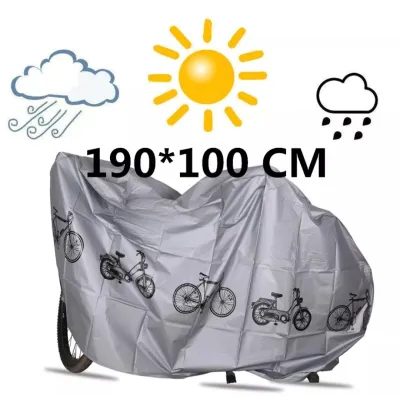
Prices are valid at publication and may change. Please refer to the product page for the latest price.
Instead, look closely at the product packaging or online listing for the exact physical dimensions, usually listed as Length x Width x Height (L x W x H) in centimeters.
- Length: This represents the total end-to-end coverage from the front tire to the rear tire.
- Width: This measures the widest span of the cover, designed to accommodate your handlebars.
- Height: This indicates the vertical coverage from the top of the handlebars down to the ground.
In Singapore’s high-humidity environment, materials can experience minor changes over time. Intense UV exposure on open balconies or outdoor racks can cause some synthetic fabrics to shrink slightly, while heavy tension can stretch the seams. Checking the exact initial dimensions ensures you have a safety margin of a few centimeters, preventing premature wear on the fabric.
How to Measure Your Bicycle for a Cover
To guarantee a precise match, you must measure your bicycle in its fully assembled, parked configuration. Do not rely on the manufacturer’s stock specifications for your bike model, as aftermarket additions can alter the overall footprint. Grab a standard measuring tape and record the three critical dimensions.

First, measure the total length. Run your tape measure horizontally from the absolute outermost edge of the front tire to the outermost edge of the rear tire. If your bicycle has a permanently mounted rear rack, a front basket, or extended mudguards, make sure your tape measure spans from the furthest front point to the furthest rear point.
Second, measure the maximum height. Place the end of the tape measure on the ground and extend it vertically to the highest point of your bicycle. For most standard setups, this will be the top of the handlebars, the brake levers, or the gear shifters. However, if you have mounted high-profile mirrors, a phone mount, or a raised saddle, use the highest point of those accessories as your reference.
Third, measure the maximum width. This is almost always the distance between the outer tips of your handlebars. If you have installed bar ends, wide-angle mirrors, or bulky handguards, measure from the outermost edge of these attachments.
For folding bikes, the measurement process depends entirely on your storage habits. If you fold your bike for storage under a desk or inside a closet, measure the folded bundle’s length, width, and height. If you park it fully assembled in a shared corridor or HDB void deck, use the standard unfolded measurements.
Adjusting for Bike Types, Accessories, and Storage Scenarios
Different bicycle styles have distinct structural shapes that directly impact how a pma cover drapes over the frame.
- Road Bikes: These frames are typically narrow and streamlined with drop handlebars. They fit easily into standard, slimmer cover profiles, but you should still ensure the cover's height accommodates the saddle and drop bars.
- Mountain Bikes (MTBs): Modern MTBs feature wide handlebars, often measuring between 720mm and 800mm, alongside front suspension forks. These bikes require a cover with a generous width specification at the front to avoid putting excessive tension on the fabric.
- E-Bikes and Fat Bikes: Electric bicycles often feature bulkier down tubes to house batteries, mid-drive motor casings, and wider tires. Fat bikes have massive tire profiles that increase both the overall length and height of the bike.
- Commuter and Utility Bikes: If your bike is equipped with child seats, front baskets, rear pannier bags, or delivery boxes, its silhouette changes dramatically. In these cases, you will almost certainly need to size up by one or two tiers to ensure the cover can drape fully over the added bulk.
Your local storage environment in Singapore also dictates the ideal fit. If you park along Park Connector Networks (PCNs) or in open-air HDB void decks, a cover that fits too tightly can trap tropical condensation. This trapped moisture accelerates chain rust and can lead to mold on foam saddles or handlebar grips. A slightly looser fit allows air to circulate underneath, helping damp components dry faster, provided the cover is anchored securely at the bottom.
Verifying the Fit: Signs of a Good vs. Poor Match
Once you have purchased your cover, perform a quick visual inspection to confirm a proper fit before leaving your bicycle exposed to the elements.
A well-fitting cover should drape smoothly over the handlebars and saddle without requiring aggressive stretching. It should reach down to cover the entire drivetrain, chain, and at least halfway down both wheels, keeping sensitive mechanical components shielded from rain. The elasticated bottom hem or heavy-duty buckle straps should easily meet under the frame, allowing you to secure the cover tightly.
Conversely, a poor fit is easy to spot. If the cover is too tight, the fabric will pull taut against sharp points like brake levers, gear shifters, and pedals, which can puncture the material over time. A tight cover also rubs continuously against the bike frame, which can scratch the paintwork during windy conditions. If the cover is too loose, excess fabric will pool on the ground, collecting dirt and water, while the loose material acts as a sail that can catch strong gusts and tip your bicycle over.
Frequently Asked Questions (FAQ)
Can I use a standard PMA cover for an e-bike with a bulky battery?
Standard covers are often designed for traditional, slim frames and may struggle with the added girth of an electric bicycle. E-bikes with integrated frame batteries or external battery packs require a wider and deeper mid-section. Always check the cover’s width specifications, and if your e-bike’s dimensions are within five centimeters of the cover’s maximum limit, choose the next size up to ensure full coverage.
Will a bicycle cover that is slightly too large blow away in the wind?
A slightly larger cover will remain secure as long as it features robust fastening systems. Look for covers equipped with elasticated bottom hems, adjustable drawstrings, or heavy-duty buckle straps that clip directly underneath the bicycle frame. Securing these straps tightly prevents wind from getting underneath the cover, keeping it firmly anchored even during heavy Singapore monsoon storms.
Community discussion
Share your experience or ask a question. Comments are reviewed before publication.