
Choosing a portable badminton net requires balancing convenience, stability, and durability. Unlike permanent indoor court setups, a portable system must adapt to various outdoor and indoor environments, from windy park lawns to hard concrete driveways. To find the right model, you must look beyond aesthetic design and evaluate critical specifications like frame material, base construction, height adjustability, and packed weight.
Quick Guide: Which Portable Badminton Net Specs Matter Most?
To select the ideal portable badminton net, you must first identify where and how you plan to play. The four primary specifications that define a net’s performance are its frame material, base anchoring design, height adjustability, and overall packed weight. Each of these features directly impacts how easy the system is to transport, how well it stands up to the elements, and how closely it mimics a real court experience.
The optimal configuration depends entirely on your primary playing surface and the skill level of the players. For instance, a system designed for sandy beaches or soft grass requires different anchoring mechanisms than one meant for concrete driveways or indoor multi-purpose halls. Furthermore, casual family games with children benefit from different height settings than serious training sessions for adult club players.
Products mentioned in this guide
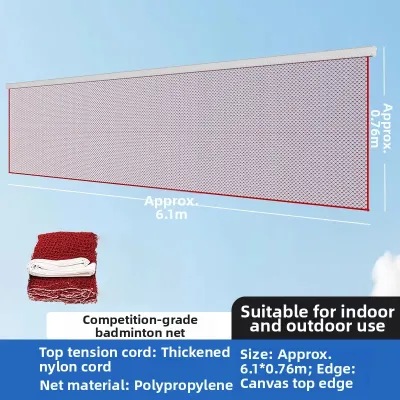
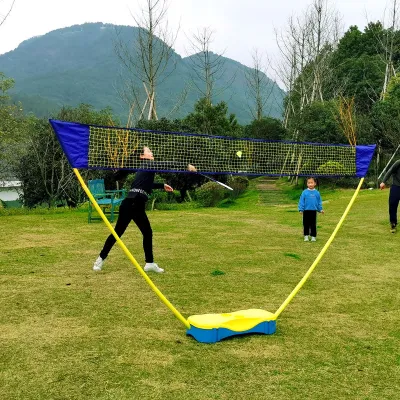

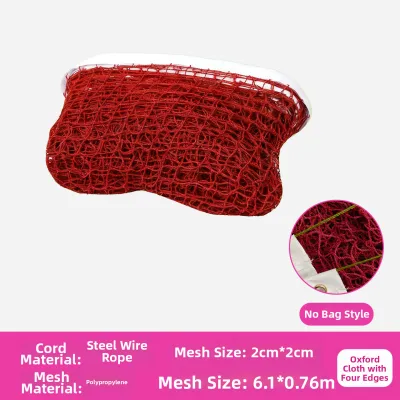
![[SG FREE ] 6.1mX0.76m Professional Sport Training Standard Badminton Net Outdoor Tennis Net Mesh Volleyball Net Exercis](https://img.lazcdn.com/g/p/2cc3f2f415b7b4810b7ff3f785fdb0cd.jpg_400x400q80.jpg_.webp)
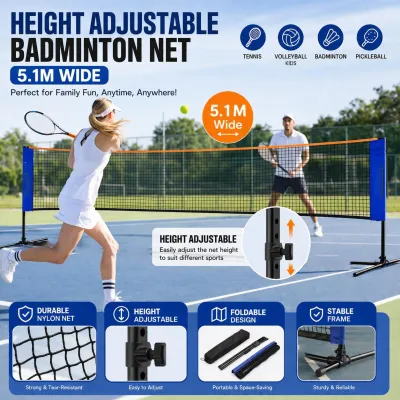
![🇸🇬 [READY STOCK] Badminton Rackets Pickleball Net - Height Adjustable Portable Net for Junior Tennis Kids Volleyball & Soccer and Backyard Games - Easy Setup Nylon Sports Net with Poles 10ft / 14ft / 17ft Wide badminton racket](https://img.lazcdn.com/g/p/7a9dd8a382c709c2e7494b8ee6e6d96f.jpg_400x400q80.jpg_.webp)
Prices are valid at publication and may change. Please refer to the product page for the latest price.
It is also important to set realistic performance expectations from the outset. Portable nets are engineered for rapid assembly and easy transport, which means they naturally prioritize convenience over the extreme lateral tension found in permanent, floor-anchored tournament posts. Recognizing this trade-off allows you to focus on finding a stable, reliable system that fits your specific recreational or training needs.
Frame Material and Pole Design: Balancing Weight and Durability
The material of the frame and poles dictates the net’s overall lifespan, structural integrity, and ease of transport. Steel frames offer exceptional durability and a reassuring weight that helps the structure remain upright in light breezes. However, steel is inherently susceptible to rust, meaning it requires a high-quality protective finish and careful storage to prevent structural degradation over time.

Aluminum frames present a highly popular alternative for players who transport their equipment frequently. Aluminum is significantly lighter than steel, making it much easier to carry to distant park locations, and it possesses natural resistance to rust. While it may bend more easily under extreme impact, its lightweight nature makes it an excellent choice for regular mobile use.
Fiberglass is commonly utilized in ultra-lightweight or youth-focused nets. This material offers incredible flexibility, allowing the poles to bend without breaking, which is ideal for high-energy play or windy conditions. However, fiberglass poles may not provide the rigid, straight structure required to keep a standard adult net perfectly level across its entire width.
When evaluating any frame, pay close attention to the pole diameter and wall thickness, as these specifications are the most reliable indicators of wind resistance and structural sturdiness. In humid, tropical environments like Singapore, selecting a frame with a robust powder coating or specialized rust-resistant finish is essential. Without this protection, moisture and salty coastal air can quickly corrode the metal joints, causing them to seize or weaken.
Net Dimensions and Height Adjustability
To ensure your practice sessions translate well to a real court, understanding standard dimensions is crucial. The Badminton World Federation (BWF) defines the official regulation net height as 1.55 meters at the outer edges and 1.524 meters at the exact center. Achieving this slight dip requires a high level of lateral tension, which is why the structural integrity of the supporting poles is so important.
If you plan to use the net for multiple sports or diverse age groups, height adjustability is an invaluable feature. Many modern portable systems allow you to lower the net to 1.0 meter or even 0.8 meters. This flexibility makes the net instantly compatible with children’s training, as well as other popular racket sports like pickleball or mini-tennis, maximizing the value of your investment.
Width is another critical dimension to consider, typically ranging from compact 3.0-meter training nets to full-size 6.1-meter double court widths. Before purchasing, carefully measure your intended playing area, whether it is a backyard, a local park clearing, or a shared community space. A net that is too wide for your space will be difficult to set up safely, while a net that is too narrow may limit your ability to practice realistic cross-court shots.
Base Stability: Ground Stakes vs. Weighted Feet
A portable net is only as good as its foundation, and choosing the right anchoring system depends heavily on your venue. Ground stakes are the traditional choice for soft surfaces such as grass lawns, sandy beaches, and park fields. They provide excellent stability by anchoring the frame deep into the earth, but you must ensure the stakes are long enough to hold in loose soil and avoid forcing them into rocky ground, which can easily bend the metal.
For hard surfaces like concrete driveways, indoor sports halls, or artificial turf, weighted bases or flat, freestanding feet are absolutely necessary. These systems rely on physical weight—often achieved by filling plastic bases with water or sand, or using heavy steel flat plates—to keep the net upright. While highly versatile, these weighted components add substantial bulk and weight to your carrying setup, making them less convenient for long-distance foot travel.
The interaction between the base design and the overall frame weight determines how well the net will withstand sudden gusts of wind. In outdoor settings, a lightweight frame with a poor anchoring system can easily tip over, risking damage to the equipment or injury to nearby players. Always assess the typical wind conditions of your playing venue and choose a base system that offers a reliable counterweight or secure physical anchorage.
Portability, Setup Mechanism, and Carry Bag Quality
True portability involves more than just a low weight specification; the ease of assembly and the durability of the storage system are equally vital. Setup mechanisms generally fall into two categories: push-button snap locks and bungee-corded (shock-corded) poles. Bungee-corded systems are highly efficient because the internal elastic cord guides the poles into place automatically, preventing lost parts and dramatically speeding up assembly time.
When assessing transportability, consider whether the packed dimensions allow the kit to be “backpack-friendly” or if it is strictly “car-boot only.” If you rely on public transport or walking to reach your playing venue, a compact, lightweight package under 3 kilograms is essential. For those with dedicated vehicle transport, a heavier, more robust system with a wider footprint may be a preferable trade-off for increased stability.
Finally, do not overlook the quality of the carry bag, as it is often the first component to fail. Look for bags constructed from heavy-duty, high-denier fabrics with reinforced double stitching and robust zippers that can withstand repeated packing cycles. Internal dividers or dedicated straps are also highly beneficial, as they prevent metal poles from rubbing against each other or tearing the outer fabric during transit.
Frequently Asked Questions (FAQ)
Can I use a portable badminton net for official tournaments?
While some high-end, heavy-duty portable nets can be adjusted to meet the exact BWF height specifications, they are not suitable for official tournament play. Sanctioned tournaments require permanent, heavily tensioned post systems anchored directly into the floor to maintain perfect net tension. Portable nets are designed and recommended strictly for recreational play, personal training, and casual practice.
How do I prevent the net from sagging in the middle?
To minimize center sag, ensure that the frame’s base is fully extended and locked securely to maintain maximum lateral tension. Choosing a net model that features a reinforced top tape or adjustable tensioning straps at the sides allows you to pull the net taut. Additionally, making sure the vertical support poles are completely upright and anchored firmly will help keep the net level.
Community discussion
Share your experience or ask a question. Comments are reviewed before publication.