
Selecting the correct resistance band level is critical for building an effective workout routine. To find the right tension, you must match the band’s resistance range to your current physical strength, training goals, and target muscle groups. Unlike fixed weights, resistance bands provide progressive tension that increases as the band stretches. Beginners typically benefit from starting with light bands offering 2 to 7 kg of peak tension, whereas intermediate and advanced lifters require a range of medium to heavy bands to challenge larger muscle groups.
Decoding Resistance Band Specs: Weight, Tension, and Color Codes
Understanding how resistance bands are rated is essential for translating product specifications into actual workout performance. Manufacturers measure resistance in kilograms (kg) or pounds (lbs), but these numbers do not function like the static weight of a dumbbell. A 10 kg dumbbell exerts a constant gravitational pull throughout a movement. In contrast, a 10 kg resistance band only provides its rated 10 kg of resistance when stretched to its maximum safe limit, which represents its peak tension. At the beginning of an exercise, when the band is slack, the actual resistance is much lower, meaning the load increases dynamically as you move through the range of motion.
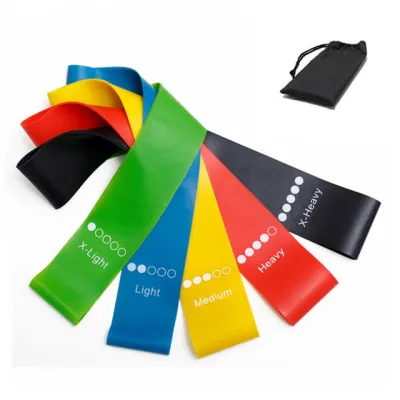
While almost every brand uses a color spectrum to indicate a progression from light to heavy tension, there is no universal industry standard. A red band from one manufacturer might represent a light 5 kg tension, while a red band from another brand could denote a heavy 20 kg resistance. To avoid purchasing the wrong equipment, always bypass the color visual and consult the manufacturer’s specific product sheet to verify the exact numerical tension range.
Products mentioned in this guide
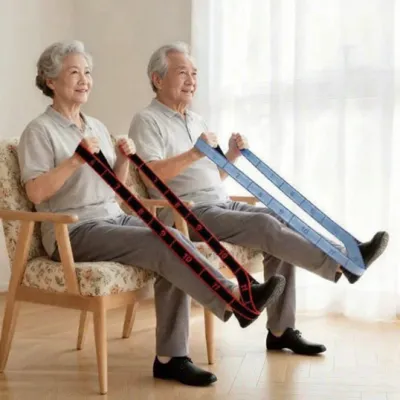
![🇸🇬 [READY STOCK] Elastic Yoga Pilates Rubber Stretch Resistance Exercise Fitness Band Belt](https://img.lazcdn.com/g/p/20dbe94b58bb8a94f4538aee88b0b8a2.jpg_400x400q80.jpg_.webp)
![🇸🇬 [READY STOCK] Pull Up Assist Resistance Elastic Band Natural Rubber Workout Loop Band for Workout icon](https://img.lazcdn.com/g/p/168ff2ad3ba2fb365fffd4d2fd22e6c4.jpg_400x400q80.jpg_.webp)
Prices are valid at publication and may change. Please refer to the product page for the latest price.
When choosing your first set of bands, it is easy to get distracted by secondary specifications such as proprietary rubber blends, textured surface finishes, or minor width variations. While these factors can influence comfort and durability, they are secondary to the actual tension rating. Focusing on the peak tension capacity ensures that you acquire a tool that matches your physical capabilities, allowing you to prioritize functional performance over minor structural differences.
Matching Tension to Your Fitness Stage and Training Goals
Your current physical conditioning serves as the baseline for choosing your starting resistance levels. If you are new to strength training or recovering from an injury, your primary focus must be on mastering proper exercise mechanics and joint alignment. For this stage, light bands offering 2 to 7 kg of tension allow you to perform movements with control, preventing your body from compensating with poor form. As your strength and stability improve, you can transition to intermediate bands (typically 8 to 15 kg) and eventually advanced options (exceeding 20 kg) to maintain a challenging stimulus.

The resistance level you select must also align directly with your specific fitness objectives. If your goal is muscular endurance, joint rehabilitation, or mobility work, you should opt for lower tension levels that allow you to perform high-repetition sets of 15 to 20 reps without experiencing muscle failure. Conversely, if you are training for muscle hypertrophy or maximum strength, you will require moderate to high tension bands. These heavier bands should limit your repetitions to a range of 6 to 12 reps per set, providing enough mechanical tension to stimulate muscle fiber adaptation.
To make continuous progress over time, your muscles must be subjected to progressive overload, which means gradually increasing the demands placed on them. Relying on a single resistance band makes progressive overload nearly impossible, as you will quickly outgrow its capacity. Purchasing a comprehensive set containing multiple bands of varying tension levels is highly practical and cost-effective. A complete set allows you to seamlessly transition to higher resistance levels as you grow stronger, ensuring your training remains effective over the long term.
Scaling Resistance for Different Muscle Groups and Exercises
A single resistance band cannot support a comprehensive full-body workout because different muscle groups possess vastly different force-producing capabilities. Large, powerful muscle groups such as the glutes, quadriceps, and latissimus dorsi require substantial resistance to trigger adaptation. Using a light band for a squat or a lat pulldown will fail to stimulate these large muscles adequately. On the other hand, smaller stabilizing muscles, such as the rotator cuff, calves, and deltoids, are highly susceptible to strain if overloaded. These smaller muscle groups require light bands to ensure the target muscles perform the work without causing neighboring muscles to compensate.
To optimize your training, you should map your exercises to specific resistance levels. For instance, compound lower-body movements like squats, deadlifts, and glute bridges are best suited for heavy or extra-heavy bands that can match the power of your legs. Mid-range exercises like bicep curls, chest presses, and overhead presses generally require medium bands. For isolated movements such as lateral raises, tricep extensions, and rotator cuff rotations, light or extra-light bands are necessary to maintain strict form and protect your joints from injury.
You can also modify the tension of a resistance band dynamically during a workout without changing the band itself. Whether you are exercising in a commercial gym, a compact HDB apartment, or a local outdoor fitness corner, adjusting your setup is straightforward. If an exercise feels too easy, you can shorten the working length of the band by choking up on your grip or folding the band in half to double its resistance. For anchored exercises, simply stepping further away from the anchor point increases the pre-stretch tension, making the movement more challenging. Conversely, if you need to reduce the resistance, widening your grip or moving closer to the anchor point will instantly lower the tension.
How to Test Your Resistance Level and Stay Safe
Determining whether a resistance band is appropriate for a specific exercise can be done using the “Two-Rep Rule.” When performing a set of a target exercise, pay close attention to your level of exertion during the final two repetitions. If you can complete your target repetitions with perfect form and feel that you could easily perform three or more additional repetitions, the band is too light. If your form breaks down, or if you are completely unable to complete the final two repetitions of your set, the band is too heavy. The ideal band allows you to complete the set with effort while maintaining strict control.
Before beginning any exercise session, perform a thorough inspection of your bands to prevent sudden equipment failure. Examine the entire length of the band for micro-tears, small nicks, white stress marks, or areas that show a noticeable loss of elasticity. In Singapore’s warm and humid climate, latex materials can degrade more rapidly if stored in non-air-conditioned spaces or exposed to direct sunlight, making regular inspections even more critical. Because resistance bands store significant potential energy when stretched, a sudden snap can cause serious injury to your face, eyes, or limbs. If you detect any signs of wear or structural compromise, discard the band immediately and replace it.
To ensure your safety during training, never stretch a resistance band beyond its rated maximum elongation, which is typically 2 to 2.5 times its resting length. Always check the manufacturer’s instructions for specific elongation limits and safety guidelines. Avoid anchoring your bands to sharp, abrasive, or unstable objects that could cut the material or tip over during use. Finally, maintain a secure grip and verify that all anchor points are locked and stable before releasing tension, ensuring that the band never slips from your hands or feet mid-exercise.
Frequently Asked Questions (FAQ)
Can I combine multiple resistance bands for a heavier workout?
Yes, you can combine or stack multiple resistance bands to increase the total workload. When you use two or more bands simultaneously, their peak tensions add together to create a heavier overall load. However, stacking bands increases the physical friction between the materials, which can accelerate wear and elevate the risk of snapping. Always inspect every band in the stack individually before starting your set, and ensure they are securely anchored together to prevent slipping.
Do fabric resistance bands provide more tension than latex ones?
Fabric resistance bands do not inherently provide more tension than latex ones; rather, the material differences primarily affect grip, comfort, and durability. Fabric bands are typically wider and woven with elastic fibers, which prevents them from rolling up or pinching the skin during lower-body movements. The actual tension level of any band is determined by its thickness, width, and the density of its elastic weave, whether it is made of latex, TPE, or fabric. Always consult the manufacturer’s specifications to compare the actual tension ratings of different materials.
Community discussion
Share your experience or ask a question. Comments are reviewed before publication.