
When selecting a toggle rope for climbing, rescue, or tactical rigging, your safety depends entirely on verifying its safety certifications, manufacturing standards, and load ratings. A true life-safety rope is never a matter of guesswork or marketing claims. Before trusting your weight or the weight of a climbing partner to any gear, you must verify that the product has undergone rigorous, standardized laboratory testing.
Climbing and vertical ropework are inherently high-risk activities. Equipment cannot replace professional training, sound judgment, and physical preparation. Always check the manufacturer’s user manual for both your rope and any connected hardware before configuring your climbing system. If instructions conflict, or if you are unsure of a product’s history, stop use immediately and consult a certified professional.
Essential Safety Certifications to Look for on the Label
The primary indicators of a reliable, safety-tested rope are certifications from the International Climbing and Mountaineering Federation (UIAA) and the European Conformity (CE) mark. These markings prove that the rope has been subjected to standardized stress, drop, and environmental tests. While a CE mark indicates compliance with essential European safety laws, the UIAA certification often sets even stricter safety thresholds specifically tailored for mountaineering and climbing environments.
Products mentioned in this guide
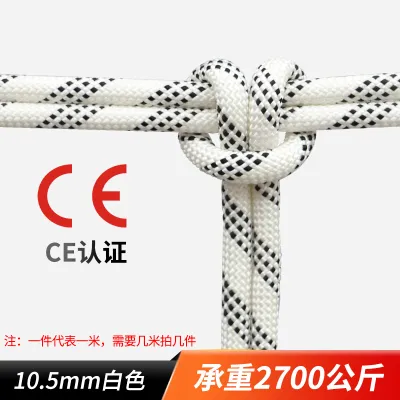
Prices are valid at publication and may change. Please refer to the product page for the latest price.
When examining a rope, look for the specific European Standard (EN) number printed on the physical product label or packaging. For dynamic ropes designed to stretch and absorb the impact of a fall, the standard is EN 892. For low-stretch or semi-static ropes used for rappelling, hauling, or fixed-line work, look for EN 1891. Accessory cords used for secondary connections or prusik loops must conform to EN 564. Knowing these specific standards allows you to verify that the rope is engineered for your exact application.
Never rely on product titles or marketing claims on online marketplaces. Reputable manufacturers physically stitch a durable label to the end of the rope or print it directly on the packaging, displaying the certification logos, standard numbers, and production batch details. If a seller claims a rope is “climbing-grade” but cannot provide photographic proof of these physical labels, the gear must not be used for life-safety applications.
Remember that safety certifications apply strictly to a specific rope model, construction, and diameter. A manufacturer may produce certified dynamic climbing ropes, but this does not mean their utility cords or uncertified toggle ropes share those safety characteristics. Always verify the individual certification documents for the exact product model you intend to purchase.
How to Read and Apply Load Ratings and Strength Specs
Minimum Breaking Strength (MBS) is the force at which a rope fails under a constant, slow-pull laboratory test. Typically measured in kilonewtons (kN), where one kN is roughly equivalent to 101.9 kilograms of force under gravity, MBS represents an absolute limit under ideal, static conditions. It is critical to understand that MBS is not a safe working load limit; knots, sharp bends, moisture, and wear can reduce a rope’s effective strength by 30% to 50% or more.

For dynamic climbing ropes, Impact Force is a much more critical safety metric than raw breaking strength. When a climber falls, the rope must stretch progressively to absorb the kinetic energy of the drop. A lower impact force rating means the rope stretches more efficiently, transferring less shock load to the climber’s body, the harness, and the anchor points. Always check the technical specifications to ensure the impact force falls within safe, certified limits.
The UIAA fall rating indicates how many consecutive, high-factor test falls a rope can sustain under standardized laboratory conditions before breaking. Although you should never subject a rope to such extreme forces in real-world scenarios, a higher UIAA fall rating serves as an excellent indicator of the rope’s long-term durability, structural resilience, and energy-absorption capacity over time.
Always match these specifications directly to your intended climbing discipline. For lead climbing, a certified dynamic rope is mandatory to absorb fall forces. For hauling gear, setting up fixed anchor lines, or vertical rescue scenarios, a semi-static rope is appropriate. Always cross-reference the rope’s technical data sheet with your hardware requirements to ensure a safe configuration.
Construction Standards and Device Compatibility Checks
Modern climbing and safety ropes utilize a kernmantle construction, consisting of an interior core (the “kern”) that provides the majority of the tensile strength and elasticity, surrounded by a woven exterior sheath (the “mantle”) that protects the core from abrasion, dirt, and UV degradation. The sheath-to-core ratio determines the rope’s handling characteristics and durability. A higher sheath percentage provides greater resistance to abrasion and friction, which is highly beneficial when using toggle hardware or mechanical ascenders that rub repeatedly against the rope’s surface.
Diameter mismatch is a critical failure point in vertical rigging. Every mechanical belay device, ascender, pulley, and specialized climbing toggle is engineered to operate within a highly specific rope diameter range (e.g., 8.9 mm to 11 mm). Using a toggle rope that is even slightly too thin can lead to catastrophic slippage, while a rope that is too thick can jam inside the device, stranding the climber.
Verify that the rope has passed UIAA tests for sheath slippage, which measures how much the outer sheath slides over the inner core under load. Excessive sheath slippage can cause the rope to bunch up at the entrance of a belay device or toggle, rendering the system inoperable.
Verify compatibility by checking both the rope manufacturer’s and the hardware manufacturer’s specifications before use. Never guess or assume compatibility based on visual appearance alone.
Critical Wear Signals and When to Retire Your Rope
Before every single climb, perform a meticulous visual and tactile inspection of your entire rope. Run the rope slowly through your bare hands, feeling for flat spots, soft or mushy sections, stiff bends, or structural inconsistencies that indicate internal core damage. Inspect the sheath visually for severe “fuzzing,” cuts, abrasions, or exposed core fibers (known as “core shots”). If you can see the white inner core fibers through the outer sheath, the rope must be retired immediately.
Environmental factors play a massive, often invisible role in degrading rope fibers. In tropical climates, high humidity, salt air, and intense UV exposure can accelerate the aging of nylon fibers. Store your rope in a cool, dry, dark place, away from direct sunlight and moisture.
Chemical contamination is a silent killer of climbing gear. Keep your rope completely isolated from battery acid, household cleaners, solvents, and fuel. Even brief exposure to acid can destroy nylon fibers without leaving any visible trace, causing the rope to fail under minimal load.
Establish strict, non-negotiable retirement thresholds. Retire your rope immediately after any major high-factor fall, if it exhibits heat glazing (melting from friction), or if it has reached the manufacturer’s maximum recommended lifespan (typically 5 to 10 years from the date of manufacture, even if unused). Saving a small amount of money on unverified gear is never worth risking a catastrophic equipment failure.
How to Verify Authenticity and Avoid Counterfeit Gear
Due to the rise of global e-commerce platforms, counterfeit climbing gear has become a significant hazard. Always purchase your toggle ropes, climbing ropes, and hardware from authorized brand distributors, official brand stores, or established local outdoor specialty retailers. Avoid buying life-safety equipment from unverified third-party sellers or discount online marketplaces.
Watch out for red flags that indicate uncertified or counterfeit products. These include suspiciously low prices, typos on the product packaging, missing batch tracking numbers, or CE/UIAA markings that look poorly printed or misaligned.
A legitimate manufacturer will always provide a unique batch or serial number on the rope’s label. You can cross-reference this batch number directly with the manufacturer’s official database or customer service portal to verify its authenticity and trace its production history.
If you cannot verify the exact origin, history, and certification status of a rope, do not use it. Saving a small amount of money on unverified gear is never worth risking a catastrophic equipment failure.
Frequently Asked Questions (FAQ)
Can I use a non-certified rope for light climbing or top-roping?
No. Any rope used to support human weight must be certified to UIAA or CE standards. Even in low-risk scenarios, non-certified utility cords lack the engineered elasticity and verified breaking strength required to absorb dynamic forces safely.
How often should I inspect my toggle rope before a climb?
You should inspect your rope before and after every single use. Additionally, develop the habit of feeling the rope for defects as you flake it out or feed it through your belay device during your climbing sessions.
Does a higher breaking strength rating always mean a safer rope?
No. A rope with an exceptionally high static breaking strength may have very little elasticity, resulting in high impact forces during a fall. This transfers dangerous shock loads to your body and anchors, making it less safe than a certified dynamic rope.
Community discussion
Share your experience or ask a question. Comments are reviewed before publication.